- B2B Procurement Alignment: Discover how to position your firm on the digital shortlists of developers and procurement committees.
- AI Overview Optimization: Learn the exact strategies needed to secure citations in Google’s generative AI search results.
- Hybrid Site Architecture: Balance regional local intent SEO with national enterprise search intent to capture high-value bids.
- Technical Portfolio Speed: Optimize heavy media assets, drone videos, and BIM models without sacrificing Core Web Vitals.
How can High-Rise Construction Companies use SEO to Win Major Development Contracts in 2026?
High-rise builders must optimize for high-intent keywords like “commercial structural engineers” or “skyscraper construction firms.” Showcasing technical expertise through detailed, keyword-rich project case studies, drone footage, and structural data builds the topical authority that institutional investors and developers search for during vendor procurement.
High-rise construction firms do not win multi-million dollar contracts through casual clicks or generic search terms. In 2026, developers, procurement officers, and institutional investors complete up to 67% of their buying journey digitally before ever contacting a general contractor. If your firm is not visible when a developer searches for specialized structural engineering or design-build capabilities, you are excluded from the shortlist before the bidding process even begins. Visibility is no longer optional.
High-rise and commercial construction firms must align their digital presence with the precise search patterns of commercial buying committees to lead search engine results. We bypass the generic “write blogs” advice to focus on the technical, local, and AI-driven search realities of 2026. By aligning your digital presence with the precise search patterns of commercial buying committees, you can transform your website into a consistent pipeline for high-value projects.
Why High-Rise Construction SEO Requires a Specialized B2B Strategy
Commercial procurement in 2026 is not a single decision: it is a distributed research process involving 13 internal stakeholders and 9 external influencers on a typical high-rise project. According to Gartner research on the B2B buying journey, these buying committees require highly technical validation. Developers, architects, structural engineers, and compliance officers each enter the search funnel with different questions. The structural engineer is validating seismic load specifications. The compliance officer is auditing your safety record. The developer is assessing scale and delivery timelines. A single, undifferentiated website cannot serve all of them, and a generic SEO strategy that targets broad industry terms will reach none of them with enough precision to matter.
This is why digital marketing for high-rise construction operates in a distinctly different register than residential or light commercial marketing. The search volume is lower, the queries are more technical, and the stakes attached to each click are exponentially higher. Ranking for “commercial general contractor” generates noise. Ranking for “design-build firm for high-rise residential towers in Phoenix” generates a shortlist placement.
The procurement data makes the urgency concrete. According to the 2025 B2B Buyer Decisions Report, 94% of buying groups establish their preferred vendor shortlist before speaking to any sales representative. That shortlist is built during the rep-free digital research phase: the period when a procurement committee is reading your project pages, scrutinizing your safety certifications, and cross-referencing your portfolio against the project’s technical requirements.
This search behavior demands unique, first-hand insights rather than generic content. Search engines increasingly reward this through search signals like Information Gain, prioritizing original data over rehashed industry summaries. If your organic visibility is weak during that window, no amount of outbound sales effort will recover the opportunity. You were never in the room.
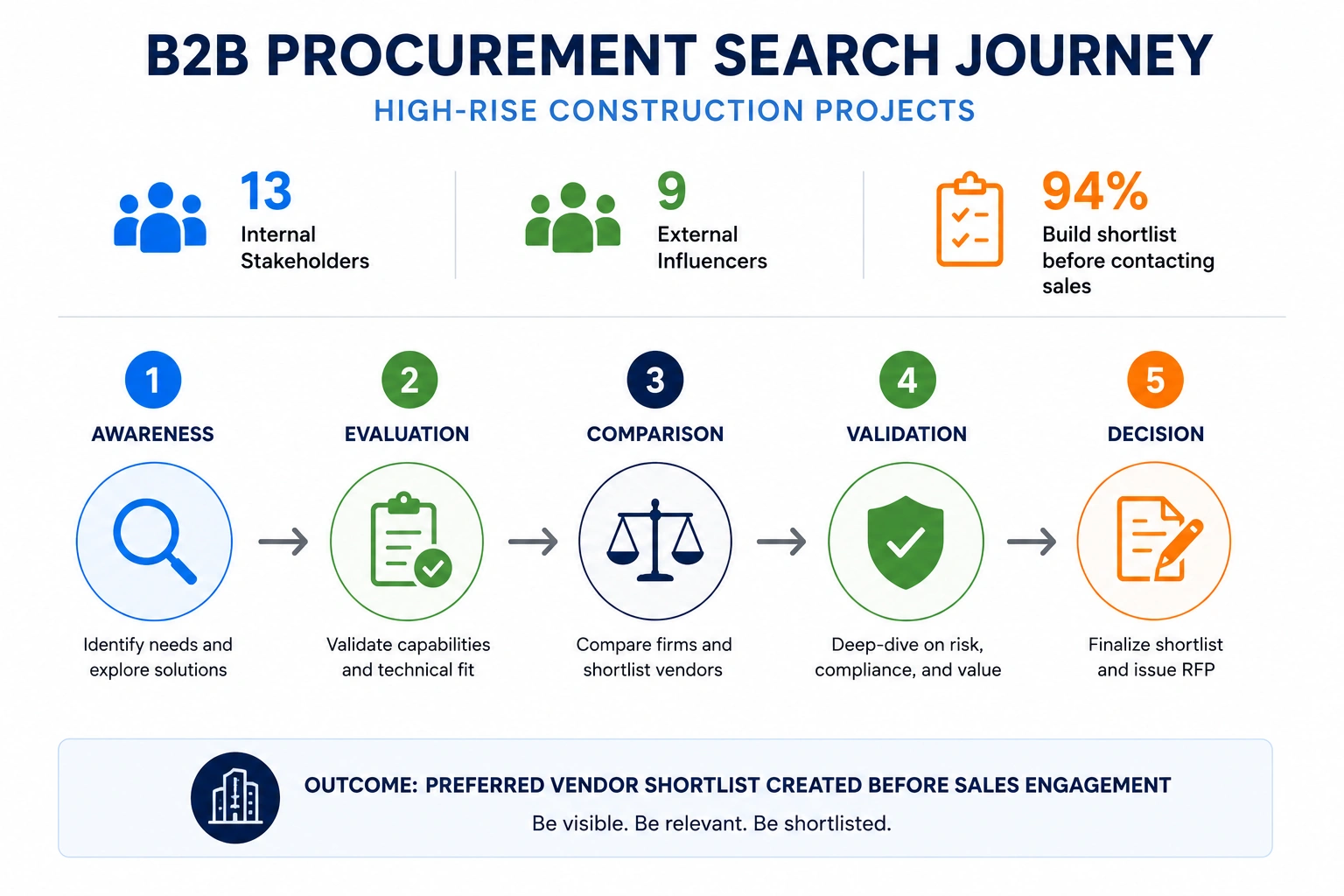
A simplified view of the B2B procurement journey showing how buyers research and shortlist construction firms before issuing RFPs.
Balancing Local Map Pack Performance with B2B Procurement Intent
While regional Map Packs might seem irrelevant for $100M+ project sourcing, dismissing local intent SEO is a mistake for firms operating across multiple metro markets. That argument has merit at the top of the market. It falls apart at the regional level, where procurement teams frequently use local intent queries to identify pre-qualified subcontractors, regional GCs, and specialty trades.
The four pillars of local search visibility for commercial builders:
- Google Business Profile: Complete every section of your profile, ensuring your primary category is set to “General Contractor” or “Commercial Real Estate Developer” and upload high-resolution photos of completed high-rise projects.
- Geographic Service Pages: Build dedicated location pages for major metropolitan areas where you operate, featuring local project details, zoning compliance expertise, and regional client testimonials.
- Review Acquisition Strategy: Systematically request reviews from developers, architects, and subcontractors immediately after project closeout, as Google’s local algorithm heavily weights review recency and volume.
- Consistent NAP Citations: Ensure your Name, Address, and Phone number are identical across your website, local directories, and industry associations like the Associated General Contractors of America (AGC).
Google Business Profiles with fully completed fields and active weekly updates receive up to 7 times more clicks than incomplete profiles. That gap compounds over time. A profile that sits dormant after initial setup is not a neutral presence; it signals inactivity to both the algorithm and the procurement officer who finds it. Pair your Google Business Profile for construction firms optimization with a disciplined local SEO management process, and the regional Map Pack becomes a reliable source of pre-qualified inquiries rather than an afterthought.
Consistent NAP citations across your website, AGC directory listing, regional Chamber of Commerce profiles, and construction trade associations are unremarkable work. They are, however, foundational. A single address discrepancy between your website and a major directory can suppress your local rankings in ways that are disproportionately difficult to diagnose and fix. Get the hygiene right before pursuing anything more sophisticated.
Optimizing for Google AI Overviews and Generative Search Engines
AI Overviews and construction searches are now deeply linked. The landscape has shifted. According to AI search statistics, 50% of all U.S. search queries now trigger these generative summaries. That exposure rate has a direct cost: pages that previously captured organic traffic from a top-three ranking now face an average 58% reduction in click-through rate when an AI Overview is present above them. The implication is not that organic SEO is dying; it is that the criteria for earning visibility have shifted.
Understanding AI Overviews optimization is essential because only 17% of the sources cited in Google’s AI Overviews overlap with the traditional organic top 10. The remaining citations are drawn from pages ranked between positions 21 and 100 that offer highly structured, fact-dense answers to specific procurement questions. A page that ranks eighth but answers a technical query with precision and schema markup can earn an AI citation that a more authoritative page without that structure will not. That is a meaningful opportunity for high-rise builders who are willing to invest in content architecture.
Four execution priorities for AI search visibility:
- Answer-First Content Structure: Structure your technical pages to answer specific procurement questions directly within the first paragraph, using clear, citable definitions.
- Structured Schema Markup: Implement LocalBusiness and Project schema to help search engines easily parse your location, safety ratings, and project portfolios.
- Digital PR and Citations: Earn mentions and backlinks from authoritative industry publications, as research shows 95% of AI search citations originate from digital PR and trusted trade journals.
- FAQ Integration: Embed structured FAQ sections on service pages to capture long-tail conversational queries used in voice and AI search.
The answer-first content structure is the most immediately actionable of these. Every service page should open with a direct, declarative answer to the most likely procurement question for that service: not a paragraph of brand positioning, not a history of your firm, but a citable fact or capability statement. AI models are extracting the first substantive answer they encounter. If your page buries that answer in paragraph four, you are not being cited.
Structured schema markup is the structural link between your content and machine readability. You can implement schema markup for contractor websites to structure your JSON-LD data. This translation helps search engines parse, cross-reference, and surface your portfolio in AI Overviews without needing to interpret unstructured prose.
“In high-rise construction, your website is your digital resume. If your project pages do not immediately demonstrate technical capability, safety compliance, and scale, the buying committee will move to a competitor who does.”
–BizIQ Search Strategy Team
Before you invest in content, you need to know where your technical foundation stands. Our team will run a thorough, manual audit of your site’s speed, mobile performance, and search visibility. Request a Free Website Audit
Structuring High-Impact Service and Project Pages
A single, generic “Services” page is the most common SEO mistake commercial builders make. It is also the most expensive, because the cost is not a penalty: it is an absence. You simply do not rank for the specific, high-intent queries that procurement committees use, because you have given search engines nothing specific enough to index. Building dedicated, optimized pages for every specific service, such as pre-construction planning, structural engineering, design-build delivery, and post-construction commissioning, is the structural prerequisite for everything else in this guide.
Think of these service and location pages like a contractor’s license that proves you are qualified before you even bid on a job. Each page needs to function as a technical resource, not a sales brochure. Facts build trust. A page for high-rise residential construction should detail your experience with concrete core systems, wind load engineering, and the local building codes of the markets you serve. The procurement engineer reading that page is not looking for enthusiasm. They are looking for evidence that you have solved the exact problem they are about to hire for. Specificity is the differentiator; a competitor with a generic services page is not competing with you on that query.
The architectural method that organizes this complexity without creating navigational confusion is the virtual silo approach, which involves grouping semantically related services and case studies through internal linking rather than deep, nested URL structures. A high-rise builder might cluster structural steel engineering, seismic retrofitting, and high-rise core casting under a single topical silo, signaling concentrated expertise to search engines while keeping the user experience coherent. For a detailed breakdown of how this works in practice, see this guide on virtual silos.
For commercial construction digital marketing to perform at the enterprise level, project portfolio pages need the same treatment. Specific metrics: square footage, project value, construction timelines, and safety records, are not just trust signals for human readers. They are the structured, citable data points that AI models extract when generating procurement-relevant summaries. A project page that says “we built a large residential tower in Chicago” is invisible to both. A page that documents a 42-story, 680,000 sq ft mixed-use tower completed in 34 months with zero lost-time incidents is citable.
Technical SEO Fundamentals for Heavy Media Portfolios
High-rise builders rely heavily on high-resolution photography, drone videos, and 3D BIM models to showcase their work. However, unoptimized media is the primary cause of slow page speeds, which severely damages your search rankings. In 2026, Google’s Core Web Vitals are a critical ranking factor, and a slow-loading site will prevent your pages from ranking or being cited by AI engines. We must optimize these heavy media portfolios to ensure they load instantly on both desktop and mobile devices.
Largest Contentful Paint (LCP) is the metric most directly affected by uncompressed project photography. A hero image served as a 4MB JPEG will consistently push LCP past the 4-second threshold that Google uses to classify a page as poor. Converting to WebP or AVIF format, implementing lazy loading for below-fold media, and serving assets through a CDN are not discretionary upgrades for a portfolio-heavy construction site: they are the baseline. Without them, your best project pages are actively suppressing your rankings.
Mobile responsiveness deserves specific attention in the commercial context. Mobile is the standard. Procurement officers reviewing your portfolio during a site visit or between meetings are doing so on a phone. A layout that renders beautifully on a 27-inch monitor but collapses on mobile is not a minor UX issue. It is a direct conversion failure at the moment of highest intent.
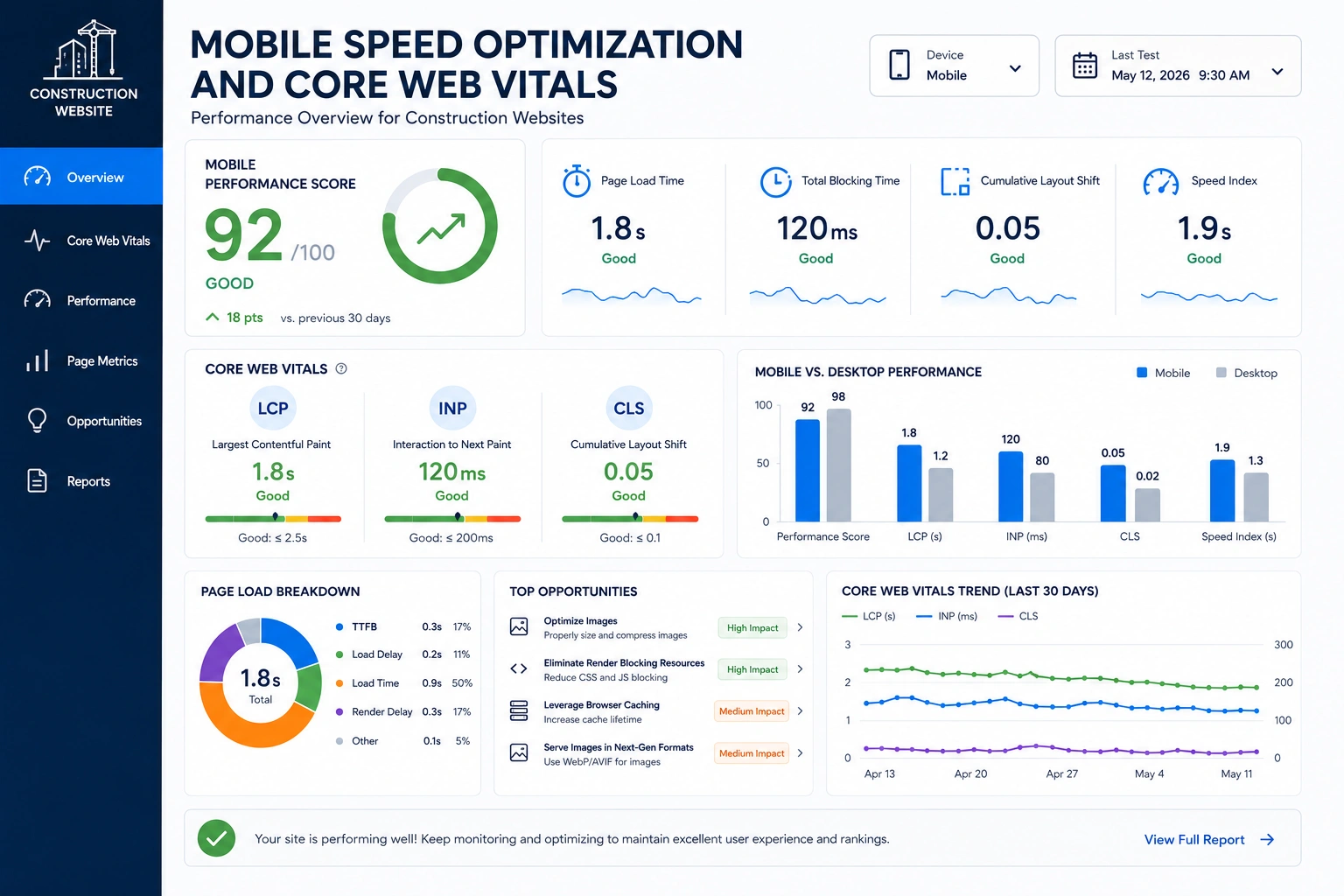
A mobile performance dashboard highlighting Core Web Vitals and website speed metrics for a construction company website.
The technical checklist for construction sites with heavy media:
- Compress all images to WebP or AVIF; target file sizes under 200KB for inline images
- Implement lazy loading for drone video embeds and BIM model viewers
- Use a CDN with edge nodes in your primary service markets
- Audit Cumulative Layout Shift (CLS): portfolio carousels and embedded 3D viewers are frequent offenders
- Ensure Core Web Vitals pass at the page level, not just the site average
The relationship between page speed and search ranking is a direct input into Google’s ranking algorithm, measured and scored per page, which is a core component of SEO for construction companies.
Maximize Your Search Visibility and Lead Flow.
If you are ready to transition from passive referrals to a predictable digital pipeline, let’s build a custom strategy for your firm. We combine advanced SEO with high-performance web design to position you as the premier builder in your market.
Schedule a Consultation with Our Team
The Role of Digital PR and Authority Building in Commercial SEO
Domain authority is not built through content alone. Links are the currency. For high-rise construction firms targeting competitive commercial keywords, the backlink profile is the ceiling on how far organic rankings can climb: and in most metro markets, that ceiling is set by how aggressively a firm pursues earned media and industry citations. Three channels drive the most durable authority gains:
- Trade Publication Outreach: Pitch guest articles and project case studies to leading industry publications like Engineering News-Record (ENR) and Building Design+Construction.
- Local Sponsorships and Associations: Secure high-quality local backlinks by sponsoring regional real estate development forums and maintaining active profiles on local Chamber of Commerce directories.
- Collaborative Case Studies: Partner with your structural engineers, architects, and major material suppliers to co-author detailed project case studies, earning backlinks from their authoritative domains.
Trade publication outreach is the most impactful tactic in this list, and also the most underutilized by commercial builders. A single guest article in Engineering News-Record carries more domain authority signal than dozens of directory citations. The pitch does not need to be a product placement: editors at trade publications want technical depth, project data, and engineering insight. A case study documenting how your team solved a specific seismic isolation challenge on a 35-story tower is exactly the kind of content that earns placement and, with it, a high-authority backlink.
Collaborative case studies with structural engineering partners, major material suppliers, and specialty subcontractors solve two problems simultaneously. They produce content with the technical depth that AI models prioritize for citations, and they generate backlinks from domains that already carry authority in the construction and engineering space. A co-authored project study published on an Autodesk partner’s site, for instance, earns a link from a domain with substantially more authority than most construction firms will build independently. Understanding the mechanics of SEO link building at this level is what separates firms that plateau at page two from those that own page one for competitive commercial terms.
Local sponsorships and associations are worth pursuing even for firms that primarily compete for national or multi-regional contracts. The local links from Chamber of Commerce directories, regional real estate association profiles, and development forum sponsorships feed directly into the Map Pack algorithm. They are also among the easiest high-quality links to acquire: the barrier is participation, not pitching.
Measuring SEO Success Beyond Vanity Traffic
Many agencies focus on superficial metrics like total organic traffic or broad keyword rankings. For high-rise builders, these metrics are meaningless. Success must be measured by pipeline value, qualified procurement inquiries, and shortlist placements. A site that attracts 500 highly targeted developers and procurement officers per month is infinitely more valuable than one that attracts 10,000 casual readers looking for home remodeling tips. We focus on tracking the metrics that directly impact your bottom line.
The attribution challenge in commercial construction is real and worth naming directly. A $60M design-build contract that closes 14 months after a procurement officer first visited your project portfolio page is not going to show up cleanly in a 30-day GA4 report. Multi-touch attribution across a sales cycle that long requires CRM integration, connecting organic search sessions to contact form submissions, to RFP invitations, and to closed contracts. Without that integration, the SEO program looks like a cost center to internal stakeholders even when it is generating the firm’s most valuable pipeline.
Setting up conversion tracking in GA4 for construction-specific micro-conversions: portfolio page depth, specification document downloads, contact form completions, and phone call tracking, gives you leading indicators that correlate with downstream pipeline activity before the contract closes. These are the numbers worth reporting. They are also the numbers that make the case for continued SEO investment to a CFO who cannot yet see the closed revenue.
Integrating SEO with Paid Search for Immediate Pipeline Support
To capture immediate search volume for active requests for proposals (RFPs), high-rise builders should integrate their organic efforts with targeted paid search campaigns. Running highly specific Google Ads alongside your SEO sprint allows you to occupy both the paid and organic sections of the search results page simultaneously, which is particularly valuable during the six-to-twelve-month window when organic rankings are still building momentum.
The coordination between paid and organic keyword targeting matters more than most firms realize. Alignment prevents waste. If your organic strategy is targeting “design-build high-rise contractor Chicago” and your paid campaigns are bidding on “commercial construction company,” you are splitting your authority signal and your budget across different intent levels. Aligning both channels on the same high-intent, procurement-specific terms produces a cumulative effect: the paid ads generate immediate visibility and conversion data, and that data informs which organic pages to prioritize and how to refine their messaging.
Landing page quality is the variable that most paid campaigns for construction firms get wrong. Sending paid traffic to a generic homepage or a broad services page wastes the specificity that made the keyword worth bidding on in the first place. Each paid campaign targeting a specific service or metro market should land on a service and location page built for that exact query: with the technical depth, project evidence, and conversion path that a procurement officer expects to find. Paid search is one component of a broader set of construction company marketing ideas that support long-term growth.
Frequently Asked Questions About High-Rise Construction SEO
How long does it take to see results from high-rise construction SEO? For established websites with a Domain Authority (DA) of 20 or higher, early ranking movement for low-competition keywords can occur within 30 to 90 days. A systematic strategy targeting highly competitive commercial terms typically requires six to twelve months of consistent optimization and authority building to produce a steady flow of qualified leads. The timeline is not a limitation of the methodology; it reflects how long it takes for search engines to accumulate sufficient evidence of topical authority and domain trust.
How do Google AI Overviews affect commercial construction searches? Google AI Overviews now appear in approximately 50% of all U.S. search queries. These AI-generated summaries pull information from highly structured, authoritative sources; critically, only 17% of those citations overlap with the traditional organic top 10. To ensure your firm is cited, your content must directly answer technical procurement questions, use proper schema markup, and be backed by strong digital PR citations from trade publications and industry associations.
Should we build separate pages for every city we build in? Yes, but only if you have unique, localized content for each city. Creating duplicate pages where only the city name is swapped can result in search engine penalties for thin or doorway content. Effective location pages should highlight specific local projects, regional team members, local zoning expertise, and testimonials from clients in that specific market. A page for Chicago high-rise construction should read differently from a page for Houston: different building codes, different seismic considerations, and different supplier ecosystems.
How do we showcase confidential high-rise projects without hurting our SEO? You can build highly effective case studies by focusing on technical outcomes, engineering challenges, and safety metrics without disclosing proprietary details or client names. Descriptive titles like “Structural Engineering for a 40-Story Residential Tower in Chicago” maintain search relevance while protecting client confidentiality. The procurement officer reading that page does not need a client name: they need evidence of capability at scale, and the technical narrative delivers that without the disclosure risk.
What is the most critical technical SEO factor for construction websites? Page speed and mobile responsiveness are the most critical technical factors. Because construction websites are highly visual, large, unoptimized project photos and drone videos often slow down load times significantly. Compressing media to next-gen formats, utilizing lazy loading, and ensuring fluid mobile navigation are essential to prevent high bounce rates and maintain search rankings. A portfolio that takes six seconds to load on mobile is not a portfolio: it is a bounce.
Establishing visibility in the high-rise construction search landscape in 2026 requires an intentional pivot from generic marketing to technical, intent-driven search optimization. By structuring your website to serve the precise needs of commercial buying committees and optimizing for the rapid rise of generative AI search engines, you position your firm as the most authoritative and trustworthy choice in your market. The digital foundation you build today will determine which projects fill your pipeline tomorrow. Action drives results.
The principles that govern local Map Pack performance are deeply intertwined with national organic authority, making local SEO strategies essential for enterprise-level search visibility.
Partner with the Commercial Construction SEO Experts.
Ready to outrank your competitors and secure your place on the developer shortlist? Explore our construction case study to see how we have helped commercial builders scale their digital presence, and contact us today to start building your custom 2026 search strategy.