Written by Chris Osburn, Local SEO Strategist at BizIQ. Chris has helped residential cleaning companies optimize their digital presence and turn local search visibility into recurring revenue for years.
- Claim Your Google Business Profile: The single fastest way to show up on Google.
- Focus on Neighborhood Keywords: How to optimize your website for the exact phrases local clients type.
- Automate Your Review Collection: A reliable way to build trust and show up on Google ahead of other local operations.
- Optimize for Mobile Bookings: Turn local search traffic into confirmed, paid cleaning jobs.
Why is SEO Important for House Cleaning Businesses?
SEO for house cleaning helps house cleaning businesses appear in search results when homeowners look for cleaning services in their area. By optimizing website content, local listings, Google Business Profile (GBP), service pages, and customer reviews, cleaning companies can increase online visibility, attract qualified leads, generate more bookings and build a steady stream of recurring customers.
To show up on Google when neighbors search “house cleaning near me,” you must claim your Google Business Profile, target neighborhood-specific keywords, and collect customer reviews consistently.
When a homeowner needs a house cleaner before a weekend party, a move, or a holiday, they do not spend days shopping around. They open Google, type “house cleaning near me,” and pick one of the first three businesses they see in the local map results. If your house cleaning business does not appear in those top spots, you are completely invisible to the homeowners who are ready to hire right now in your neighborhood. Fortunately, you do not need a massive advertising budget to win these clients; you simply need a smart local search strategy that tells Google exactly who you are, what you clean, and where you work. We can show you how.
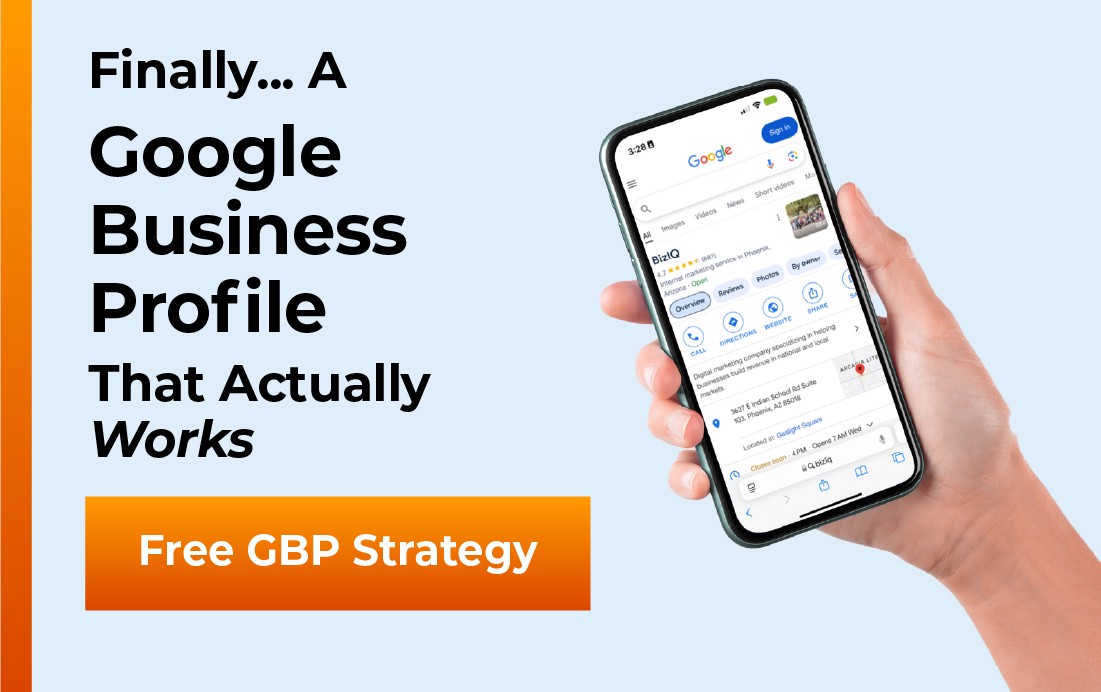
Claim and Optimize Your Google Business Profile
Understanding the Service Area Business (SAB) Framework
Most house cleaning operators run their business from home. That creates an immediate compliance tension with Google that trips up a surprising number of otherwise well-run operations. This is a common mistake.
Google’s guidelines for Service Area Businesses are clear: if you serve clients at their location rather than at your own address, you must configure your profile as an SAB and suppress your physical address. Using a residential address, PO Box, or virtual office violates Google’s terms of service and can trigger an immediate profile suspension: not a warning, a suspension. The distinction matters because a suspended profile is invisible to every searcher in your market while the issue gets resolved, which can take weeks.
Hiding your address does not reduce your visibility. It protects it.
Selecting the Primary Category and Secondary Categories
Category selection is where most cleaning businesses leave ranking potential on the table. It is a massive opportunity. Your primary category, “House Cleaning Service,” carries more algorithmic weight than almost any other single field in your profile, serving as the foundation that tells Google’s algorithm exactly what services you offer to local homeowners. It signals to Google’s local search engine exactly what type of business you are and which queries you should appear for.
Secondary categories like “Cleaning Service,” “Janitorial Service,” or “Carpet Cleaning Service” extend your reach into adjacent queries without weakening the primary signal. Think of them as supporting cast, not competition for the lead role. Proper categorization is one of the more underappreciated search engine optimization tips that directly aligns your profile with user intent across a wider range of cleaning-related searches.
Defining Your Service Area and Profile Completeness
Google permits a maximum service area radius of roughly a 2-hour drive, or approximately 50 miles, from your base of operations. Claiming the full radius from day one is tempting, but it tends to dilute your local authority across too many geographic signals before your profile has earned the trust to support them. Starting with 6 to 12 tightly defined neighborhoods lets you build concentrated relevance faster, then expand from a position of established authority.
Profile completeness is non-negotiable. Do not skip this. A local phone number, accurate operating hours, a business description written in customer-centric language (750 characters is the ceiling, not the target), and at least five high-quality before-and-after photos of cleaned spaces are the baseline requirements. If any of these are missing or stale, your profile signals incompleteness to Google’s crawler, and incomplete profiles rarely surface in competitive local map results.
For a step-by-step walkthrough of the full setup process, our Google Business Profile guide covers every field worth filling out and a few worth leaving alone.
Think of your Google Business Profile like your storefront. Instead of a physical street corner, it sits on the most visited corner of the internet, making it the digital storefront of your cleaning company. According to recent local search data from Whitespark’s Local Search Ranking Factors, Google Business Profile signals account for roughly 33% of all Map Pack ranking factors, making it the single most powerful tool for your business. When you fully optimize your profile, Google rewards you with higher visibility in the desired “Local 3-Pack,” which is the map section at the top of search results that captures approximately 70% of all clicks for local service queries.
Proximity signals work a lot like a server recommending a nearby restaurant. Google wants to show searchers the closest viable options first: not the most polished website or the biggest brand, but the most geographically and categorically relevant match. Many operators make the mistake of selecting a generic category or leaving their service areas undefined, which forces Google to guess. By selecting “House Cleaning Service” as your primary category and defining specific ZIP codes and neighborhoods, you ensure that Google’s proximity signals work in your favor rather than against you, connecting you with local homeowners who are actively ready to hire.
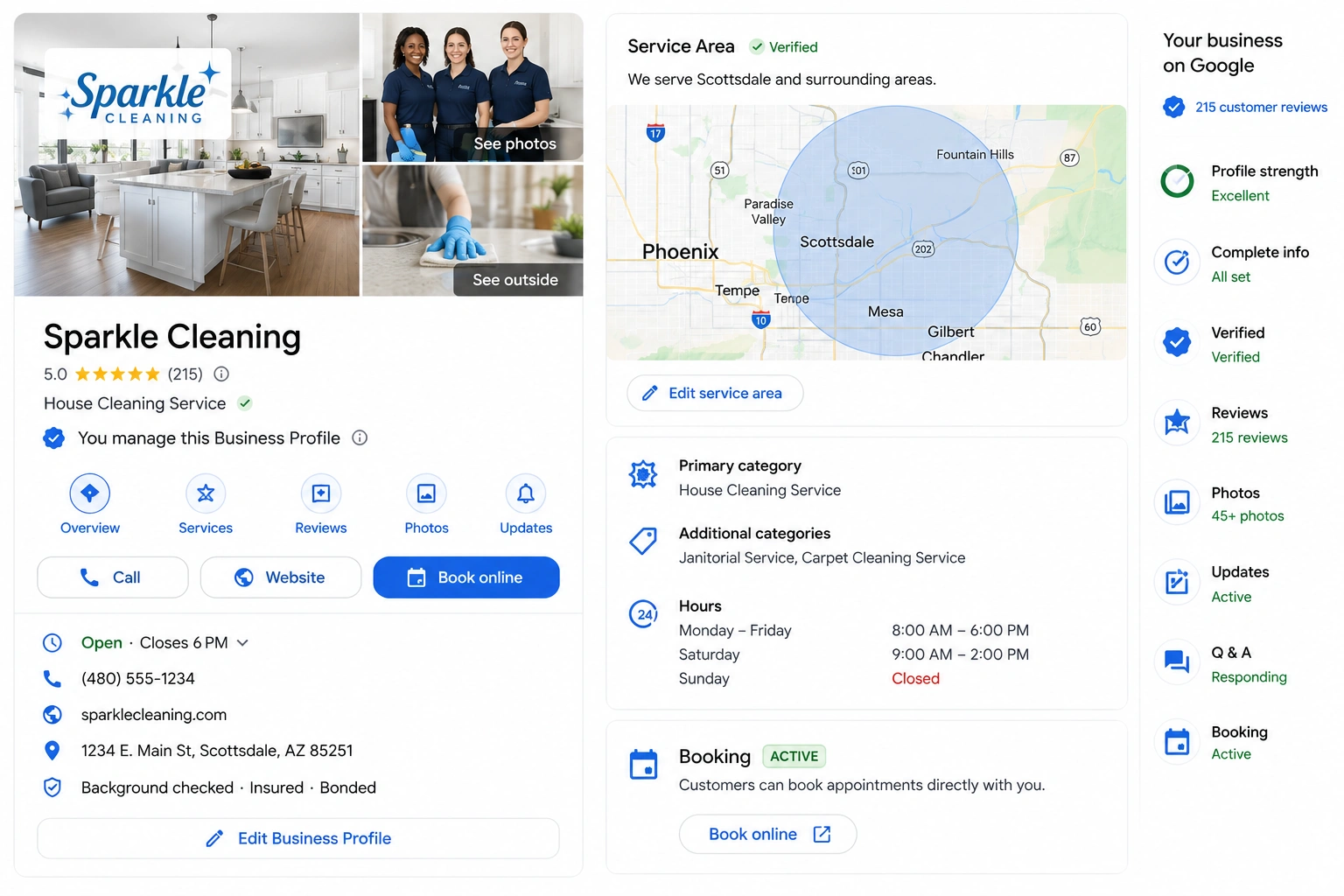
A fully optimized Google Business Profile featuring a verified service area, House Cleaning Service category, and active booking link.
Target Local Keywords That Match Search Intent
Understanding “Near Me” and High-Intent Search Volume
“House cleaning near me” generates approximately 110,000 monthly searches in the United States, and that number has been climbing. “Near me” searches for local cleaning services have grown 150% year-over-year, a growth rate that shows no sign of plateauing. The more telling figure is the device split: roughly 70% of those searches happen on mobile, meaning the person searching is almost always at home, already frustrated with the mess, and ready to book.
That behavioral profile, which combines high urgency with a mobile device and a specific location, is what makes local search optimization for residential cleaning so valuable compared to almost any other digital marketing channel available today. These are not browsers. They are buyers.
Structuring Your Keyword Strategy
The keyword architecture for a cleaning business follows a clear two-tier logic. It is highly effective. Your homepage targets the “Service + City” formula, focusing on terms like “house cleaning in Denver” or “maid service in Seattle,” where search volume is highest and competition is highest. Dedicated landing pages handle the “Service + Neighborhood” formula, like “deep cleaning in Cherry Creek” or “move-out cleaning in Capitol Hill,” where competition thins out considerably and conversion intent runs even higher.
This is the core mechanic of local SEO for service businesses: you trade broad reach at the city level for concentrated authority at the neighborhood level, then let the two reinforce each other over time. It’s a compounding structure; or more precisely, a geographic authority-building strategy that looks like simple keyword targeting until the rankings start moving.
Creating Dedicated Service-Area Pages
Dedicated service-area pages are the most lasting way to overcome Google’s proximity bias, which is the tendency to favor businesses whose registered address sits closest to the searcher. A well-constructed neighborhood page that mentions local landmarks, features testimonials from clients in that specific area, and targets a long-tail neighborhood keyword gives Google a strong local relevance signal even when your physical base is several miles away.
Each page needs to be genuinely distinct. Thin pages that swap a city name into a template get filtered. Google spots these easily. Pages that reflect real knowledge of a neighborhood, its character, its common housing stock, and the kinds of cleaning jobs that come up there, earn the local authority that moves rankings.
- Service + City: Optimize your homepage for high-volume terms like “house cleaning in Denver” or “maid service in Seattle.”
- Service + Neighborhood: Create dedicated landing pages for specific neighborhoods, such as “deep cleaning in Cherry Creek” or “move-out cleaning in Capitol Hill.”
- Problem-Solving Keywords: Write blog posts targeting questions like “how much does a move-out clean cost” or “what is included in a deep house cleaning.”
Build Review Velocity to Outrank Competitors
The Power of Online Reviews in Local Algorithms
Online reviews represent approximately 20% of the total ranking influence in Google’s local algorithm, a share large enough that no amount of profile optimization fully compensates for a thin or inactive review count. The click-behavior data makes the stakes concrete: listings with 50 or more reviews win 4.4 times more clicks than those with fewer than five. Cross the 100-review threshold and the compounding effect accelerates, with businesses in that range reporting 31% year-over-year lead growth on average.
Reviews are like word-of-mouth on steroids: they don’t just reach one person at a time, they show up every time someone searches. They are not just a trust signal for potential clients. They drive rankings. For a deeper look at how reviews fit into the full picture, our guide to local SEO breaks down each ranking factor and how they interact.
Implementing Automated Review Collection
Timing is the variable most operators underestimate. Sending a review request within 2 to 4 hours of job completion, or immediately upon digital payment processing, produces response rates 3 to 5 times higher than a follow-up sent the next day. The emotional window is short: the client just walked into a clean home and felt the satisfaction of it. That’s the moment to ask.
Modern review platforms like QuoteIQ, NiceJob, and CleaningOS use what’s sometimes called “Happy-Path” logic: automated branching that routes 4- and 5-star responses directly to a public Google or Yelp review page, while 1- to 3-star responses go to a private feedback form. The business resolves the issue quietly; the public profile only accumulates positive signal. It is a practical system, and it works precisely because most cleaning businesses still rely on manual, delayed requests that clients never respond to.
Encouraging Keyword-Rich Reviews
A review that says “great job” helps your star rating. A review that says “Maria did an incredible deep cleaning of our kitchen in Austin before our move-out inspection” helps your ranking for “deep cleaning Austin” and “move-out cleaning Austin” at the same time. That distinction is worth communicating to your clients, not by scripting their reviews, but by prompting them with specific questions: “What service did we complete for you today?” and “Which neighborhood are you in?”
Responding to every review within 48 hours compounds the benefit further. It shows you care. Your responses are indexed by Google, which means weaving service and location keywords into your replies, like “Thank you for choosing us for your move-out cleaning in Capitol Hill,” adds another layer of local relevance signal to your profile.
- Ask Immediately: Send an automated text message with a direct Google review link within two hours of completing a cleaning job.
- Respond to Every Review: Reply to both positive and negative reviews within 48 hours to signal to Google that your business is active and responsive.
- Incorporate Keywords in Responses: Naturally weave service and location keywords into your replies (e.g., “Thank you for choosing us for your sofa cleaning in Austin!”).
Is your cleaning business invisible online?
Get a Free Local Visibility Audit today. We will analyze your Google Business Profile, audit your local keywords, and show you exactly what is holding you back from showing up on Google.
Claim Your Free Audit Now
Ensure NAP Consistency Across the Web
What Is NAP and Why Does It Matter?
NAP (Name, Address, and Phone number) is the identity fingerprint your business leaves across every directory, citation site, and social platform on the web, serving as a critical reference point for search engines. Google crawls those sources to cross-reference your profile and verify that your business is legitimate, active, and geographically anchored where you claim to be. Inconsistencies in that fingerprint don’t just create confusion; they weaken the trust signal Google needs to surface your listing confidently in local search results.
Industry data puts the scale of this problem in sharp relief: 32.7% of local businesses fail to maintain consistent NAP data across their key directories. This is a major gap. That’s nearly one in three businesses actively undermining their own local search visibility through a fixable, operational oversight.
Top Citation Directories for House Cleaning Businesses
The citation ecosystem for house cleaning businesses has a clear hierarchy. BrightLocal’s Top Citation Sites for Cleaners identifies Yelp, Angi, Thumbtack, HomeAdvisor, Porch, and Nextdoor as the highest-authority directories in the category, platforms where Google places meaningful weight when verifying a cleaning business’s legitimacy. Bing Places deserves a spot on that list too, particularly for capturing searchers who never touch Google.
Auditing these listings is time-consuming work, but the standard is unambiguous: every character must match your Google Business Profile exactly. “St.” versus “Street.” “LLC” present or absent. A phone number with or without a hyphen. Google’s crawler does not interpret intent; it matches strings. A mismatch reads as a discrepancy, and discrepancies accumulate into ranking suppression.
NAP stands for Name, Address, and Phone number. Google crawls hundreds of directories across the internet to verify that your business is legitimate and active. If your business is listed as “Sparkle Cleaners” on Google, “Sparkle Cleaning LLC” on Yelp, and “Sparkle Maid Service” on Facebook, search engines get confused. Consistent NAP data across high-authority directories is a foundational trust signal required to prevent Google from filtering your listing out of search results.
Industry studies show that over 32% of local businesses fail to maintain consistent NAP data, which directly damages their search rankings. To prevent this, audit your listings on Yelp, Angi, Facebook, and your local Chamber of Commerce. Ensure every single character, including abbreviations like “St.” versus “Street,” matches your Google Business Profile exactly.
“In local service SEO, consistency is your currency. If Google cannot verify your business name and phone number across multiple trusted directories, it will not risk showing your listing to local searchers.”
Local SEO Strategist at BizIQ
Optimize Your Website for Mobile and Speed
The Mobile-First Local Search Reality
Seventy percent of local searches for home services happen on mobile devices. That figure has been cited enough times that it risks becoming wallpaper, but the conversion data attached to it is what really demands attention. Over 78% of those mobile searches result in a call or booking within 24 hours, which means a slow or poorly formatted mobile site isn’t just a UX problem; it’s a direct revenue leak occurring in real time, on every search, every day.
Google’s mobile-first indexing means your mobile site is your site, as far as the search engine is concerned. Responsive web design is the baseline, not a differentiator. Speed is what matters. What separates the cleaning businesses that convert mobile traffic from those that don’t is load time and friction: a site that loads in under two seconds and shows a booking form or click-to-call button within the first scroll captures the client; everything slower or more buried loses them.
Technical On-Page Optimization
Image compression is the fastest single technical improvement most cleaning websites can make. It is simple to do. Switching to WebP format and compressing before-and-after photos, which tend to be large files, routinely cuts page weight by 40% to 60% without visible quality loss. That alone can move a site from a 4-second load time to under 2 seconds on a mid-range mobile connection.
LocalBusiness and CleaningService schema markup is the other significant technical gap. Only 34.8% of cleaning websites currently implement schema, which means that for the majority of markets, adding structured data is still a genuine competitive advantage rather than table stakes. Schema doesn’t guarantee rankings, but it gives Google’s crawler a clear, machine-readable summary of your business name, service area, hours, and service types. That clarity reduces the interpretive work Google has to do, and businesses that reduce that friction tend to see incremental ranking improvements within a few crawl cycles.
For a broader look at what’s possible when technical and local signals work together, our guide on optimizing your local business covers the full stack of on-page and off-page factors worth addressing.
Over 78% of mobile searches for local services result in a call or booking within 24 hours. If your website takes more than three seconds to load on a smartphone, or if the booking form is too small to navigate with a thumb, those potential clients will immediately bounce back to the search results and click on a business like yours that got the technical details right. Compress your images, use modern WebP formats, and ensure your site uses a responsive design that renders cleanly on any screen size.
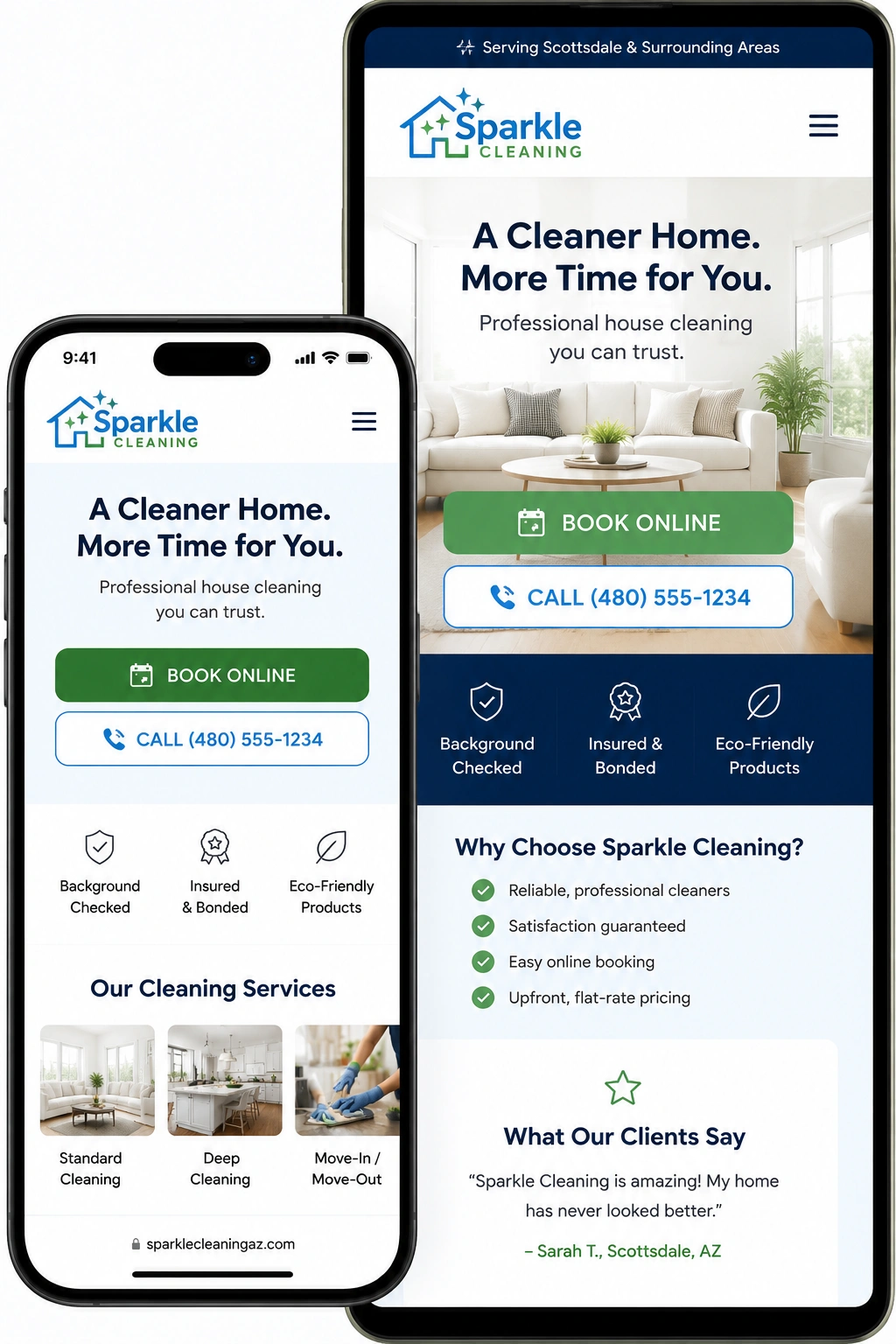
A fast, mobile-friendly cleaning service website featuring online booking and click-to-call functionality for easy conversions.
Stop losing mobile visitors to slow load times.
Track Your Local SEO Performance and ROI
Key Metrics to Monitor
Google Analytics and Google Search Console are the two tools every cleaning business should have configured before any other optimization work begins. Google Analytics website traffic data tells you how many visitors are arriving through organic search versus paid channels. Google Search Console shows you which queries triggered your listing, your average position for those queries, and where click-through rates are underperforming relative to your ranking position; a gap that often signals a title tag or meta description worth revising.
The conversion metrics that matter most for cleaning businesses are Map Pack click-to-booking rates and direct call rates. These numbers tell the story. Map Pack clicks convert to booked jobs at an average rate of 3.3% to 7.3% depending on market and profile quality. Direct phone calls initiated from the Map Pack convert at a dramatically higher rate, often 40% to 70%, because a caller has already made a near-final decision before dialing. Tracking these separately gives you a clearer picture of where your funnel is working and where it’s losing clients.
Realistic Timelines and ROI Expectations
Initial local SEO ranking improvements typically become visible within 60 to 90 days. That’s the window where profile optimization and early citation work start registering in Google’s local index. Be patient. Most campaigns reach their break-even point somewhere between 4 and 8 months, which is the honest answer to the question most cleaning business owners ask in month two when results are still small.
The compounding value comes later. A mature local SEO campaign running 6 to 12 months yields an average ROI of 200% to 500%, and that figure can exceed 900% when recurring cleaning contracts are factored into the customer lifetime value calculation: a single recurring client at $200 per month represents $2,400 to $6,000 or more in annual revenue from one organic lead. In a documented home services campaign, a detailed local search strategy generated $244,000 in organic revenue over 12 months, representing a 13.6x return on ad spend. Those numbers are not typical for every market, but they illustrate what’s possible when the strategy is executed consistently and the compounding effect of recurring contracts is allowed to build.
- Monitor Organic Traffic: Use Google Analytics website traffic data to track how many visitors find your site through search engines rather than paid ads.
- Track Local Map Rankings: Use local rank tracking tools to see where your business ranks in specific zip codes for “house cleaning near me.”
- Measure Conversion Rates: Track how many website visitors directly call your business or submit an online booking form.
Solo Operators vs. Multi-Crew Agencies: Does SEO Work for Both?
The Trust Advantage for Solo Operators
Solo operators carry a competitive asset that franchise networks genuinely cannot replicate: the same person shows up every time. That consistency matters to homeowners in a way that’s easy to underestimate from a marketing perspective. Many clients are not just hiring a cleaning service; they are granting access to their home, their personal spaces, and their routines. Trust is everything. The promise of a single, known individual, rather than a rotating crew dispatched by a call center, is a real differentiator, and it belongs front and center in your Google Business Profile description.
Speed compounds that advantage. Enabling the GBP chat feature and pairing it with an automated SMS auto-responder means a solo operator can respond to an inquiry within minutes, often before a larger competitor’s lead has been routed through a sales team. In local service markets, speed to first contact is frequently the deciding factor between winning and losing a job: not price, not brand recognition.
Hyper-Local Niche Focus
Competing city-wide against national franchise networks on broad terms like “house cleaning Denver” is a difficult fight for a solo operator, and usually an unnecessary one. The more productive approach is targeting long-tail, neighborhood-specific keywords with lower competition and higher specificity: “weekly eco-friendly maid service in [Specific Neighborhood]” attracts a client who has already filtered by frequency, values, and location. That’s a buyer, not a browser.
Proximity and review recency level the playing field in ways that advertising budgets cannot. This is your edge. A solo operator with 50 recent, high-quality reviews in a specific neighborhood can outrank a national franchise that has thousands of reviews but lacks local relevance in that ZIP code. Google’s local algorithm is not a popularity contest; it’s a relevance and proximity calculation, and those are variables a well-run solo operation can win on.
A common mistake among independent house cleaners is that local search optimization is only viable for large agencies with substantial marketing budgets. Local search is, in practice, one of the few channels where a solo operator’s structural advantages (proximity, agility, personal trust) translate directly into ranking signals. Because Google’s local algorithm heavily weights review recency and geographic specificity, a solo operator who executes consistently on the fundamentals can hold top-three Map Pack positions in their target neighborhoods against competitors with far greater resources.
The Cost of Ignoring Local SEO: Why Paid Ads and Lead Brokers Aren’t Enough
The Pitfalls of Relying Solely on Paid Ads and Lead Brokers
Paid advertising costs for home service keywords have risen steadily year-over-year, shrinking margins in a business category that already operates on thin ones. The cost-per-click for “house cleaning near me” in competitive urban markets can reach $15 to $30 per click, and those clicks don’t come with any guarantee of exclusivity or intent quality. That gets expensive quickly.
Lead brokers present a different structural problem. The same lead is frequently sold to four or more competing cleaning businesses simultaneously, which triggers a race to the bottom on price and response time. The client who came through a lead broker is not choosing you; they’re fielding multiple calls and picking whoever responds fastest or quotes lowest. That’s a fundamentally different buyer relationship than someone who searched for your business specifically and called you directly.
Organic search leads cost 61% less than outbound leads on average, and they convert at a meaningfully higher rate because the client initiated the contact themselves after searching for your services. That asymmetry is the core argument for investing in local search over paid channels as a long-term growth strategy for house cleaning businesses.
The Compounding Value of Recurring Contracts
A single recurring house cleaning contract, say a biweekly client at $180 per visit, generates $4,320 in annual revenue from one organic lead. Scale that to ten recurring clients acquired through local search over a year, and the math starts to look very different from a per-click cost model. The customer lifetime value of a recurring cleaning contract runs $2,400 to $6,000 or more per year, and those clients tend to refer neighbors, leave reviews, and stay for years.
The documented outcomes from well-executed local search campaigns in this category are striking: a thorough local search overhaul for a residential cleaning business produced a 5,000% increase in lead volume and a 600% increase in phone calls, according to a case study published by FS Agency. Those figures reflect an extreme outcome, not a median result, but they illustrate the ceiling of what’s possible when local search visibility compounds over time with a consistent strategy behind it.
Relying solely on paid ads or third-party lead brokers is a risky long-term position. Paid ad costs continue to climb, and lead brokers sell the same lead to multiple competitors. This is unsustainable. By investing in local search, you build a digital asset that you own outright, one that generates inbound leads without a cost-per-click attached to each one. Organic search leads cost 61% less than outbound leads and convert at a higher rate because the client actively sought you out rather than being solicited.
Frequently Asked Questions About Cleaning Business SEO
Q: How long does it take to see results from local SEO?
A: You will typically start seeing measurable improvements in your local map rankings within 3 to 6 months. The exact timeline depends on the level of competition in your city and how consistently you collect customer reviews. Markets with fewer established competitors can show movement in as little as 60 days; dense urban markets with multiple well-optimized profiles may take closer to 6 months before ranking shifts become significant.
Q: Do I need a physical commercial office space to rank on Google Maps?
A: No. If you run your cleaning business from home, you can register as a Service Area Business (SAB) on Google. This allows you to hide your physical address while still showing up in search results for the specific cities and ZIP codes you serve. The key is configuring your service areas accurately and keeping your profile fully complete: address suppression does not reduce visibility when the profile is otherwise well-optimized.
Q: What is LocalBusiness Schema, and do I need it?
A: LocalBusiness Schema is structured code added to your website that gives search engines an unambiguous, machine-readable summary of your business name, address, phone number, and services. Currently, only 34.8% of cleaning websites use schema markup, which means implementing it puts you ahead of roughly two-thirds of your market from a technical SEO standpoint. It’s not a ranking guarantee, but it removes interpretive friction for Google’s crawler, and that tends to produce incremental ranking improvements over time.
Q: How many Google reviews do I need to rank in the top 3?
A: There is no fixed threshold, but listings with 50 or more reviews win 4.4 times more clicks than those with fewer than five. More important than the total count is review velocity: a steady cadence of 2 to 3 new reviews per week signals ongoing business activity to Google’s algorithm far more effectively than a burst of 50 reviews followed by months of silence.
Q: Can I do local SEO myself, or should I hire an agency?
A: You can handle the foundational work yourself, such as optimizing your Google Business Profile, building citation consistency, and asking clients for reviews. Where the decision shifts is at the technical layer: implementing LocalBusiness schema, building authoritative local backlinks, and creating a network of neighborhood landing pages are time-intensive tasks that compound in value when executed correctly. If your schedule is already full and you want to scale faster, working with a specialized local SEO team tends to deliver a higher return on the time investment than attempting to manage the full stack independently.
Showing up when your neighbors search online doesn’t happen by accident, and it doesn’t require an unlimited budget. It takes consistent effort. By claiming and fully optimizing your Google Business Profile, building neighborhood-specific keyword pages, automating your review collection, and ensuring your NAP data is consistent across every directory that matters, you create a local search presence that keeps your schedule filled weeks in advance, filled with clients who found you, chose you, and are far more likely to stay.
Stop letting competitors sweep up your local clients. Schedule your Free Local Visibility Audit today, and let us show you the exact steps to claim your spot on Google Maps. Get Your Free Visibility Audit (house cleaning businesses)