Written by the BizIQ Organic Search Strategy Team
As a dedicated small business marketing partner, the BizIQ team has helped thousands of local service providers, including landscapers, lawn care operators, and design-build contractors, scale their operations. We specialize in bridging the gap between traditional local search optimization and cutting-edge generative AI search engine strategies, helping local businesses grow their presence and secure high-value jobs.
- The 2026 Shift: Why traditional blue links are only half the battle in the age of ChatGPT, Gemini, and Google AI Overviews.
- The 5 Pillars of Local SEO: A step-by-step blueprint to optimize your website and Google Business Profile for maximum local visibility.
- Generative Engine Optimization (GEO): Actionable strategies to get your business recommended by conversational AI engines.
- Technical Authority & Schema: How to use structured data to translate your services for search crawlers.
- High-Intent Content Strategy: Moving away from generic blogging to target high-value local design-build search terms.
What is SEO for Landscapers and Why is it Important?
SEO for landscapers is the process of optimizing a landscaping company’s website and online presence to rank higher in search engine results and AI search. By optimizing website content, local listings, service pages, and customer reviews, landscapers can rank higher in local searches and throughout AI, attract qualified leads, increase quote requests, and generate long-term business growth.
When a homeowner decides to invest in a $50,000 outdoor living space, they do not flip through a phone book or scroll past pages of ads. They search. Today, that search is happening across a splintered landscape of traditional Google searches, local map packs, and generative AI engines like ChatGPT, Google Gemini, and Perplexity. If your landscaping company isn’t optimized for both traditional local SEO and modern AI search, you are actively losing high-ticket jobs to competitors who set up their digital foundations early. At BizIQ, we’re a small business too, and we know that sophisticated marketing belongs to you too: not just the national chains with massive budgets.
The landscaping industry is more competitive than ever. The stakes are high. With the U.S. landscaping services market reaching $176.7 billion in 2026 (according to IBISWorld), capturing local market share requires a sophisticated digital presence. According to the Scorpion 2026 State of Home Services Marketing Report, 83% of homeowners start their search online when looking for home services, and 98% of consumers search online before hiring a business. To win these clients, you must show up at the exact moment they are looking for solutions.
The $176 billion landscape: Why landscapers need SEO in 2026
The way homeowners find and hire landscapers has fundamentally shifted. It is no longer just about ranking for “landscaper near me.” The old playbook is dead. Today’s homeowners are highly research-driven, especially when planning large-scale design-build projects like paver patios, outdoor kitchens, or complex drainage systems. They ask highly specific questions online long before they ever request a consultation, and the companies that answer those questions credibly are the ones that get the call. What works best for small businesses is building a search presence that matches how people research.
What makes this moment particularly consequential is the speed of the consumer migration. Gartner projects that traditional search engine volume will drop 25% by 2026 as consumers migrate their queries to AI chatbots and virtual agents. That is not a distant forecast; it is already visible in how homeowners approach high-consideration purchases. A couple planning a $35,000 backyard renovation is not just Googling “patio contractors near me”: they are asking ChatGPT to explain the difference between concrete pavers and natural stone, then asking Gemini to recommend local installers who specialize in Belgard or Techo-Bloc products. The research phase has expanded, and it now runs through channels that most landscaping companies have never considered optimizing for.
Furthermore, search engines have evolved from simple link directories into sophisticated answer engines. With 22% of homeowners now using AI tools like ChatGPT to research home services, and 35% using AI at the product discovery stage (according to a Princeton/Georgia Tech 2024 Study), your website must be structured so that both human searchers and AI algorithms can easily read, verify, and recommend your business. The companies that understand this dual-channel reality right now are the ones that will keep their schedules full.
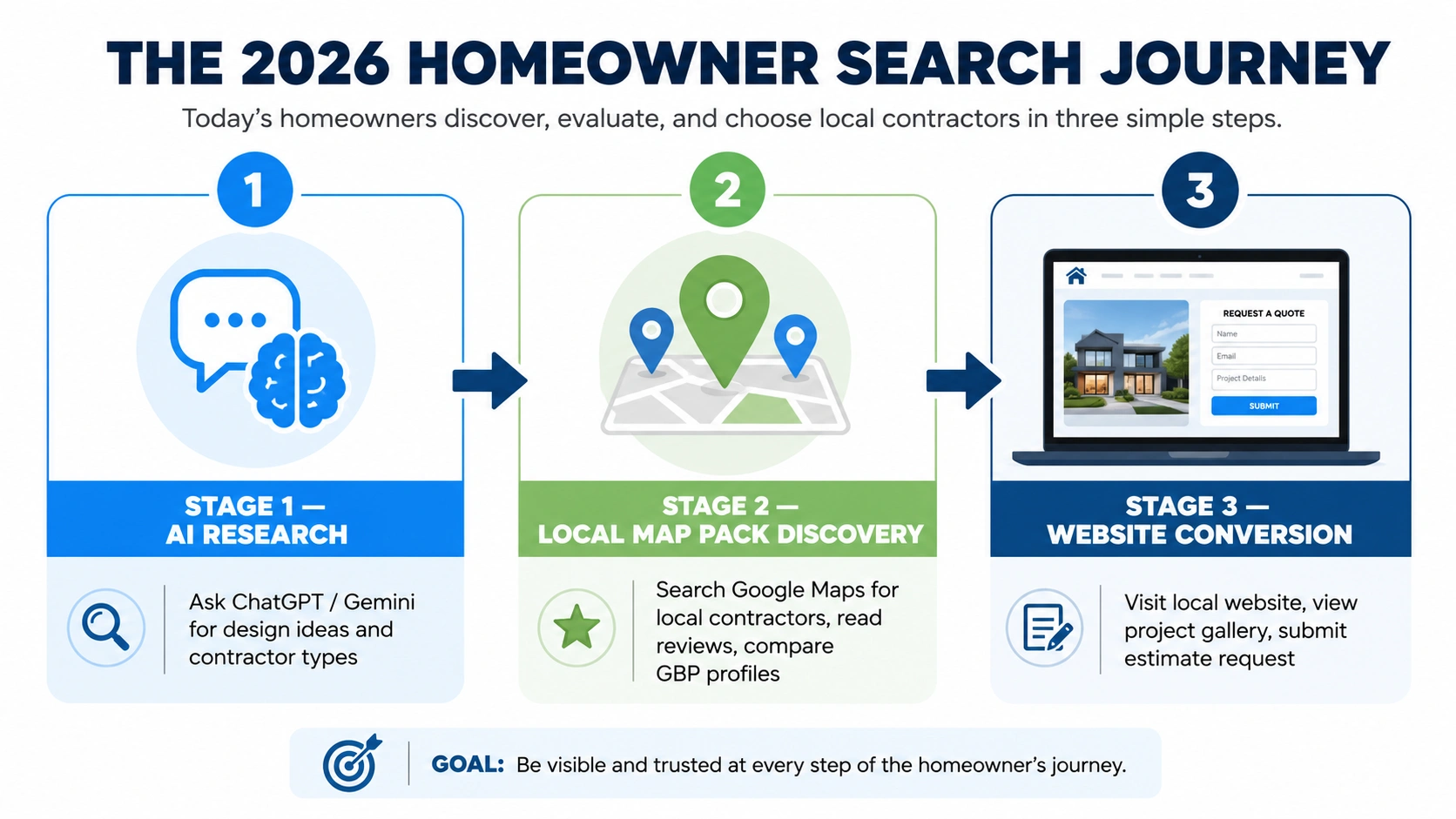
The 2026 homeowner search journey: AI research leads to Google Maps discovery, then contractor website visits and estimate requests.
Traditional local SEO vs. AI search: What’s the difference?
These are not synonymous disciplines, and conflating them is one of the more costly mistakes a landscaping company can make when building a digital strategy. Each targets a different search surface, relies on different ranking signals, and requires a different content architecture. Most landscapers need both, and they need to understand how each one works before investing in either. They are distinct tools.
- Traditional Local SEO: Focuses on ranking in the Google Local Map Pack and organic search results for localized queries (e.g., “hardscaping contractor near me”). It relies heavily on proximity, Google Business Profile optimization, local citations, and localized backlinks. The goal is to appear in the top three map results: positions that capture 33% of all clicks on local service searches and generate up to 126% more website traffic and 93% more phone calls than standard organic listings.
- Answer Engine Optimization (AEO): Focuses on optimizing your content to be pulled directly into Google AI Overviews and featured snippets. It requires writing clear, conversational, and direct answers to common homeowner questions. For deeper insights, learn more about Answer Engine Optimization.
- Generative Engine Optimization (GEO): Focuses on getting your landscaping business recommended as a direct solution when homeowners ask conversational queries in ChatGPT, Gemini, or Perplexity (e.g., “Who is the best high-end landscape designer in North Atlanta?”). It relies on consistent brand mentions, deep review sentiment, and authoritative industry credentials across the web. The way AI is transforming SEO is not incremental; it is a structural change in how search authority gets assigned.
The practical implication is that a landscaping company with a strong local SEO foundation is already halfway to GEO readiness. The signals overlap: a fully built-out Google Business Profile, consistency across directories, and a website with clear service and location pages all feed both disciplines. Where GEO diverges is in its demand for credentialed authority, substantive review language, and content that conversational AI engines like ChatGPT, Gemini, and Perplexity can parse as genuinely expert rather than just keyword-optimized.
The 5 pillars of local SEO for landscaping companies
Think of these five pillars the way you think about a landscape installation itself. You can have the most beautiful plant selection in the region, but if the grading is off, the drainage fails, and the irrigation is undersized, the whole project deteriorates within a season. SEO works the same way: each pillar supports the others, and overlooking one creates a structural weakness that limits the performance of everything else. Every detail matters.
- Optimize Your Google Business Profile (GBP): Claim, verify, and fully complete your profile. Set “Landscaper” as your primary category and add secondary categories like “Lawn care service” or “Landscape designer.” Upload high-resolution project photos weekly: Google Business Profiles with 100+ images receive 520% more phone calls and 1,065% more website clicks than profiles with fewer images. Actively collect and respond to every review. Solid Google My Business optimization is the single most impactful action most landscaping companies can take right now, and most are still leaving it half-finished.
- Build Dedicated Service & Location Pages: Do not lump all your services onto a single homepage. Create individual, highly-optimized pages for core services (e.g., paver patio installation, segmental retaining walls, irrigation repair) and specific service areas. Each page should function as its own landing page: with localized copy, project photos from that geography, and a clear call-to-action. This architecture is what allows you to rank for “french drain installation in [City]” and “retaining wall builder in [Suburb]” simultaneously.
- Target High-Intent Local Keywords: Incorporate local keywords in your content, including service-specific terms in your title tags, meta descriptions, H1s, and body copy (e.g., “drip irrigation installation in [City]”). Broad terms like “landscaping” carry enormous competition and attract searchers at every stage of awareness: including people who are nowhere near hiring. Long-tail, service-plus-location combinations attract people who have already decided they need the work done and are now choosing who to call.
- Optimize Website Images for Speed and SEO: Landscaping is highly visual, but heavy images slow down your site. Compress all images, use modern formats (WebP), and rename files to include keywords and locations (e.g., backyard-patio-installation-city.webp) with descriptive alt text. This is a genuine tension in the industry: the portfolio photos that convert visitors are the same ones that tank your site speed if left unoptimized. The fix is not to reduce image quality; it is to implement proper compression and lazy loading so both goals coexist.
- Secure Local Citations and Backlinks: Ensure your NAP (Name, Address, Phone) is consistent across Yelp, Houzz, Angi, and local chambers of commerce. Build high-authority backlinks by partnering with local suppliers, sponsoring community events, or contributing guest articles to regional home improvement blogs. Citation inconsistency: even minor variations like “St.” vs. “Street”: creates conflicting signals that suppress your local rankings. Clean it up before building new links.
Beyond these five pillars, there is a broader ecosystem of landscaping marketing ideas that can amplify your SEO investment: particularly when offline reputation-building activities feed directly into your online review volume and brand mention frequency.
Generative engine optimization (GEO): How to get recommended by ChatGPT and Gemini
To win in the era of AI search, you must understand how generative engines generate endorsements. When a homeowner asks ChatGPT, “Who does the best hardscaping near me?”, the AI does not guess. It cross-references data from your website, your social media profiles, local directories, and online reviews to build a trust profile. If the AI can easily verify your services, location, and reputation across multiple authoritative sources, it will confidently recommend your business. If the signals are thin, inconsistent, or absent, it will recommend someone else or give a generic non-answer.
Evidence shows that integrating expert quotes with credentials, say, a quote from a certified landscape architect or ISA-certified arborist on your service pages, yields a 40.9% citation lift in AI search results (according to the Princeton/Georgia Tech 2024 Study). Including statistics with named sources (e.g., “According to the EPA, native plants can reduce outdoor water use by up to 60%”) yields a 30.6% visibility lift. Using inline citations that link to university extension offices or agricultural departments yields a 27.5% citation lift. Traditional keyword stuffing, by contrast, showed zero positive impact. What this means for your business is clear: the content that earns AI recommendations reads as a credentialed expert wrote it, not like a page optimized for a keyword count.
Review substance is critical for GEO. A simple “great service” review provides very little context for an AI. However, reviews from happy customers that read, “They installed a beautiful Techo-Bloc paver patio with a built-in fire pit at our home in Lititz, PA, and completed the project in under a week,” give the AI rich, structured data. The AI now knows your specific service (Techo-Bloc paver patio), your location (Lititz, PA), your project timeline (under a week), and your quality of work. That is the difference between a review that passively exists and one that actively functions as a GEO signal. Prompt your clients to be specific. Give them a template if needed. The return on that small operational investment compounds over time as AI engines encounter your business name alongside detailed, location-tagged service descriptions across dozens of reviews.
“AI search engines are not looking for keyword density; they are looking for trust, consistency, and real-world authority. The landscaping companies that make their expertise, credentials, and customer outcomes crystal clear across the web are the ones that AI will recommend.” (Megan Ramirez, Product Owner of SEO & Ranking Strategy)
Technical optimization: Schema markup and E-E-A-T for landscapers
Search engines and AI crawlers rely on structured data to understand the context of your website. By implementing Schema Markup (behind-the-scenes code), you translate your website’s content into a machine-readable language. Think of it as a property survey map for your digital presence: just as a survey defines your exact lot boundaries, easements, and structures for legal and planning purposes, schema markup defines your business name, service area, specific offerings, and customer ratings in a format that search engines can parse without ambiguity. For landscapers, this means using LocalBusiness schema (specifically HomeAndConstructionBusiness) to define your service area, Service schema to detail your specific offerings, and FAQPage schema to make your educational Q&As easily extractable for AI Overviews.
The E-E-A-T framework: Experience, Expertise, Authoritativeness, and Trustworthiness, is Google’s evaluative lens for determining whether a website deserves to rank conspicuously. For landscaping companies, E-E-A-T is built through a combination of signals that most contractors already possess but rarely document online: years of field experience, industry certifications (ICPI, NCMA, ISA), manufacturer authorizations (Belgard, Techo-Bloc, Hunter), completed project portfolios with verifiable locations, and a review record that reflects consistent quality over time. The gap is not in the credentials: it is in surfacing them where search engines and AI crawlers can find and verify them. Proof builds trust. Your “About” page, your team bios, your project case studies, and your service pages should all carry explicit signals of professional authority, not just marketing language.
Implementing schema correctly is where many landscaping websites fall short; or more precisely, where they implement it partially and then never revisit it as their service offerings expand. A LocalBusiness schema block that lists your original three services but not the irrigation repair and outdoor lighting divisions you added two years ago is actively misleading to search crawlers. Schema maintenance is not a one-time task; it belongs in the same recurring workflow as your GBP photo uploads and review responses.
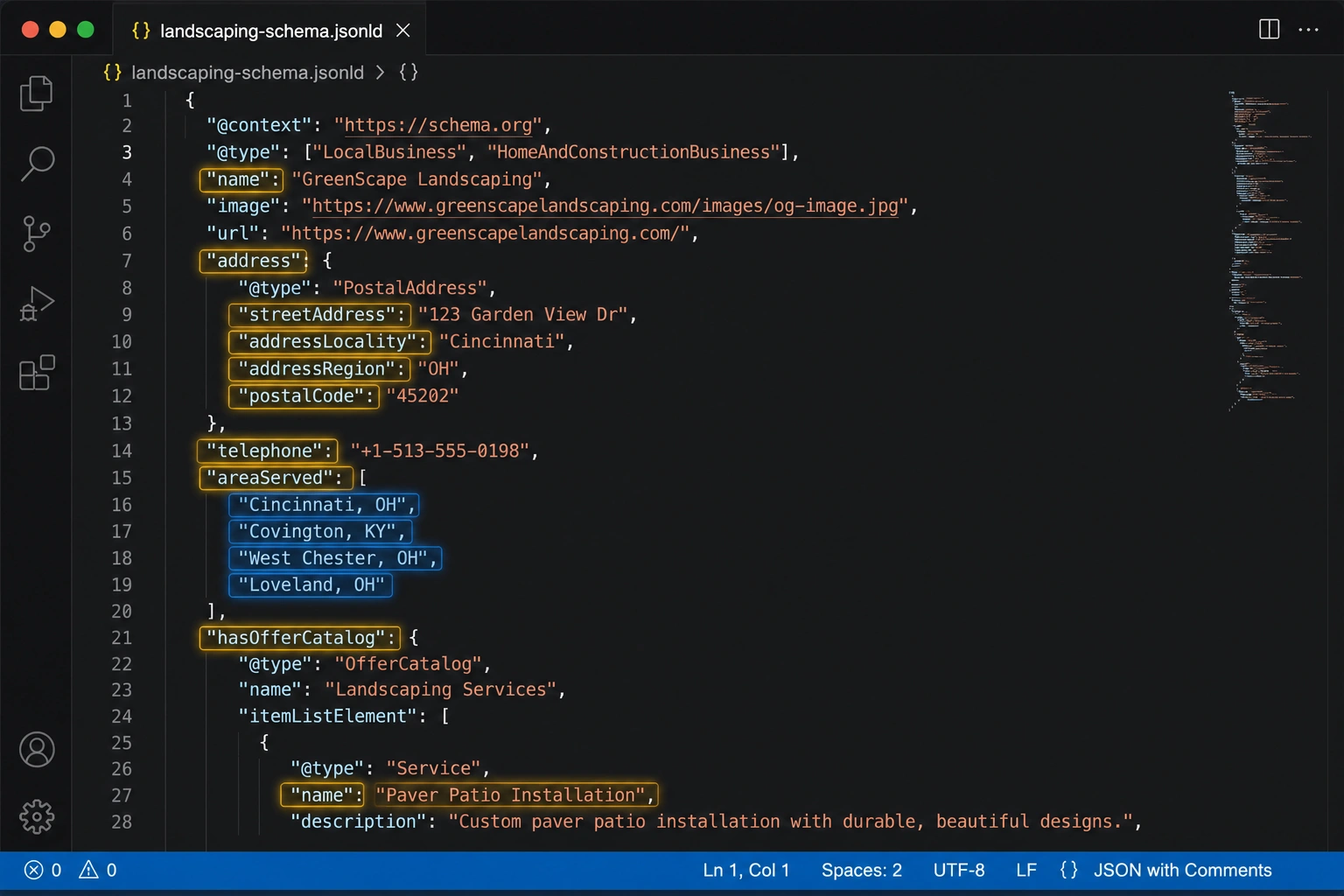
Example JSON-LD schema for a landscaping company highlighting essential LocalBusiness fields that improve local search visibility.
Actionable content strategy: Writing for homeowner search intent
Generic blogging is not a landscaping SEO strategy. It wastes resources. A post about “10 Beautiful Backyard Ideas” might attract national Pinterest traffic, but it will not generate a single estimate request from a homeowner in your service area who is ready to spend money. The content that drives high-ticket landscaping leads answers specific, high-intent questions that prospective clients are actively searching at the moment they are evaluating contractors: and it answers those questions with enough depth and local specificity that both the reader and the search engine recognize your authority.
What we’ve seen work for landscaping companies follows a few reproducible patterns:
- Address Real Pricing Questions: Write detailed guides on project costs (e.g., “How Much Does a Paver Patio Cost in [Your Region] in 2026?”). Provide realistic price ranges, material options, and cost-driving factors. Homeowners planning large projects are not scared off by honest pricing discussions: they are reassured by them. A contractor willing to discuss cost variables openly signals confidence and transparency, which is exactly what a high-ticket client is looking for before they invite someone onto their property.
- Explain Local Regulations and Permits: Create resources addressing local building codes (e.g., “Do I Need a Permit for a Retaining Wall in [Your County]?”). This type of content establishes genuine authority because it requires local knowledge that a national chain or out-of-area competitor cannot replicate. It also captures searchers at a very specific, high-intent moment in their decision process.
- Provide Seasonal and Regional Advice: Write climate-specific content (e.g., “When is the Best Time to Aerate and Overseed a Lawn in [Your State]?”). This signals hyper-local relevance to search engines and positions your company as a neighbor who understands local conditions, not a generic service provider.
- Clarify Industry Terminology: Help homeowners understand their options (e.g., “Landscape Designer vs. Landscape Architect: Which One Do You Need?”). These decision-stage pieces attract clients who are close to hiring and need one final piece of clarity before committing.
One structural detail that separates high-performing landscaping content from generic articles: answer the question in the first two sentences of every FAQ block and every section opener. AI engines are scanning for direct, extractable answers. A paragraph that buries its answer in the third sentence after two sentences of setup gets passed over. An answer-first structure gets cited. This is not a stylistic preference: it is a functional GEO requirement, and it also happens to be what busy homeowners prefer when they are reading on a phone between meetings.
Measuring success: Clicks vs. booked jobs
Many SEO agencies focus purely on traffic reports and keyword rankings. But in the landscaping industry, traffic means nothing if it does not translate into booked jobs. A high-ranking blog post about “how to prune roses” might bring thousands of national visitors to your site, but it will not help you sell a $30,000 hardscape project in your local service area. The metrics that matter are booked estimates, inbound calls from your service area, and contact form submissions from people who describe a real project: not session counts and page views.
This divergence matters especially when evaluating Landscaper SEO investments. An agency that reports 40% traffic growth but cannot show you a corresponding increase in qualified leads is optimizing for the wrong outcome. Ask for conversion data. Ask which keywords are driving phone calls. Ask what percentage of organic visitors are coming from your actual service area. Those questions separate a genuine performance conversation from a vanity metrics report.
To build a highly profitable digital presence, we must focus on high-intent local traffic and address the exact questions your local prospects are asking.
The average landscaping website converts only 2.3% of organic traffic into leads. Websites that implement instant-quote tools or interactive pricing calculators see conversion rates climb to 8% to 15%: a 3x to 5x improvement. That gap is not primarily an SEO problem; it is a conversion rate optimization problem that SEO investment alone cannot fix. Real-world case study data reinforces this: A marketing piece recently documented a 56% increase in digital leads and a 397% increase in GBP-driven website traffic over an 18-month campaign for a hardscaping contractor. Another study showed a 180% increase in organic search traffic and a 121% ROI on new customer revenue just six months after an SEO overhaul. Yes another effort optimized a lawn care provider’s local presence and drove organic conversions from 17 to 174 during the off-season: a period when most landscaping companies assume digital marketing goes quiet. These outcomes share a common thread: they were achieved by combining technical SEO with conversion-focused website architecture, not by chasing rankings in isolation. The goal is always booked jobs, and every metric we track should trace back to that outcome.
Frequently asked questions about landscaping SEO
Q: How long does it take to see results from landscaping SEO?
A: If your landscaping business already has an established website and an active Google Business Profile, you can expect to see initial traction and lead increases within 3 to 6 months. For brand-new websites starting from scratch, it typically takes 6 to 9 months of consistent optimization, content creation, and review building to generate a steady flow of organic leads. Competitive markets: particularly densely populated metros with multiple established landscaping companies: tend toward the longer end of that range. Results also depend heavily on how aggressively you pursue review generation and local link building alongside the technical work.
Q: How is AI SEO different from traditional SEO for landscapers?
A: Traditional SEO focuses on ranking your website in a list of blue links or map results on Google. AI SEO (or GEO/AEO) focuses on optimizing your digital footprint so that generative AI engines: like ChatGPT, Gemini, and Google AI Overviews: pull your content into their direct, conversational answers and recommend your business as the top local solution. The underlying signals differ: traditional SEO rewards keyword relevance and backlink authority, while GEO rewards credentialed expertise, consistent brand mentions across authoritative sources, and review language that contains specific service and location data. A landscaping company that is strong in traditional SEO has a meaningful head start on GEO, but the two disciplines require separate, deliberate optimization efforts.
Q: How do I rank in multiple towns or service areas?
A: To rank across multiple towns, you must create dedicated, unique location pages for each major city or suburb you serve (e.g., “Lawn Care Services in [Town A]”). Do not use duplicate templates with only the town name swapped out. Instead, include hyper-local details, project photos from that specific area, local client reviews, and accurate LocalBusiness schema that defines your service area. Search engines have become adept at identifying thin, templated location pages: and they penalize them. A page that mentions a specific neighborhood, references a local landmark or soil type, and includes a review from a client in that zip code will consistently outperform a generic template with a city name inserted.
Q: Can I do landscaping SEO myself, or should I hire an agency?
A: Basic local SEO: such as claiming your Google Business Profile, optimizing your homepage, and collecting reviews: can be handled in-house with a reasonable time investment. However, advanced strategies like technical schema markup, ongoing high-intent content creation, local link building, and Generative Engine Optimization (GEO) require specialized expertise and significant sustained effort. If you are running a multi-crew landscaping business, the opportunity cost of pulling an owner or office manager into technical SEO work is often higher than the cost of hiring a specialized agency. The more relevant question is not whether you can do it yourself: it is whether doing it yourself is the highest-value use of your time relative to what a specialist can deliver.
Q: How does SEO help me compete against national lawn care chains?
A: Local landscapers possess a structural advantage over national chains that most contractors undervalue. National chains rely on generic, templated content and broad national campaigns that cannot be meaningfully localized at scale. By creating hyper-local, highly-specific content (e.g., “How to treat grubs in [Your City]”), securing authentic local reviews that mention specific neighborhoods, and showcasing real local project galleries, you will consistently outperform national chains in local map packs and AI search recommendations. AI engines, in particular, favor businesses with verifiable local presence: real addresses, real local reviews, real project histories in specific communities. A national brand’s templated city page cannot compete with a local contractor’s genuine neighborhood-level authority.
The landscaping industry is undergoing a massive digital transformation. Homeowners planning high-ticket outdoor projects are making their first calls based on what Google, ChatGPT, and local map packs recommend. The companies that build a strong local SEO and AI search foundation today will lead their local markets for years to come. That foundation is not complicated, but it is methodical: a fully optimized Google Business Profile, a technically sound website with dedicated service and location pages, credentialed content that AI engines can cite with confidence, and a review generation process that produces substantive, location-tagged feedback after every completed job. None of those elements require a massive budget. They are highly accessible. Focus on building your digital presence step by step to secure your local market share.
Here’s how to get started: claim your Google Business Profile if you haven’t already, or take a look at your current digital footprint.