
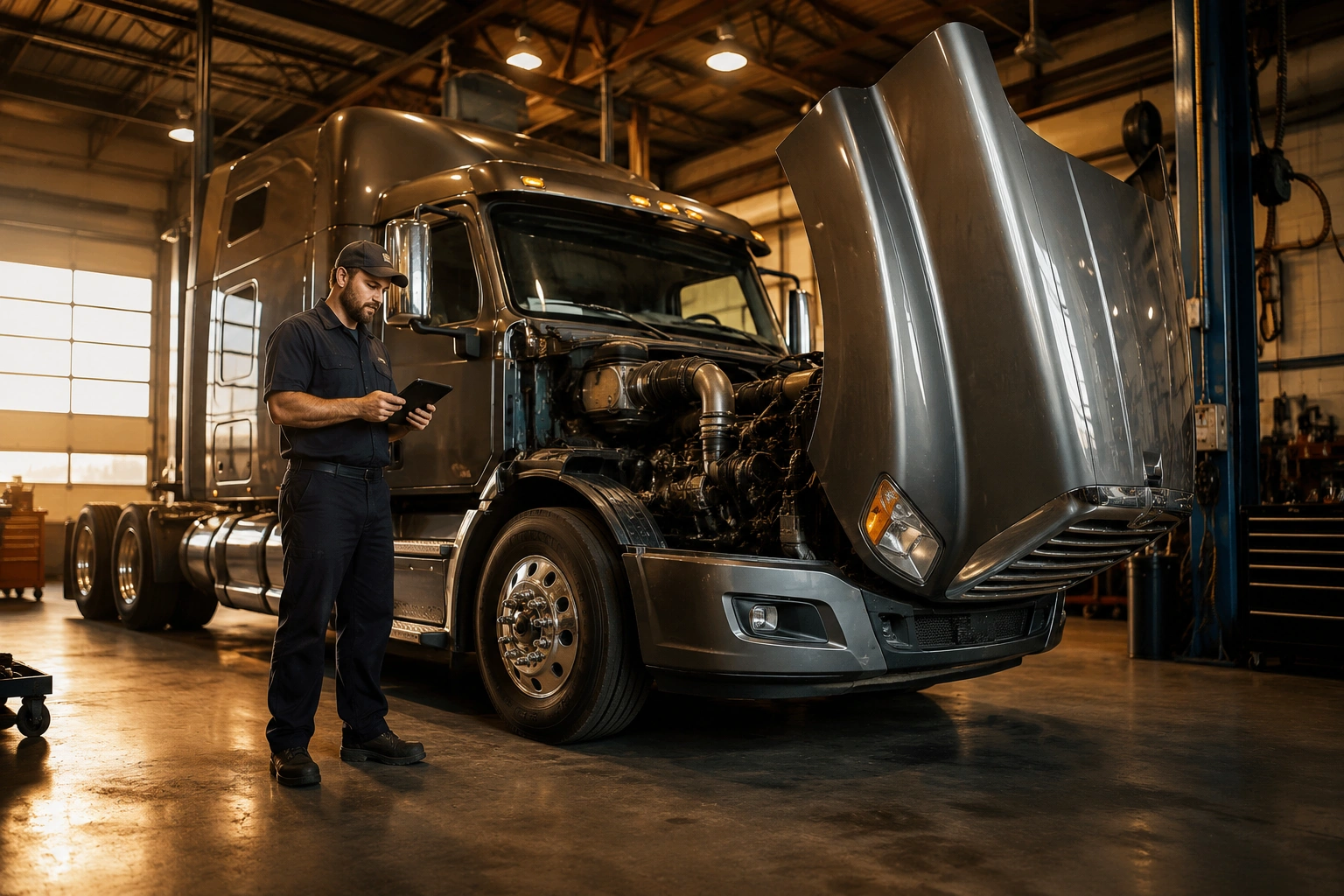
A diesel technician performs diagnostics on a Class 8 truck, combining hands-on expertise with modern diagnostic tools.
Written by the BizIQ Fleet Marketing Strategy Team. We partner with local automotive and heavy-duty repair shops to build sustainable, organic visibility that keeps bays full and commercial fleets moving.
What This Playbook Covers
- Google Business Profile Optimization: How to claim and structure your local listing to capture immediate roadside and shop-bound leads.
- The “Fleet-First” Keyword Strategy: Moving beyond generic terms to target high-intent commercial fleet managers.
- Service Page Architecture: Building dedicated engine and repair landing pages that convert searchers into customers.
- Review Acquisition & Citation Management: Algorithmic ranking signals that build trust and drive inbound phone calls.
How can Diesel Repair Shops Optimize for Local Search to attract Fleet Leads?
Dominate local search by creating service pages targeting “fleet diesel repair”, optimize your Google Business Profile (GBP) with commercial categories, and publish case studies that focus on quick turnaround times, preventative maintenance, and mobile diagnostics.
Running an independent diesel repair shop is not just about turning wrenches. It is about keeping the local economy moving. At BizIQ, we are small business owners ourselves, and we believe that small businesses are the backbone of innovation. Your shop plays an essential role in keeping commercial vehicles on the road, which in turn helps drive America forward.
Keeping bays consistently filled with high-margin work, though, can feel like an uphill battle against national truck stop chains and dealership service networks that have entire marketing departments behind them. The evidence, however, points to a clear competitive opening: an evidence-based approach to local search is the most reliable way to build a durable digital presence around an independent shop. National brands cannot out-localize you. They cannot own your specific highway corridor, your county’s fleet relationships, or the trust signals that come from 80 reviews on a Google Business Profile that names your technicians by name.
Commercial fleets are also operating under unusual pressure right now. According to the 2025 Verizon Connect Fleet Technology Trends Report, vehicle delivery lead times are averaging a 20-week on-time delivery delay, which means fleet managers cannot simply replace aging equipment; they are forced to maintain it. At the same time, 78% of fleet leaders identify cost savings as their dominant priority heading into 2026, up from 61% the year prior. When those managers search for partners who can help them achieve the average 16% decrease in maintenance costs associated with preventive care, they are not calling a 1-800 number. They are running a local search. If your shop does not appear, that contract goes to whoever does.
The Local Search Reality: Why General Auto SEO Fails Heavy-Duty Shops
Many digital agencies apply the same playbook to diesel repair that they use for passenger car shops. It does not work, and the reason is structural. Heavy-duty is different. In the passenger car space, a driver picks the closest oil change shop. In heavy-duty diesel, the search landscape splits into two distinctly different buyer profiles:
- Owner-Operators: Drivers in transit who need immediate roadside assistance, mobile diagnostics, or emergency repairs. Proximity and availability dominate their decision.
- Fleet Managers: B2B buyers managing Class 8 tractors, medium-duty delivery vans, or municipal equipment. They spend an average of 9.5 hours researching online before committing to a service partner, and they prioritize uptime, DOT compliance, and predictable maintenance costs over price alone.
Generic automotive keywords are structurally misaligned with both audiences. “Car mechanic near me” attracts the wrong traffic entirely. To capture commercial accounts, your heavy-duty truck shop’s local SEO must be built around service-specific, commercially oriented queries, the kind that signal a buyer who already knows what they need and is evaluating who can deliver it.
Google’s local algorithm decides which shops appear in front of those buyers based on three variables, as detailed in Moz’s analysis of local ranking factors and studies by BrightLocal:
- Proximity: Physical distance between the shop and the searcher.
- Relevance: How precisely your website and listings match the specific query: “DPF cleaning” and “general truck repair” are not the same signal.
- Prominence: Measured trust, expressed through review volume, citation consistency, and inbound links from credible sources.
Understanding the Local Search Landscape
| Search Element | What It Is | Why It Matters for Diesel Shops |
|---|---|---|
| Google Map Pack (Local 3-Pack) | The map and three business listings shown at the top of local search results. | Receives 126% more traffic than organic positions 4 to 10. Businesses here get 93% more calls and clicks. |
| Organic Search Results | Traditional website listings appearing below the Map Pack. | Where fleet managers conduct deep research, reading service pages and verifying credentials before reaching out. |
Some shops look at SEO companies for collision repair or general automotive marketing to evaluate what a strong digital strategy looks like. Paid ads can offer fast visibility, but organic search builds a more durable, lower-cost-per-lead channel over time. Organic rankings endure. Industry data shows that targeted local SEO can reduce cost per conversion to $63, compared to the $80 industry average for paid search. If you are evaluating digital partners, our guide on what to look for in the best SEO company for collision repair outlines the technical and transparency standards worth holding any agency to.
Optimizing Your Google Business Profile for Fleet and Breakdown Leads
Your Google Business Profile (GBP) is the single most valuable digital asset for local search visibility. Roughly 82% of commercial vehicle service and emergency roadside searches happen on mobile devices. A driver stranded on the highway with a forced regen issue needs to find your shop in under 30 seconds. Speed is everything. Your GBP is what makes that possible, or prevents it.
Four configuration decisions carry the most weight:
- Select the Correct Primary Category. According to the Google Business Profile Help Center, choosing the right primary category is critical because Google uses it as a core relevance signal. Choose “Truck Repair Shop” or “Diesel Engine Repair Service”, not “Auto Repair Shop,” which dilutes your visibility for heavy-duty queries. Secondary categories like “Mechanic” or “Trailer Repair Service” can supplement without competing.
- Align Your NAP Data Precisely. Your business name, address, and phone number must be identical across your GBP, your website, and every directory listing. Data from Semrush indicates that uniform NAP information yields more inbound calls than inconsistent profiles. The discrepancy does not need to be dramatic: “Suite A” versus “Ste. A” is enough to introduce crawl confusion.
- Define Your Service Area Correctly. Physical shops with bays should list their address. Mobile-only mechanics are required by Google’s guidelines to register as a Service Area Business (SAB), hide their physical address, and define coverage by zip codes or counties. There is legitimate debate among local SEO specialists about whether hiding an address creates a proximity disadvantage, but proper service-area configuration largely closes that gap.
- Upload High-Resolution Shop Photos. Photos of your service bays, mobile units, diagnostic equipment, and technicians do more than build visual credibility; they signal operational capacity to fleet managers who are vetting whether your shop can handle Class 8 tractors or heavy municipal equipment. A profile with no photos reads as unverified.
The “Fleet-First” Keyword Strategy: Targeting High-Value Accounts
Securing recurring fleet contracts requires an intentional shift in keyword targeting. Fleet managers do not search the way individual drivers do. Their queries are specific, compliance-aware, and commercially framed. That specificity is exactly what makes them valuable.
Instead of optimizing for broad terms like “diesel mechanic,” the commercial truck service keywords that attract fleet buyers look like this:
commercial fleet maintenance [City]Class 8 truck repair [City]DOT inspection service [City]mobile diesel mechanic [City]preventive maintenance for fleets [City]semi truck brake repair [City]
Search volumes on these terms are lower than consumer-facing queries. That is not a weakness: it is a filter. It filters out waste. A single fleet manager searching “preventive maintenance for fleets” can represent dozens of vehicles and tens of thousands of dollars in annual recurring revenue. The math on customer lifetime value makes these low-volume terms worth more than high-volume consumer keywords by a significant margin.
Building High-Converting Service Pages for Specific Repairs
One of the most consistent architectural mistakes we see across diesel shop websites is the single-page service list: a bulleted inventory of capabilities that gives search engines nothing to work with and gives fleet managers no reason to trust the depth of your expertise. A line that reads “we handle engine work, brakes, and diagnostics” does not rank for anything specific, and it does not convert a buyer who is evaluating vendors.
Dedicated, geo-modified landing pages solve both problems simultaneously. They build trust. Each core service needs its own page, built around the specific query a buyer would use, populated with the technical detail that signals genuine expertise.
[Your Website]
  ├── /services/ (Overview)
  ├── /services/fleet-preventive-maintenance/
  ├── /services/dpf-cleaning/
  ├── /services/dot-inspections/
  └── /services/mobile-roadside-assistance/
The Anatomy of a High-Converting Service Page
- An H1 Header with a Local Modifier. “Class 8 Diesel Engine Repair in [City Name]” tells Google exactly what the page is about and where it is relevant.
- Technical Depth and Engine Specifics. Name the engines you service: Cummins, Detroit Diesel, Duramax, Powerstroke, PACCAR. Describe the actual work: EGR valve replacements, fuel injector service, DPF cleaning, turbocharger diagnostics. This level of specificity signals subject matter authority to both human readers and search engine crawlers. It is the detail that separates a shop page from a template.
- Clear, Friction-Free Calls to Action. Emergency roadside callers need a conspicuous click-to-call number. Fleet managers scheduling preventive maintenance need a detailed contact form that captures vehicle type, fleet size, and service frequency. These are different buyers at different stages; the page should accommodate both without making either hunt for the path forward.
To help search engines read this detailed content, we recommend implementing structured data. It guides search crawlers. Our peers at Trusted Local Auto explain how FAQ schema markup for auto repair can make your technical details stand out in automated and AI-driven searches.
“Specificity wins in heavy-duty SEO. A fleet manager searching for ‘Detroit DD15 EGR valve replacement’ is ready to buy; a generic ‘truck repair’ page won’t convert them.”
To see how structured local optimization translates into measurable business outcomes, our auto repair case study walks through the exact process. For shops operating across multiple locations, the franchise marketing and SEO tactics framework addresses how to maintain brand consistency while capturing hyper-local search traffic at each site.
Review Management: Turning Customer Feedback into Search Rankings
Reviews are a direct ranking signal, not just social proof. Google’s local algorithm weighs review volume, recency, and sentiment as part of the prominence calculation that determines Map Pack placement.
The numbers are definitive. Diesel repair shops with complete Google Business Profiles and 50 or more reviews receive 2.4 times more inbound phone calls than competitors with fewer than 10 reviews, according to the Heavy Duty Journal diesel repair shop SEO guide. Furthermore, local search data indicates that every 10 new reviews increases local conversion rate by 2.8%, and responding to at least 25% of reviews improves conversions by an additional 4.1%.
Building review volume requires a system, not a habit. Automation makes it easy. The most reliable approach is to send a direct review link via text or email immediately after vehicle delivery, when the service experience is fresh, and the customer’s goodwill is highest. Waiting until the end of the week or relying on verbal asks produces inconsistent results.
When reviews come in, respond to every one. Responses serve two purposes: they demonstrate to prospective customers that your shop is attentive, and they create a natural opportunity to integrate relevant search terms without keyword stuffing.
Example of an Optimized Review Response
Optimized Response: “Thank you for the feedback! We were glad to help with your semi truck DOT inspection and get your vehicle back on the road safely. We appreciate your partnership and look forward to helping with your future fleet maintenance needs.”
The response reads naturally. It also reinforces two high-value search terms in a context that Google indexes, helping your shop rank for both DOT inspections and fleet maintenance without looking like spam. Neither goal requires compromising the other.
Local Citations and NAP Consistency for Diesel Shops
A local citation is any online mention of your business name, address, and phone number. Citation volume and consistency are direct inputs into Google’s prominence calculation, the third pillar of local ranking. Shops with broad, accurate citation coverage signal established, trustworthy businesses to the algorithm.
Priority platforms to audit and claim:
- General Directories: Yelp, Yellow Pages, Bing Places.
- Industry-Specific Directories: TruckersReport, Find Truck Service, NTTS Breakdown Directory, American Trucking Associations (ATA) directory.
- Local Directories: Your Chamber of Commerce and regional business associations.
Consistency matters more than volume. Search engines demand accuracy. Even minor formatting variations, like “Suite A” on one listing and “Ste. A” on another, can fragment your citation authority and introduce crawl ambiguity. Audit your existing listings before building new ones; cleaning up variations often produces faster ranking improvements than adding new citations to a messy foundation.
Our detailed breakdown of local SEO covers citation building in full technical detail. If you want a faster starting point, the 10 tips for optimizing your local business for search engines covers the foundational elements that affect every local ranking factor simultaneously.
Tracking Your SEO Performance: Metrics That Matter
Impressions and keyword rankings are useful indicative signals, but they do not reflect business health on their own. Three metrics connect directly to revenue: Focus on these instead.
- Inbound Phone Calls: Track calls originating from your Google Business Profile and local landing pages separately. GBP call tracking is available natively; landing page calls require UTM parameters or a call-tracking integration.
- Direction Requests: Users requesting driving directions to your shop represent immediate, high-intent buyers. This metric is available in GBP Insights and correlates strongly with same-day service bookings.
- Organic Lead Form Submissions: Fleet managers rarely call cold. They research, then submit an inquiry. Tracking form submissions from organic traffic, segmented from paid, shows you the actual pipeline your SEO investment is generating.
Shops that implement targeted heavy-duty truck repair SEO have seen a 45% increase in organic leads and a 20% rise in average ticket size. At the more dramatic end of the documented range, a localized SEO and website optimization strategy produced a 3,830% increase in first-time calls. That figure should be treated as a ceiling, not an everyday expectation, but it illustrates the compounding effect of organic visibility in a low-competition local market where most competitors have not invested in their digital presence at all.
Frequently Asked Questions
Why is local SEO better than Google Ads for diesel shops?
Paid search requires ongoing funding to sustain lead flow. The moment the budget pauses, the leads stop. That is expensive. Organic SEO functions as a compounding asset: once your shop ranks in the Map Pack, you receive qualified traffic and phone calls without paying per click, meaning your marketing budget goes further over time. Over a 12-to-24-month horizon, organic SEO consistently produces a lower cost-per-lead and a more stable booking pipeline than PPC alone.
How long does it take to rank in the Google Local 3-Pack?
Most diesel repair shops see measurable organic traffic and lead growth within 3 to 6 months of implementing a localized strategy, which includes optimizing your Google Business Profile and building local citations. The timeline depends on your market’s market saturation and your website’s existing domain authority. Patience pays off. In less saturated markets, meaningful movement can appear in 60 to 90 days.
Do I need separate pages for mobile road service and shop repairs?
Yes. They are different services. Mobile roadside assistance and in-shop repairs target different search intents completely. A driver stranded on the highway searches “mobile diesel repair near me.” A fleet manager scheduling quarterly maintenance searches “heavy duty truck shop [City].” Separate pages ensure you rank for both query types without one diluting the other, allowing you to capture both immediate roadside emergencies and long-term fleet maintenance contracts.
How do I get fleet managers to find my shop via SEO?
Fleet managers are researching answers to operational questions: uptime, compliance, cost-per-mile. They want proof. Content that addresses those questions directly, paired with commercial keywords like “preventive maintenance for fleets” and visible certifications or diagnostic capabilities on dedicated service pages, positions your shop as a trustworthy vendor before the first call is ever made.
What is the most important Google Business Profile category for diesel repair?
Select “Truck Repair Shop” or “Diesel Engine Repair Service” as your primary category. Do not choose auto repair. These align directly with high-intent heavy-duty search queries and prevent your profile from being categorized with general passenger car repair shops in Google’s relevance calculations, which can dilute your local search visibility.
Partnering for Long-Term Growth
Managing a digital presence while running a shop, coordinating technicians, and maintaining fleet relationships is genuinely difficult. There is no shortage of marketing vendors making large promises, and the industry has earned some of the doubt shop owners bring to these conversations.
At BizIQ, we are small business owners ourselves. We understand your challenges. We do not believe that sophisticated marketing is reserved for national chains or enterprise fleets; sophisticated marketing belongs to you too, the independent operators who keep communities running. Our approach to automotive digital marketing is built on transparent, evidence-backed strategies designed to produce measurable outcomes: more inbound calls, more fleet inquiries, and more bays filled with recurring work.
If you are ready to build a sustainable source of local leads and secure more commercial fleet contracts, book a free local SEO strategy session with our team. We will analyze your current search visibility and map out a clear path forward: no hype, no vague projections, just an honest assessment of where your shop stands and an empowering next step to get moving.