

A conceptual comparison of single-location growth versus expanding into a connected commercial property network.
If you are comparing these two models, you are already thinking at the right level. You might be asking yourself: Do I need a different strategy for a franchise network? Does it work differently for franchises? Most franchise operators do not ask these questions until they are deep into a scaling challenge: watching organic traffic plateau across new locations while a single-location competitor three blocks away outranks every franchisee in the metro. That gap is not a content challenge or a budget challenge. It is a structural one.
Running a local business campaign for one storefront is like learning to cook one recipe well. You know the exact ingredients, the heat settings, and the timing. You can adjust in real time, focus closely on a handful of terms, and manage every citation by hand. Running a campaign for a franchise network is something fundamentally different: it is like running a restaurant chain where every location must deliver the same quality. You are managing dozens or hundreds of locations you’ve invested in simultaneously, each with its own local climate, each needing consistent maintenance, and all of them needing to reinforce a single brand identity without trampling each other. You need a system, not just a single recipe.
The four structural differences that separate these two disciplines are:
- Architectural Complexity
- Content Scalability
- Brand Governance
- Data Syndication
Franchise SEO is a complex system-design challenge rather than a simple localized effort. Franchise networks must balance national brand authority with hyper-local relevance. The risks of duplicate content, internal keyword cannibalization, and inconsistent business data across the web are significant.
The risks compound quickly. If you are wondering, what moves the needle vs. what’s just busy work?, look at how you manage listings. Templated location pages that swap only the city name trigger duplicate content filters. Sister locations targeting the same metro keywords cannibalize each other’s rankings. A single franchisee updating their own Google Business Profile with an incorrect address creates a citation conflict that erodes trust signals across the entire domain. None of these challenges exist at meaningful scale for a single-location operator, but for a franchise network running 50 or 500 locations, each one is a constant operational risk.
Architectural foundations: subfolders vs. standalone domains
A local business campaign strategy concentrates all domain authority on one homepage and a few service pages. When scaling a franchise network, a hierarchical subdirectory configuration (such as brand.com/locations/city/) is the industry standard because search engines treat subdomains as separate entities, which dilutes backlink equity and forces each location to build authority from scratch.
Franchise networks do not have that luxury. When a brand operates 200 locations, the question of where those location pages live, and how they inherit authority, determines whether new markets rank in weeks or years. A practical starting point is a hierarchical subdirectory configuration: brand.com/locations/austin/, brand.com/locations/dallas/, and brand.com/locations/chicago/. Search engines treat these pages as integral parts of the root domain. This means every backlink the corporate site has ever earned contributes to the ranking potential of every location page underneath it.
Subdomains, such as austin.brand.com and dallas.brand.com, look like a reasonable alternative, and some franchise systems still use them for the perceived benefit of local customization. The technical trade-off is costly, though. Search engines treat subdomains as separate entities. A backlink to brand.com does not pass equity to austin.brand.com in any meaningful way, which means each subdomain is effectively starting its domain authority from zero. For a new franchise location entering a competitive local market, that is a significant structural handicap before a single piece of content is written.
Here’s what the data shows: subdirectories consistently outperform subdomains in franchise network ranking benchmarks precisely because of this authority inheritance mechanism. New location pages on a subdirectory structure can rank for competitive local terms within weeks of launch because they immediately benefit from the parent domain’s established backlink profile. Subdomain-based locations often require months of independent link-building before they gain any traction; link-building that, even when successful, never consolidates into the corporate domain.
Separate microsites or subdomains can lead to a “Ghost Location” crisis where individual franchise units are treated as entirely new websites. Every backlink earned by the corporate site strengthens the local pages, and every local citation earned by a franchisee boosts the national domain. While separate microsites offer maximum local control, the technical trade-off is a massive dilution of search authority.
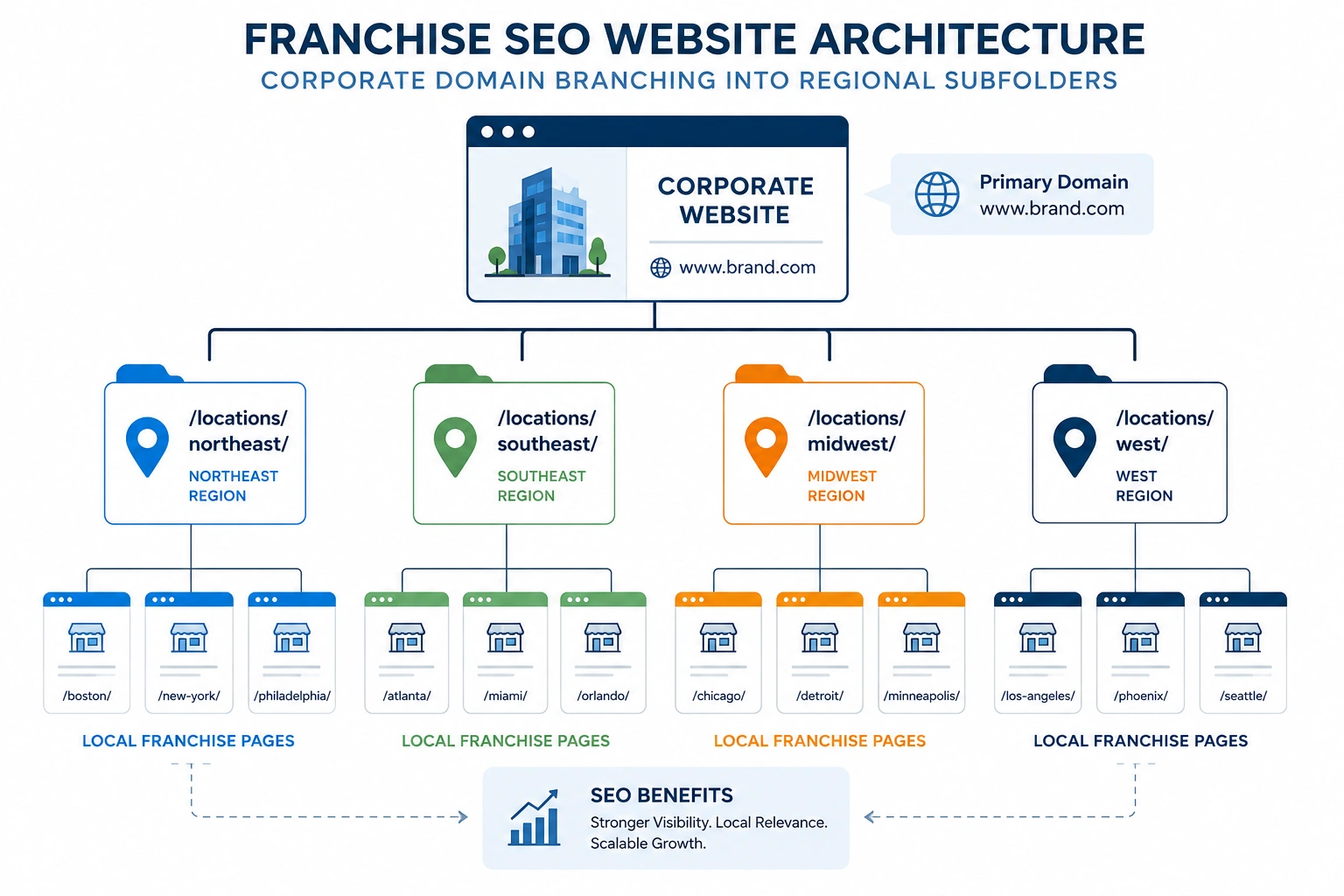
A scalable franchise website structure connects one corporate domain to regional subfolders and optimized local location pages.
Content scaling: hyperlocal customization vs. single-site focus
A single-location operator can afford to focus closely. One service area, one set of local keywords, one voice. Content strategy at that scale is about quality and depth, not about manufacturing differentiation across hundreds of nearly identical pages.
Franchise content strategy is a different challenge. Scale changes everything. The network needs hundreds of location pages that are simultaneously consistent enough to reflect a unified brand and distinct enough that search engines don’t treat them as duplicate content. That is not a content writing challenge; it is a content engineering challenge. The difference matters because the solution isn’t “write more”; it’s “write differently, systematically, at scale.”
The hyperlocal optimization playbook for franchise location pages involves four essential elements:
- Every location page must feature at least 600 to 900 words of unique, localized copy describing the specific service area, local landmarks, and community involvement to bypass duplicate content challenges.
- Mapping specific neighborhood and city-specific keywords to prevent sister locations from competing against each other in search results.
- Replacing generic stock photos with real, geotagged images of the local team, storefront, and branded vehicles.
- Building clusters of supporting blog content around local issues, such as regional climate challenges or local building codes, to establish strong topical authority.
A national pharmacy brand that implemented a hyperlocal content strategy across 60 pilot locations achieved an 80% increase in clicks and a 200% increase in impressions, improving its average local ranking from 3.2 to 1.3. That is not a marginal gain from better copywriting, it is a structural shift in how those pages were positioned relative to local search intent.
Brand governance: centralized control vs. local autonomy
Managing search strategy across a franchise network requires balancing corporate standards with local execution. “I don’t have a big marketing team,” you might think, “so how do enterprise brands handle this?” The debate between centralized control and local autonomy is not resolved; there are real costs on both sides, and the right balance depends on the size of the network, the sophistication of individual franchisees, and the maturity of the brand’s digital infrastructure.
What is clear is that fully centralized models produce technically compliant but often generic location pages. Corporate-controlled content tends to lack the authentic local signals (genuine community references, real customer stories, locally relevant service nuances) that distinguish high-performing pages from their templated counterparts. It is like having a home office that sets standards, but each franchise owner still controls their own inventory. Both sides must cooperate. Fully decentralized models, on the other hand, frequently produce citation conflicts, inconsistent name, address, and phone number data, duplicate listings, and off-brand messaging that creates brand confusion at scale.
The hybrid governance framework that most enterprise franchise networks are converging on looks like this:
- Corporate marketing teams maintain absolute control over the website’s CMS, schema markup templates, and core technical SEO.
- Individual franchisees manage their local Google Business Profiles, respond to customer reviews, and post weekly updates.
- Establishing clear policies for tone of voice, logo usage, and localized content creation to ensure a consistent brand image across all territories while balancing brand consistency.
- Implementing unified dashboards to track local pack visibility, organic lead volume, and review velocity across the entire network.
Our franchise search services are built around exactly this governance model, providing the centralized technical infrastructure and reporting layer while equipping franchisees with the tools and guidelines to contribute meaningful local signals. It is a system that scales without sacrificing the local authenticity that drives real conversions.
“Consistent NAP data is non-negotiable for franchise networks. Research shows that 62% of consumers actively avoid using a business if they find incorrect information online, making data integrity a direct driver of franchise revenue.” , BizIQ Local Search Insights
Many franchise networks lose up to 30% of their organic traffic due to internal keyword competition and duplicate location pages. Book a free consultation with our enterprise search specialists today to audit your site architecture.
Citation management: API syndication vs. manual directory submissions
Manual citation management works at single-location scale. One business, one address, one phone number. You can submit to the major directories, verify the listings, and check back quarterly. This is about making sure every branch of your business lists the exact same phone number and address, because search engines get confused when they do not. The operational overhead is manageable. The error rate stays low because the data set is small.
Scale that to 200 locations and the system breaks down. Managing two hundred locations across major data aggregators, niche industry directories, GPS platforms, and mapping services means coordinating thousands of individual citation instances that must remain perfectly synchronized to prevent search engine confusion. Any one of them can drift. And they do.
Manual directory submissions work for a single storefront but fail catastrophically for a franchise network. “Data Drift”, the gradual corruption of online business listings due to incorrect third-party data or automated search engine updates, directly destroys search engine trust and consumer confidence.
Enterprise franchises must implement centralized data management systems. Integrating the corporate database directly with primary data aggregators via API-driven platforms (like Yext or Uberall) synchronizes updates instantly. The Bojangles case study shows the brand saved 58,000 hours of manual labor per year by utilizing Yext for bulk content uploads, achieving a 9.2x ROI in 2023.
The massive ROI of local search for franchise networks
A common mistake is over-allocating budget to paid ads while under-investing in organic search. The NP Digital Franchise Marketing Survey shows local business campaigns deliver a 274% ROI for franchise networks, compared to an 81% ROI for paid advertising campaigns. Organic leads generated through local business campaigns for franchises cost 80% to 90% less than pay-per-click (PPC) campaigns. The savings are substantial.
The local search intent data reinforces this. 76% of local searches result in a store visit within 24 hours, and 93% of franchise customers search online before visiting a physical location. These are not top-of-funnel awareness searches; they are bottom-of-funnel, purchase-intent queries from people who have already decided they want the service and are now deciding which provider to visit. Capturing that traffic organically, rather than paying per click for it, is the difference between a scalable customer acquisition model and a continuous reliance on paid advertising.
While the precise 274% ROI figure from secondary sources lacks public methodology, the broader trend of organic search outperforming paid ads is well-documented. The 274% ROI figure comes from secondary marketing blog posts referencing an NP Digital survey whose primary methodology isn’t publicly accessible. The directional finding, that local business campaigns significantly outperform paid advertising on a cost-per-lead basis for franchise networks, is consistent with platform data and practitioner experience, even if the precise number should be treated as an estimate rather than a verified benchmark.
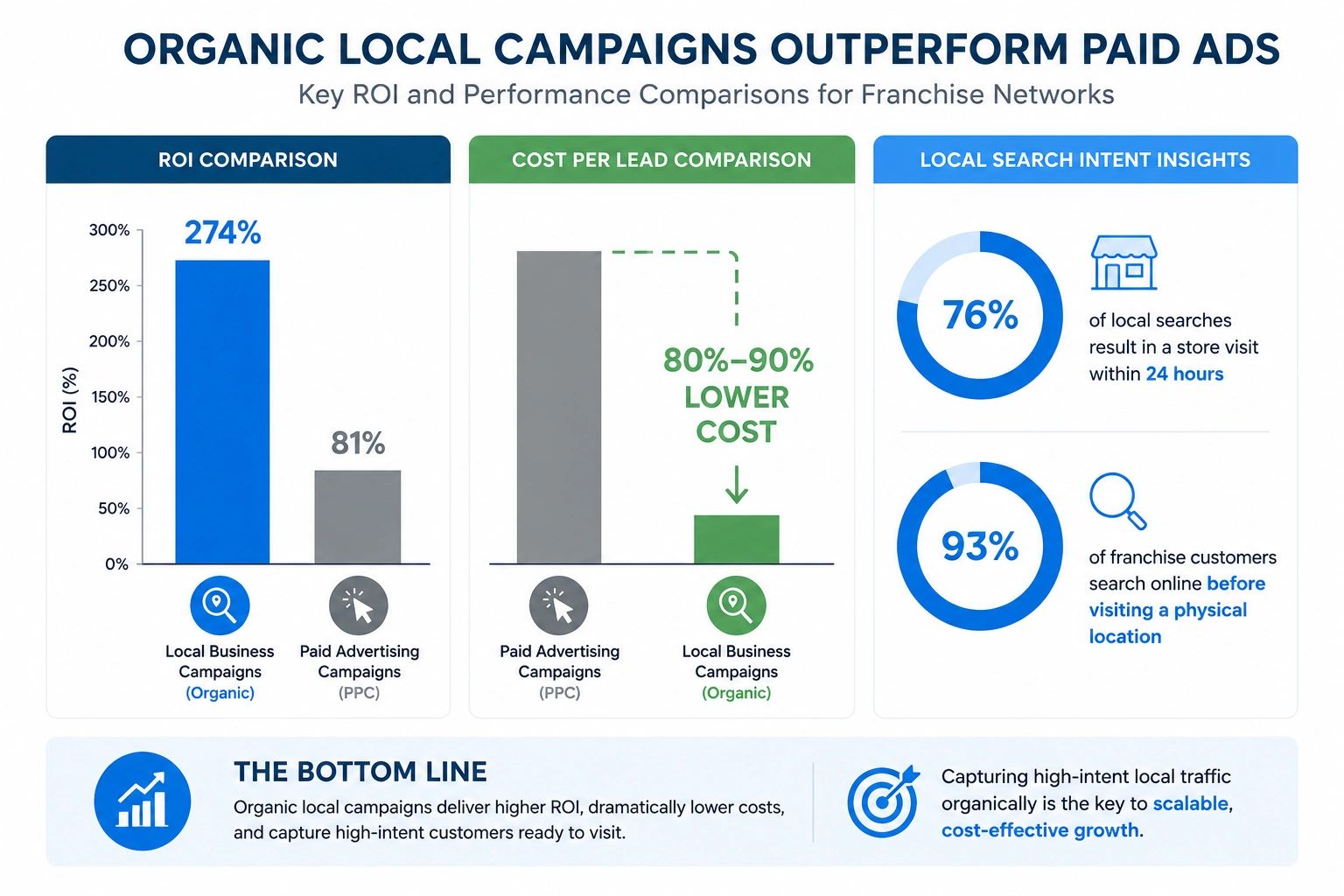
Organic local campaigns deliver higher estimated ROI, lower lead costs, and stronger purchase intent than paid advertising.
Generative engine optimization: the AI search advantage
AI-powered search is not a future consideration for franchise networks. It is a present one. Google’s Search Generative Experience and third-party AI answer engines are already pulling structured data from location pages, synthesizing it into direct answers, and surfacing brands that have invested in structured content formats. Franchise networks that built their location pages for 2019 search behavior are already losing ground in this environment. The shift is happening now.
Future-proofing a franchise search strategy for AI-driven discovery requires four specific investments:
- AI search engines rely heavily on schema markup to parse information; flawless LocalBusiness JSON-LD schema is mandatory for every location.
- Writing in natural, conversational language that directly answers hyper-specific local questions.
- Publishing detailed FAQs, detailed local case studies, and transparent pricing to demonstrate experience, expertise, authoritativeness, and trustworthiness.
- Cultivating a steady flow of positive reviews and local community mentions to reinforce brand authority to AI models.
Avoiding the cannibalization trap
Keyword cannibalization in a franchise network is an internal conflict, and it is more common than most marketing directors realize. It occurs when multiple location pages within the same network target identical or near-identical search queries, such as “plumber near me in Dallas,” “Dallas plumbing services,” and “emergency plumber Dallas,” across locations that serve overlapping geographic areas. Google does not crown a winner in that competition; it splits ranking authority among the competing pages, which means none of them accumulate enough signal to break into the local map pack.
The algorithm does not distinguish between a corporate brand competing against itself and two separate businesses competing for the same term. It treats them the same. It sees multiple pages with similar content, similar keyword targeting, and overlapping geographic signals, and it distributes authority accordingly. The practical outcome is that three Dallas-area franchise locations, each targeting the same broad city keyword, collectively occupy a lower average ranking position than any one of them would achieve if it owned a distinct, non-overlapping keyword territory.
Resolving this requires establishing clear geographic boundaries at the page level and the Google Business Profile level simultaneously. Each location page should target hyper-specific, non-overlapping keyword sets: neighborhood-level terms, specific service-area zip codes, and long-tail queries tied to local landmarks or community identifiers. The goal is to ensure that no two location pages within the same metro are competing for the same search intent.
The hub and spoke content model
The Hub and Spoke model is the primary content strategy for franchise network campaigns. The corporate homepage and main service pages target high-volume, national keywords and broad brand-level queries. Individual location pages target geographically specific, high-intent search terms. This ensures corporate captures top-of-funnel research traffic, while local pages capture bottom-of-funnel conversion traffic.
The model also creates a natural internal linking architecture. Corporate service pages link to relevant location pages. This builds clear pathways. Location pages link back to corporate service pages and to supporting blog content in their geographic cluster. That bidirectional link structure reinforces topical authority at every level of the hierarchy, which is precisely the kind of entity-centric architecture that both traditional search algorithms and AI-powered answer engines reward.
Frequently asked questions about franchise search strategy
What is the difference between franchise network campaigns and local business campaigns?
Franchise network campaigns manage search visibility for a franchise network across both national and local levels. Local business campaigns typically focus on optimizing a single physical location or independent business within a specific geographic area.
Should each franchise location have its own website?
No. Creating separate microsites or domains for each franchise location is cost-prohibitive and dilutes your link equity. Hosting all local pages under a single corporate domain using a subfolder structure consolidates your domain authority and helps new locations rank significantly faster.
How do you prevent duplicate content on franchise location pages?
Avoid using identical templates where only the city name is swapped. Every location page must feature unique, localized copy (600 to 900 words) that includes specific neighborhood details, local customer testimonials, unique service area definitions, and real photos of the local team.
Why is NAP consistency important for franchises?
NAP (Name, Address, Phone number) consistency is a primary trust signal for search engine algorithms. Inconsistent business details across online directories confuse search crawlers and lower your rankings, while also driving away consumers.
How does Google Business Profile impact franchise network campaigns?
An optimized Google Business Profile is the single most critical asset for local conversion, generating up to 520% more calls than unmanaged listings. Franchises must actively manage separate profiles for each physical storefront, maintaining steady review velocity and posting weekly localized updates using customized Google Business Profile management.
Succeeding in the search landscape as a franchise network requires a shift from isolated local tactics to a scalable, enterprise-grade system. Systems drive success. By implementing a unified subfolder architecture, enforcing absolute name, address, and phone number consistency, and deploying the Hub and Spoke content model, you can use your national brand authority to earn hyper-local search results. Review your current URL structure and Google Business Profile ownership models to identify immediate technical conflicts.
Contact our enterprise SEO team today to schedule a detailed franchise network search audit and build a customized growth playbook for your entire franchise network.