- Master the Map Pack: Learn how to optimize your Google Business Profile to show up when people search for salons near them.
- Uncover High-Intent Keywords: Find the exact search terms local clients use when they are ready to book a service.
- Build Bulletproof Citations: Ensure your business directory mentions are perfectly consistent across the web to build search engine trust.
- Create a Review Engine: Turn your daily client interactions into a powerful stream of 5-star Google reviews.
- Optimize Your Website: Structure your site with a logical “ladder” and local schema markup to capture organic search results.
If local SEO feels like a mystery, you’re not alone. Most salon owners feel the same way. It feels overwhelming. The good news is, you don’t need a marketing degree to get this right. In fact, 46% of all Google searches carry local intent (https://www.brightlocal.com/resources/local-seo-statistics/), meaning hundreds of potential clients in your neighborhood are actively searching for hair stylists, nail technicians, and beauty treatments right now. This guide is your step-by-step blueprint to getting found by local customers and filling your chair without spending a fortune on complex marketing.
To rank a physical beauty salon at the top of Google Maps and capture high-intent local search traffic, you need to optimize three core pillars: proximity, relevance, and prominence. Local search engine optimization isn’t about gaming an algorithm; it’s about making it straightforward for Google to understand exactly who you are, what services you offer, and where you operate. Align your digital presence with these three pillars consistently, and you can systematically convert online searchers into loyal, recurring salon clients.
Why local SEO is essential for beauty salons
Understanding the three pillars: Proximity, relevance, and prominence
These three pillars aren’t equally weighted, and they don’t operate in isolation: which is where a lot of salon owners get tripped up when they expect one quick fix to move the needle.
- Proximity (The Distance Factor): Proximity measures the physical distance between the searcher and your salon. You can’t control where someone is standing when they search, but you can make your physical address unmistakably clear to Google through consistent listings, embedded maps, and location-specific page content.
- Relevance (The Alignment Factor): Relevance gauges how precisely your salon’s online information matches what a user is searching for. Incomplete profiles, vague service descriptions, and mismatched categories all erode this signal. The more granular and accurate your profile details, the stronger your relevance score. This is like putting out a bright, clear sign on the busiest street in town, making sure everyone knows exactly what you do.
- Prominence (The Authority Factor): Prominence reflects your salon’s overall credibility across the web: built through business directory citations, inbound backlinks, and the volume and quality of your Google reviews. It’s the hardest pillar to build quickly, and the most durable once established.
- Pillar Synergy: Google balances all three at once to decide which salons earn a spot in the coveted Local 3-Pack. Dominating one pillar while neglecting the others produces inconsistent, fragile rankings. Balance is key.
Connecting search visibility to real-world salon bookings
- The Power of the Local Pack: The top three Google Map positions absorb over 70% of all click-through traffic from local beauty searches. Positions four through ten split the remainder. The drop-off is steep.
- High-Intent Traffic: Social media puts your salon in front of people who might book someday. Google puts you in front of people who are booking today: that distinction changes how you should allocate your marketing energy.
- Cost-Effective Gaining: A well-executed local SEO strategy compounds over time. Unlike paid advertising, which stops delivering the moment your budget runs out, organic search visibility continues generating client inquiries for months and years after the initial investment.
- Trust and Social Proof: Ranking prominently on Google Maps functions as an implicit endorsement. Prospective clients treat map position as a proxy for quality before they’ve read a single review.
When a local consumer searches for a “beauty salon near me,” they aren’t browsing; they’re preparing to make a decision. According to BrightLocal’s Local Consumer Review Survey (https://www.brightlocal.com/research/local-consumer-review-survey-2023/), 76% of consumers regularly read online reviews when evaluating local businesses. Your search engine optimization and digital marketing efforts directly shape that first impression. If your digital storefront is invisible or incomplete, those high-value clients will book with a competitor down the street without a second thought.
To close that gap, the most efficient path is pairing your own efforts with specialist support. By working with a team that provides tailored digital marketing services for beauty businesses, you can transform your online presence from a static webpage into an active client-acquisition engine.
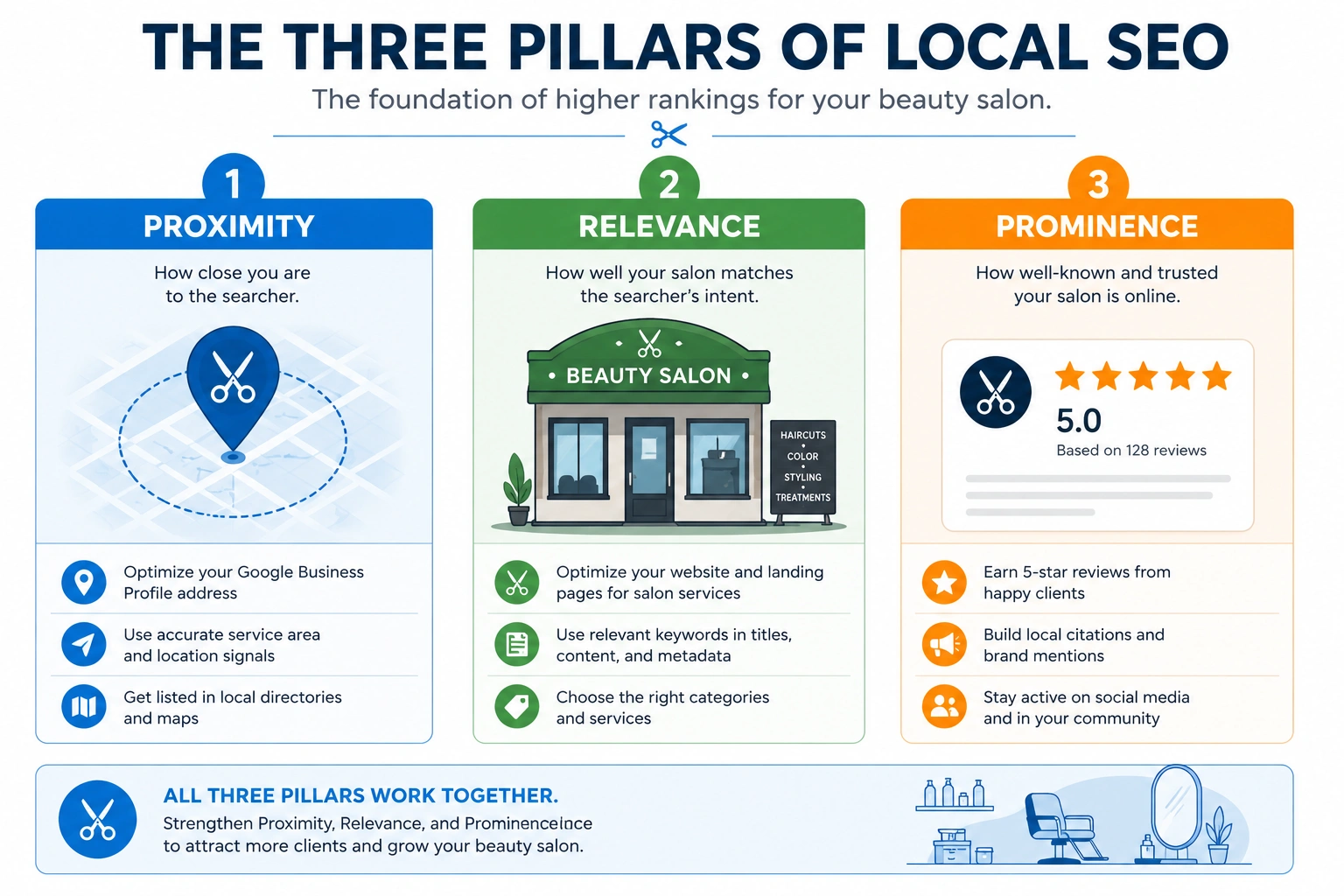
The three pillars of local SEO help beauty salons improve local visibility through proximity, relevance, and online prominence.
Optimizing your Google Business Profile
Claiming and verifying your digital storefront
Your Google Business Profile is what prospective clients encounter before they ever set foot in your salon. It’s not extra to your marketing; for most local searches, it’s the primary decision-making surface. It is your digital storefront.
Claiming your profile is simple: search for your business on Google Maps, select “Claim this business,” and follow the verification prompts. Google currently offers video verification, phone verification, and postcard-by-mail depending on your business type and history. Video verification has become the most common path and typically resolves within a few days. Once verified, you gain full access to editing, posting, and performance analytics.
Your Name, Address, and Phone number must be an exact character-for-character match to your real-world signage and any other directory listing you maintain. “Suite” versus “Ste.” is not a trivial difference to a search engine crawling hundreds of data sources. Do not add descriptive keywords to your business name field, such as “Bella Hair Salon: Best Balayage & Extensions”. Google’s guidelines prohibit this explicitly, and profiles caught doing it face suspension: a penalty that can take weeks to reverse and costs you rankings you’ve spent months building.
Category selection and service descriptions
Primary category selection is the single influential decision you’ll make on your profile. Google uses it as the primary relevance signal when matching your listing to search queries, so “Hair Salon,” “Beauty Salon,” or “Nail Salon” needs to reflect your core revenue driver, not your aspirational positioning.
Beyond the primary category, you can add up to nine secondary categories. Use them intentionally to capture specific searches: “Hair Extension Technician,” “Waxing Service,” “Eyebrow Bar,” and similar designations each pull from distinct search pools that your primary category alone won’t reach.
The Services section is where most salons leave significant visibility on the table. Populate every treatment with a clear, keyword-conscious description and accurate pricing. A client searching “keratin treatment near me” who lands on a profile with a detailed keratin treatment entry, including timing, pricing, and aftercare notes, is far more likely to call than one who finds a generic “smoothing services” line item.
Integrate a supported booking partner, since Fresha, Booksy, Vagaro, or Square Appointments all connect natively with Google, so clients can schedule directly from your search result without navigating to a separate site. Every additional click you eliminate increases conversion. On the photo side, showing potential clients the experience they’ll have when they walk through your door is backed by clear data: salon listings with more than 100 photos of your actual work receive 520% more phone calls and 2,717% more direction requests than listings with fewer than 10. That’s not a marginal improvement. Shoot your interior, exterior, individual stylists at work, and real client results consistently.
- Claim and Verify: Complete Google’s verification process to unlock full editing and performance reporting.
- Set Primary Category: Choose the category that reflects your core revenue driver: “Hair Salon,” “Beauty Salon,” or “Nail Salon.”
- Add Secondary Categories: Select up to nine relevant secondary categories to capture niche search queries.
- Add Service Descriptions with Local Keywords: Add clear descriptions and pricing for every service on your menu.
- Upload 100+ Photos of Your Actual Work: Showcase your salon’s interior, exterior, stylists, and real client results.
- Integrate Booking Software: Connect Booksy, Vagaro, or a similar platform to enable direct scheduling from Google Search and Maps.
- Fill Out Business Description: Write a compelling, 750-character description of your salon, incorporating local keywords naturally.
Conducting local keyword research for salons
Identifying high-intent local search terms
Not all search traffic is equal. Someone querying “how to maintain balayage at home” is in research mode: useful for content marketing, but unlikely to book this week. Someone searching “balayage salon near me” or “hair extensions Miami” is ready to spend money. The distinction between informational and transactional intent should drive every keyword decision you make.
Local keywords for beauty salons follow an expected architecture: service + geographic modifier. “Nail salon downtown Austin,” “keratin treatment Denver,” “haircut near me”: these are the queries your service pages need to own. Google Autocomplete is an underused tool for surfacing exactly what your local market is typing; start a search, pause before hitting enter, and document every suggestion that appears, as these are direct insights into the minds of your future clients. Those are real queries from real people in your area.
Competitor keyword analysis fills in the gaps. Pull the title tags and H1 headers from the top three ranking salons in your market and map the patterns. You’re not copying their strategy; you’re identifying the search terrain they’ve already validated.
Mapping keywords to your salon’s service menu
A single “Services” page trying to show up in local searches for balayage, keratin treatments, extensions, and nail services at once will rank well for none of them. Each major service deserves its own dedicated page, optimized for a specific local keyword cluster. Do not bundle them.
The mapping logic is direct: “keratin treatment Denver” targets your Keratin Treatment page; “hair extensions [Neighborhood]” targets your Extensions page. This prevents keyword cannibalization, the scenario where multiple pages compete against each other for the same query, splitting your authority and confusing Google’s crawlers about which page to surface. Write for the human reader first, placing keywords naturally in your H1, subheadings, body copy, and image alt text. Forced keyword insertion reads awkwardly to clients and signals low quality to search engines.
- Core Brand Keywords: “beauty salon [City]”, “best beauty salon [City]”, “[Neighborhood] beauty salon”: High-intent discovery searches.
- Hair Salon Keywords: “hair salon [City]”, “haircuts near me”, “best hair colorist [City]”: Transactional booking intent.
- Specialty Service Keywords: “balayage [City]”, “keratin treatment [City]”, “hair extensions [Neighborhood]”: High-value service searches.
- Nail and Spa Keywords: “nail salon [City]”, “manicure and pedicure near me”, “day spa [City]”: Immediate booking intent.
- Informational Keywords: “how long does a lash lift last”, “balayage vs highlights”, “aftercare for keratin treatment”: Research and top-of-funnel content.
Ready to help your neighbors find you?
Let our team of local search specialists handle the technical heavy lifting. Explore our digital marketing services for beauty businesses to see how we can help you show up when people search for salons near them.
Building local citations and NAP consistency
Keeping your salon’s digital fingerprints consistent
Think of your salon’s name, address, and phone number like your business’s fingerprints: they should look exactly the same everywhere they appear online. That means identical formatting, identical abbreviations, and identical punctuation across every directory, social profile, and aggregator that lists your business.
The damage from inconsistent listings is growing and quiet. ‘Bella Salon’ on Google, ‘Bella Salon LLC’ on Yelp, and ‘Bella’s Salon’ on a local directory aren’t just cosmetic discrepancies; they register as three potentially different businesses to a search engine crawling for corroborating signals. Each inconsistency chips away at your prominence score. It hurts rankings. Common culprits include suite numbers appearing on some listings but not others, phone number formatting differences (parentheses versus dashes), and old addresses that were never updated after a relocation.
Auditing your existing footprint manually is tedious but necessary. Search your business name across Google, Yelp, Facebook, Apple Maps, Bing Places, and any niche beauty directories you’ve claimed. Document every discrepancy and correct them one by one, prioritizing the highest-authority platforms first.
Selecting niche beauty directories and platforms
Major aggregators: Yelp, Facebook, Apple Maps, Bing Places: are non-negotiable starting points. Beyond those, industry-specific directories like MyLocalSalon, Booksy, and Fresha carry significant relevance weight for beauty searches because Google recognizes them as authoritative sources within the vertical.
The citation volume benchmark is worth knowing: BrightLocal’s Citations Study shows that beauty businesses ranking in the top three positions on Google Maps maintain an average of 68 local citations. That number isn’t a magic threshold, but it signals that a broad, consistent footprint correlates with stronger map visibility. Aim for consistency. Whether you build citations manually or use an automated tool to distribute your business details, the consistency requirement doesn’t change: automated tools can propagate errors just as efficiently as they propagate correct information if your source data isn’t clean before you start.
Building a strong citation footprint is a foundational step in establishing your salon’s prominence. When search engines crawl the web and find your exact business details repeated consistently across reputable directories, it validates your physical location and confirms your legitimacy as an operating business. This process doesn’t require advanced technical knowledge, but it demands meticulous attention to detail: a single transposed digit in your phone number, replicated across 40 directories, creates 40 simultaneous trust signals pointing in the wrong direction.
If you want a structured guide for this process, our guide to local SEO walks through how to systematically claim, verify, and clean up listings across all major and niche platforms, keeping your digital fingerprints perfectly aligned.
“According to BrightLocal’s Citations Study, beauty salons ranking in the top three positions of Google Maps maintain an average of 68 local citations. Consistency across these directories is far more critical than sheer volume; even a minor spelling discrepancy in your address can dilute your local search authority.” (BizIQ Local SEO Team)
On-page SEO and website optimization
Structuring your website with the salon SEO ladder
Your website is the organic search foundation that your Google Business Profile sits on top of. The two strengthen each other, or they undermine each other, if the signals don’t align.
The structural logic follows a clear hierarchy: Homepage at the top, individual Service Pages in the middle, and Location Pages at the base for multi-location operations, ensuring that search engine crawlers can navigate your content without hitting dead ends. Each tier serves a distinct purpose. Your homepage establishes brand authority and targets your broadest city-level keyword. Service pages capture high-intent transactional queries for specific treatments. Location pages, if applicable, prevent your branches from competing against each other for the same geographic searches.
Title tags and H1 headers follow a strict formula: Service + City/Neighborhood + Brand Name. ‘Balayage Miami | Bella Hair Salon.’ ‘Keratin Treatment Denver | Studio Luxe.’ This structure tells Google exactly what the page is about, where it’s relevant, and who owns it: all in one scannable line. Embedding an interactive Google Map on your contact and location pages adds a physical validation layer that strengthens your address data.
Implementing LocalBusiness schema markup
Schema markup is a translation layer between your website content and Google’s crawlers. Rather than inferring your business details from prose, structured data gives search engines a machine-readable summary of exactly who you are and how to reach you.
For beauty salons, the correct schema subtype is BeautySalon or HairSalon within the JSON-LD format. The required properties are: name, url, telephone, address (with street, city, state, and zip code broken into their respective sub-properties), and openingHoursSpecification. These aren’t optional enhancements: they’re the baseline signals that allow Google to display your hours, address, and phone number accurately in rich search results.
The ranking impact of getting this right is documented. It works. A BrandIgnity case study for Salons showed that localized on-page SEO combined with schema implementation moved the salon from 1 keyword ranking in position one to 54 keywords in top positions within a short window. That’s not a marginal gain; it’s a structural shift in search visibility driven by technical precision.
Your website optimization efforts must work in tandem with your Google Business Profile. Over 80% of salon searches occur on mobile devices, which means a slow-loading or non-responsive site isn’t just a user experience problem: it’s a direct ranking liability. Fast load times, mobile-responsive design, and clear local signals across every page create a coherent experience for both search engines and the clients they’re sending your way.
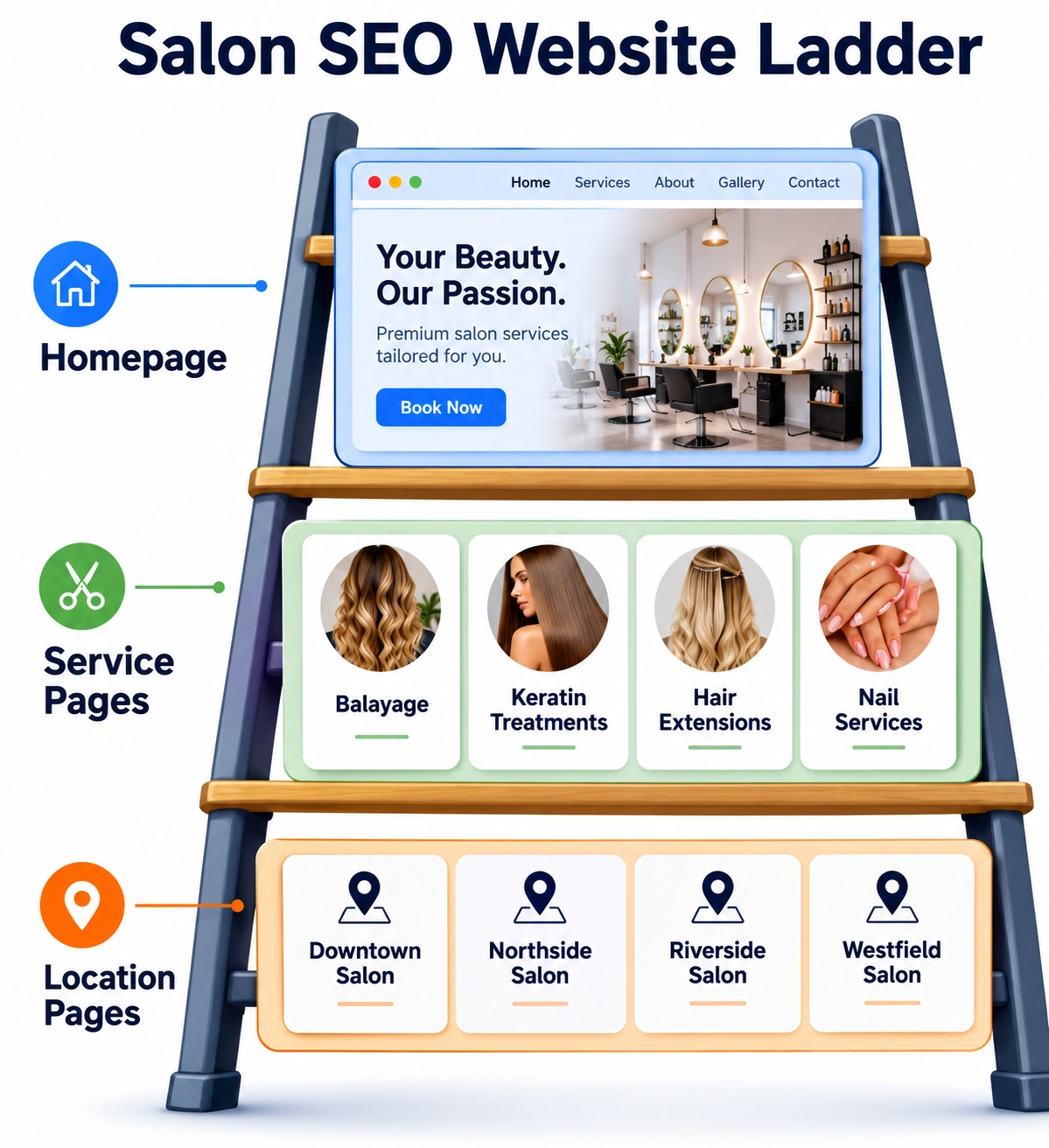
A three-tier Salon SEO website structure organizes the homepage, service pages, and location pages for stronger local search performance.
Replying to reviews and building your reputation
Using the mirror moment for review generation
The mirror moment is specific: it’s the instant a client looks in the mirror, loves their new look, and feels most excited and satisfied. That’s the highest-receptivity window you’ll get for a review request, and most salons let it pass without acting on it. Do not miss it.
Train your stylists to make the ask feel personal rather than routine. “If you have a second, a Google review would mean a lot: it really helps people find us” lands differently than a laminated sign at the checkout counter asking for five stars. The verbal request during that peak emotional moment converts at a higher rate than any automated follow-up sent hours later: though both have a role.
Simplify the mechanics. QR codes placed at styling stations and the reception desk eliminate the friction of searching for your business manually. Automated SMS follow-ups sent within two hours of the appointment, with a direct link to your review page, capture clients who intended to leave a review but got distracted. The combination of an in-person ask and a timely digital reminder is more effective than either alone.
Want to see where your salon stands online right now?
Get a clear picture of your digital footprint with our detailed local SEO audit. Let us show you here’s what works and why, so you can start showing up when people search for salons near them. Learn more about our local SEO services and start growing your business today.
Responding professionally to reviews
Replying to reviews is a trust signal for Google’s algorithm and for every potential client who reads your profile before booking. Think of it as having a conversation with a customer who just complimented your work. Profiles that respond consistently signal an engaged, professionally managed business.
For five-star reviews, keep your response warm and specific, and incorporate a local keyword naturally: “Thank you so much: we love being your go-to hair salon in [City]!” For negative reviews, the approach is different. Acknowledge the frustration briefly, keep your response calm and concise, and move the resolution offline immediately by offering a direct phone number or email. Never argue in a public reply. Potential clients reading that exchange aren’t evaluating who was right: they’re evaluating how you handle conflict.
The compounding effect of a systematic review strategy is measurable. A recent case study documented a beauty salon growing organic traffic from 450 to 3,200 monthly visitors over six months through consistent review generation, yielding a 3.1x return on investment. Reviews aren’t just a reputation asset; they’re a direct organic search driver.
- Ask During the Mirror Moment: Train stylists to request reviews when the client is at their peak level of satisfaction.
- Deploy Checkout QR Codes: Place scannable QR codes at the reception desk linking directly to your Google review form.
- Automate Post-Appointment SMS: Send a friendly text within two hours of the appointment with a direct review link.
- Reply to Every Review: Acknowledge all feedback within 24 to 48 hours to signal professional engagement.
- Incentivize Stylists, Not Clients: Run internal team contests for the most reviews mentioned by a stylist by name: not discount offers to clients, which violates Google’s terms of service.
Free Resource: The Ultimate 15-Minute Salon Local SEO Checklist
Don’t let technical jargon stand between you and a full appointment book. We’ve compiled a simple, step-by-step checklist designed specifically for busy salon owners. It takes just 15 minutes to audit your profile, check your local keywords, and ensure your business directory mentions are perfectly aligned.
See the local SEO checklist to start optimizing your storefront today!
Local link building and community partnerships
Sponsoring local events and cross-promoting with neighbors
Backlinks from local sources carry a different weight than generic directory links. When a neighborhood charity, a community festival website, or a local .org links to your salon, Google interprets that as a signal of genuine community connection: something a national chain or a competitor who only operates online can’t easily replicate.
Sponsoring local events is one of the most direct paths to earning these links. It is highly effective. Youth sports teams, charity fundraisers, neighborhood festivals: most of these organizations list their sponsors on a dedicated page, and that listing typically includes a link. The investment is often modest relative to the SEO value, and the community visibility compounds the digital benefit.
Adjacent business partnerships work on a similar logic. Bridal boutiques, wedding photographers, fitness studios, and med spas serve overlapping client bases without competing directly with your services. A cross-promotional arrangement, a joint blog post, a shared event, a mutual referral page: generates a backlink while also putting your salon in front of a warm, pre-qualified audience. Another recent case study for First & Park Beauty demonstrated that a focused localized link-building effort achieved first-page rankings within three months, producing a 400% increase in leads.
Partnering with local lifestyle and beauty bloggers
Local lifestyle and beauty bloggers occupy a specific niche that national publications can’t fill: they have genuine credibility with your exact geographic audience. Identifying two or three active bloggers in your city who cover fashion, wellness, or beauty, and offering a complimentary treatment in exchange for an honest review and a backlink, is a low-cost acquisition strategy with a long shelf life.
The same logic applies to local press. A charity cut-a-thon, a grand opening, a stylist certification milestone: these are legitimate story angles for neighborhood news sites and local lifestyle publications. A single feature in a well-read local outlet can generate both a high-authority backlink and a surge of direct referral traffic that your analytics will track for months.
Building local backlinks is about building real-world relationships and translating them into digital authority. Focus on relationships. When Google sees other respected local businesses and community organizations linking to your website, it treats your salon as an essential, trusted fixture in the neighborhood. That kind of prominence is structurally difficult for national competitors to manufacture, which makes it one of the most defensible advantages a local salon can build.
Tracking and measuring your local SEO success
Monitoring Google Business Profile performance metrics
Your Google Business Profile dashboard surfaces the performance data most directly relevant to a salon: phone calls initiated from your listing, direction requests, and direct website clicks. These aren’t vanity metrics: they’re the actions that precede a booking, and tracking them week over week tells you whether your optimization work is translating into client activity. They show real progress.
The Search Queries report within your Google Business Profile dashboard is particularly helpful. It shows the exact terms people typed before your profile appeared, which often surfaces keyword opportunities you hadn’t considered targeting. A fully optimized profile can generate substantial activity: a Dwight Davis case study documented 551 total actions in a single 30-day period: 290 website visits, 166 phone calls, and 95 direction requests from a single well-maintained listing.
Tracking organic traffic and bookings
Google Search Console gives you visibility into your website’s organic performance: impressions, clicks, and average ranking positions for every query your site appears for. Set it up if you haven’t already, and check it monthly for ranking shifts on your core service keywords.
Google Analytics 4 closes the loop between search visibility and actual bookings. Configure a conversion event for clicks on your booking link, and you’ll know precisely how many website visitors are converting into scheduled appointments: not just how many are arriving. Attribution isn’t perfectly clean in digital marketing: it rarely is. Do not stress over it. Asking new clients “How did you find us?” at checkout validates your digital data with a direct human signal and often surfaces channels your tracking setup missed.
Local SEO is not a one-time setup. Rankings shift as competitors optimize, as Google updates its algorithm, and as your own profile ages. Monthly check-ins on your Google Business Profile metrics, Search Console data, and review velocity keep you ahead of those changes rather than reacting to them. For a deeper look at refining your campaigns over time, our SEO local search strategies resource covers how to interpret these signals and adjust your approach as your market evolves.
Frequently asked questions
What is the most important local SEO ranking factor for beauty salons?
Selecting the correct primary category on your Google Business Profile is the single most influential factor for ranking in the Local 3-Pack. Google relies heavily on this category to determine the relevance of your business to a user’s search query. Ensure your primary category matches your core revenue driver: “Hair Salon” or “Beauty Salon”: and use secondary categories to capture your other specialty services.
How long does it take to see results from salon local SEO?
Results vary, but the general pattern holds: some salons see initial ranking improvements and increased phone calls within 30 to 90 days. Achieving dominant local visibility and a consistent stream of organic bookings typically requires six months of sustained optimization, citation building, and review generation. The XSquareSEO case study documented the full transition to 3,200 monthly visitors playing out over exactly that window.
Should I include keywords in my Google Business Profile name?
Google’s guidelines are clear: your profile name must match your real-world business name. Keyword-stuffed names: “Best Balayage Salon Miami” appended to your actual name: occasionally produce short-term ranking lifts, but the risk of profile suspension is real and the recovery process is slow. Building long-term, stable authority on your legal business name is the more defensible path.
How do I handle negative reviews on Google?
Respond promptly, professionally, and briefly. Acknowledge the client’s frustration, keep your reply calm, and offer to resolve the issue offline by providing a direct phone number or email address. Never argue in a public reply: prospective clients reading that exchange are evaluating your customer service, not adjudicating who was right.
Do I need a website if I have a Google Business Profile?
Yes. Your Google Business Profile functions as your digital storefront, but your website is your digital brochure and booking hub. A well-optimized website with dedicated service pages and schema markup reinforces your local search signals, helping you rank higher in both organic search results and Google Maps, which ultimately drives more high-value bookings directly to your calendar. One without the other leaves meaningful visibility on the table.
What to do next
Earning your neighborhood’s trust starts with a single, optimized step. Plan for about 45 minutes to complete your Google Business Profile the first time: category selection, service descriptions, photos, and booking integration. After that, a monthly check takes roughly 10 minutes. It is highly manageable. By focusing regularly on these core local SEO pillars, you’ll build a steady stream of recurring client bookings and establish your salon as a recognized community hub. What to do next is audit your primary category against your top three local competitors and claim your digital storefront today.
Partner with BizIQ to Grow Your Salon
You focus on making your clients look and feel amazing; we’ll focus on getting them through your door. Our team of local search specialists has helped thousands of small businesses improve their visibility and secure more bookings. Let us help you implement a custom local SEO strategy that works. Contact us today for a free consultation!