Showing up online can feel like a completely different language when you are trying to run a beauty business. You know your products, your clients, and your community inside and out, but translating that passion into search engine visibility often feels like chasing a moving target. Many small business owners make the mistake of targeting broad, high-volume search terms like “moisturizer” or “hair salon.” Trying to rank for these terms is like trying to yell over a crowd at a stadium concert: the enterprise brands with massive budgets will always drown you out. The real opening lies in finding “golden keywords.” These are highly specific, lower-competition search terms used by consumers who are actively looking for exactly what you offer and are ready to make a decision. As a small business helping small business, we know that generic marketing advice does not fit your industry.
To capture these highly qualified leads, you must understand how to run structured beauty industry SEO and find low-competition keywords. According to a June 2026 industry report by GetEcommerceLeads, organic search accounts for 58.9% of total beauty e-commerce traffic, representing 39.6 million out of 67.3 million monthly visits. Meanwhile, paid search accounts for a mere 0.4% of traffic. That gap is not a coincidence. It reflects how beauty consumers shop. They research, compare, and seek out trusted voices before they ever reach for a credit card. By shifting your focus from vanity metrics to high-converting keyword targets, you can position your brand as the practical authority your audience returns to when they are ready to purchase or book.
Key Takeaways
- The Power of Intent: Shifting from high-volume, generic queries to problem-solving, long-tail terms is the key to vying against industry giants without a giant’s budget.
- Dual-Track Workflows: Keyword discovery frameworks differ meaningfully between e-commerce beauty brands and local brick-and-mortar salons: each demands its own execution path.
- AI-Era Optimization: Google’s AI Overviews are reshaping the search results page, which fundamentally alters how organic traffic flows to informational content. Structuring content for citation real estate is no longer optional. Intent dictates success.
- Practical Toolkits: Free and premium tools can map keywords directly to the beauty buyer’s journey, but only if you know which metrics to filter for and why.
Understanding Beauty Search Intent
Defining User Intent in the Beauty Space
User intent is the underlying reason someone types a query into a search engine. It sounds obvious, but most beauty businesses skip this step entirely: they build keyword lists around what they sell rather than what their customers are asking. That disconnect is where traffic goes to die, as users quickly bounce from pages that fail to answer their immediate questions.
In the context of beauty industry SEO, intent breaks into three distinct buckets, and each one demands a different type of content response. Informational queries, like “why is my skin dry” or “what does niacinamide do,” signal a user in research mode. They are not buying yet. Match their mindset. Commercial investigation queries, like “best serum for sensitive skin” or “top-rated balayage salons,” indicate someone actively comparing options, which means they are close. Transactional and local queries, such as “hydrating facial near me” or “book lash extensions Austin TX,” represent a user with their wallet essentially already open.
Targeting a transactional keyword with a blog post, or an informational keyword with a product page, wastes both the user’s time and your ranking potential. Understanding user intent for SEO prevents you from pouring resources into high-volume keywords that generate sessions but zero revenue. Think of keyword research as asking your best customers what they would type to find you, then making sure your website uses those words.
The Anatomy of a Golden Keyword
A golden keyword sits at the intersection of two forces: meaningful purchase intent and realistic keyword difficulty. Neither alone is enough. A term can carry enormous intent but be locked behind a wall of domain authority you cannot breach in the next 18 months. A term can be easy to rank for but attract users who are nowhere near a buying decision.
The contrast becomes concrete fast. “Skincare” pulls millions of monthly searches globally and is dominated by Sephora, Ulta, and Allure. “Organic face cream for sensitive skin” pulls a fraction of that volume, but the person typing it has already narrowed their inclinations to organic formulations, already identified their skin type as sensitive, and is now shopping. That specificity is the conversion signal.
High-value modifier terms are what create this specificity. Words like “cruelty-free,” “dermatologist-recommended,” “fragrance-free,” and “for acne-prone skin” act as filters that the consumer applies before they even click. When your page matches those filters precisely, you are not just ranking: you are answering the exact question they came to ask.
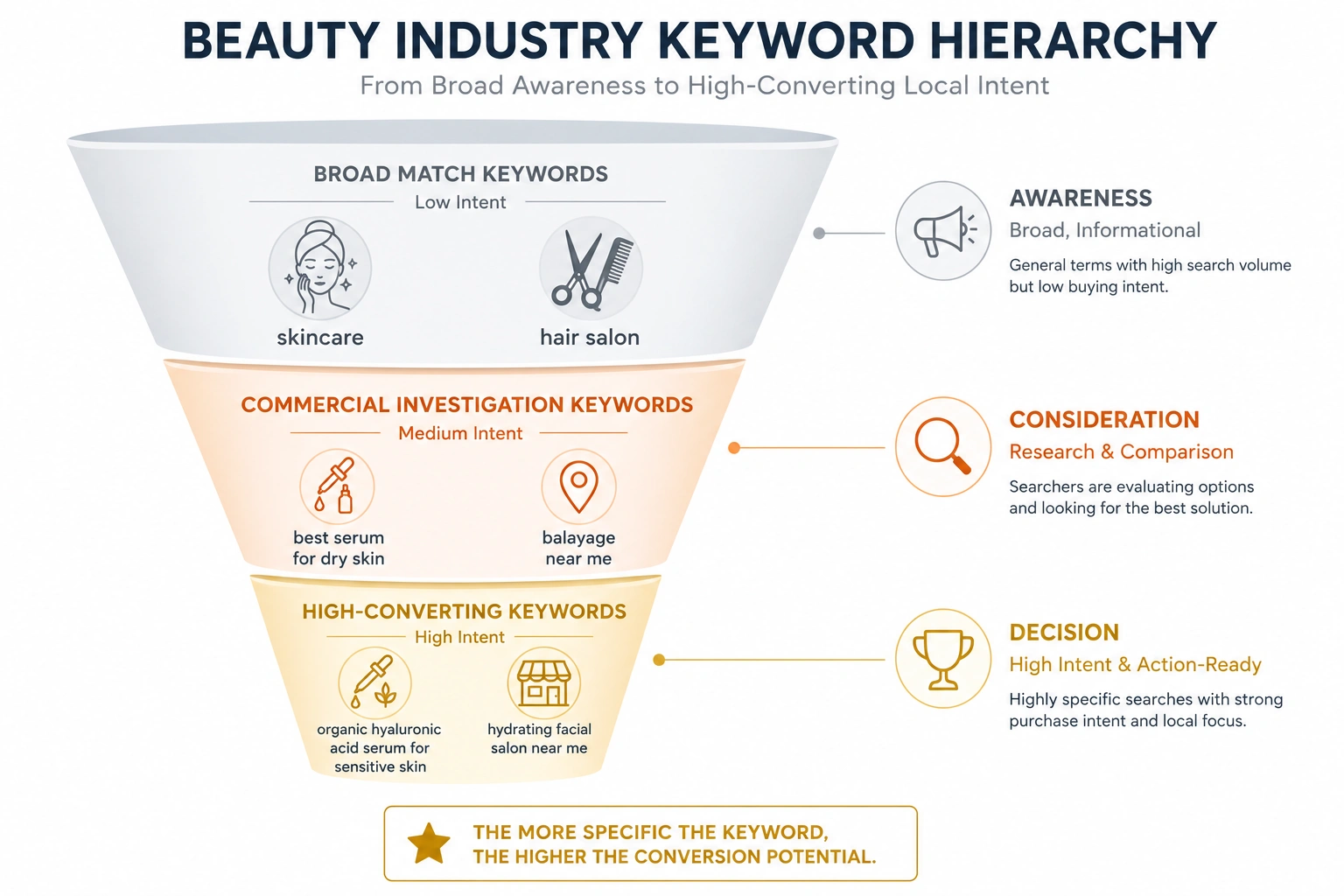
A keyword hierarchy funnel illustrates how beauty-related search terms progress from broad awareness to high-converting local intent.
The Core Framework for Beauty Keyword Research
Keyword research without a framework is just a list of words. The framework is what turns a spreadsheet into a content strategy. Here’s exactly how to build it:
Identify Seed Keywords. Start with your core product categories and work inward toward specificity. Active ingredients, such as “niacinamide,” “retinol,” or “salicylic acid,” are particularly powerful seed terms in beauty because they signal a consumer who has already done preliminary research. Pair those with the skin or hair concerns your products address: “hyperpigmentation,” “split ends,” “barrier damage.” These combinations become the raw material for everything downstream.
Determine Search Intent. Before you do anything with a seed keyword, categorize it. Informational queries belong on educational blog posts and ingredient explainers. Transactional queries belong on product collection pages, service booking pages, and local landing pages. Mixing these up: putting an informational keyword on a product page: confuses both the search engine and the user.
Apply High-Value Modifiers. Take your categorized seed keywords and append the modifiers that reflect how your actual customers filter their searches. “Vegan,” “fragrance-free,” “best salon in [city],” “for mature skin”: each modifier narrows the audience and raises the probability of conversion. This is where long-tail phrases are born.
Analyze Keyword Metrics. Use SEO tools to gauge monthly search volume and keyword difficulty (KD) for each candidate term. A KD score under 30 on a 1 to 100 scale, paired with consistent monthly search volume, marks the territory where smaller brands can realistically compete. Chasing a KD of 80 with a domain authority of 20 is not ambition: it is a resource drain.
Map to Content Assets. Every selected keyword gets assigned to a specific page on your website. One keyword cluster per page. This prevents cannibalization, where multiple pages compete against each other for the same term, and creates a coherent site architecture that search engines can crawl efficiently, which ultimately improves your overall search performance.
Step-by-Step Guide to Finding High-Intent Keywords
Uncover Your Seed Keywords
Start with the language your clients use, not the clinical or industry nomenclature you default to internally. A client does not search “dermatological pigmentation treatment.” They search “how to get rid of dark spots.” Keep it simple. Brainstorm your core services and product lines, then translate each one into the phrasing a non-expert would use when depicting the problem it solves, ensuring your content aligns with real search behavior.
Leverage Free Search Data
Google Autosuggest and the “People Also Ask” box are genuinely underrated research mechanisms. Both surfaces reflect real-time, aggregated user behavior: the exact phrasing real people employ when they are actively searching. Type your seed keyword into Google and document every autocomplete suggestion. These tools are free. Then expand the “People Also Ask” results and record those questions word-for-word, which gives you a direct look into the exact problems your target audience is trying to solve. This process costs nothing and surfaces intent signals that paid tools often miss because they rely on historical data rather than live query patterns.
Conduct a Competitor Gap Analysis
When you look at a competitor’s site, you are not looking for inspiration; you are looking for their blind spots. Identify three to five direct competitors, not Sephora or L’Oréal, but brands operating at an analogous scale in your niche or geography. Export their organic keyword rankings using a tool like Semrush or Ahrefs, then filter for terms where they appear on page one and your site does not appear at all. Pay particular attention to competitors whose content on those ranking pages is thin, stale, or generic. Look for weak spots. That is the gap you can fill with more specific, more current, and more useful content, allowing you to easily outrank them in search results. This direct comparison reveals exactly where your content can outshine theirs.
Filter by Search Volume and Difficulty
Once you have a raw list, apply your filters. Be patient. Target terms with a KD score under 30 and a monthly search volume that is steady rather than spiking: viral spikes often collapse as quickly as they appear. These low-difficulty, steady-volume terms are your near-term ranking opportunities, allowing you to build search momentum without competing against major industry giants. They will not make you famous overnight, but they will build compounding organic traffic that paid ads cannot mirror.
Group and Cluster Your Keywords
Grouping similar keywords into thematic clusters is what distinguishes a keyword list from a content strategy. “Retinol for beginners,” “how to apply retinol,” and “best starter retinol serum” all belong on the same page, or in the same tightly linked content cluster, because they serve the same user at the same stage of their journey. Clustering builds topical authority, which signals to search engines that your site is a detailed resource rather than a collection of disconnected pages. Focus on relevance.
Is your beauty brand struggling to show up where your clients are searching?
We are a small business ourselves, and we know that navigating search engines can feel overwhelming. Let us help you find what works for a business like yours. Schedule Your Free Beauty SEO Consultation Today
Analyzing Competitors in the Beauty Space
Finding Competitor Insights
Competitor scrutiny in SEO is not about copying what your rivals are doing. It is about identifying where they are weak and building something better in that space. A detailed keyword research and competitive scrutiny process starts with exporting your top competitors’ organic keyword rankings and filtering specifically for terms where they hold a page-one position but your site is absent. That absence is a map. Study their pages.
Once you have that list, the next question is what type of content is earning those rankings. A competitor ranking for “best vitamin C serum for hyperpigmentation” with a thin, 400-word product description is far more exposed than one ranking with a detailed, ingredient-backed editorial piece. The content type tells you what the search engine has decided satisfies that query: and whether you can satisfy it better.
Identifying the “Differentiation Window”
Beyond standard keyword gap analysis, there are nascent terrain shifts worth tracking. Audio SEO, optimizing for voice-to-text video transcripts, is one area most beauty brands have not touched. As consumers increasingly search via voice on mobile devices, the phrasing of queries shifts toward full sentences and conversational questions. Brands that structure their content around those patterns now will have a structural advantage as the behavior scales. Voice search is growing.
Competitor content audits also reveal weak engagement points that are invisible in a keyword report. Static pages with no interactive elements, ingredient explainers that list facts without addressing the user’s specific concern, service pages that describe treatments without answering “is this right for me”: these are the gaps that a well-structured, intent-matched page can capitalize on. The New Image by Hilary case study illustrates exactly this dynamic: a real beauty brand that carved out measurable search market share by targeting the specific questions competitors were neglecting and answering them with precision.
“In the highly competitive beauty market, trying to compete on broad terms is a losing battle for smaller brands. The businesses that succeed are those that look closely at competitor analysis, find the specific questions their competitors are neglecting, and answer them with absolute clarity.”
Targeting Long-Tail Keywords for E-commerce
The Power of Long-Tail Terms for Product Sales
Targeting long-tail beauty keywords for e-commerce is not a consolation prize for brands that cannot rank for head terms. They are a calculated strategy for capturing buyers who have already done their research and are now making a final decision. “Sulfate-free purple shampoo for blonde hair” is not a niche curiosity: it is a buyer describing exactly what they want. The person searching that phrase is not browsing. They are purchasing.
The conversion math supports this consistently. Highly targeted e-commerce landing pages built around specific long-tail terms outperform generic category pages on conversion rate, not because they get more traffic, but because the traffic they attract is pre-qualified. The user’s query and your page’s content are in precise congruence, which removes friction from the purchase decision.
Integrating these terms into your product pages requires more than dropping a phrase into a title tag. For practical beauty product ranking tips, the keyword needs to appear naturally in the H1, the product description, the meta title, and the image alt text: each instance serving the user’s understanding of the product, not just the search engine’s indexing process.
Structuring Ingredient and Concern-Based Content
Ingredient-led and concern-specific content is where beauty brands build the kind of topical authority that accrues over time. A page built around “hyaluronic acid for dehydrated skin” does not just rank for that term: it becomes the foundation for a cluster of related queries, such as “how to layer hyaluronic acid,” “best hyaluronic acid concentration for dry skin,” or “hyaluronic acid vs. glycerin.” Each spoke in that cluster reinforces the hub’s authority. Build topical authority.
Structuring these pages to satisfy both the search engine’s web query evaluation and the human reader’s need for clarity means using descriptive H2 and H3 headings, bulleted ingredient breakdowns, and clear “who this is for” framing early in the page. Skin concern pages, such as rosacea, barrier repair, or post-acne scarring, follow the same architecture but lead with the problem rather than the ingredient, because the user’s entry point is their grievance, not their formulation knowledge.
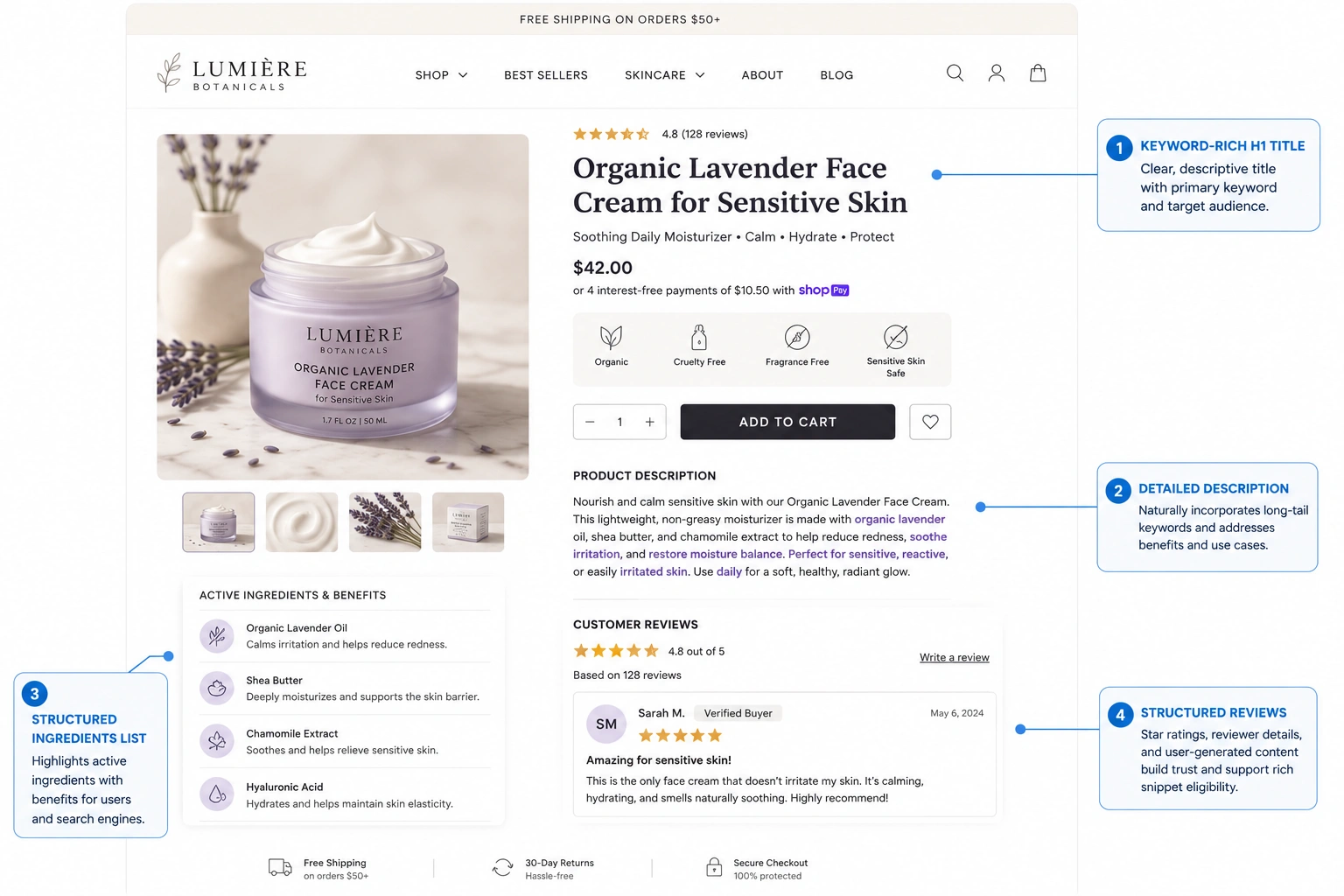
An optimized beauty product page demonstrates SEO best practices with targeted keywords, structured content, and customer reviews.
Tools of the Trade: Semrush, Ahrefs, and Free Tools
Google Search Console is the most neglected instrument in most beauty brands’ toolkits. As a free keyword research tool, it surfaces “near-miss” keywords. These are terms your site already ranks for on pages two or three that are close enough to page one that a targeted optimization push can move them. These are not hypothetical opportunities. They are confirmed signals that your content is relevant; it just needs refinement.
Semrush earns its subscription cost primarily through competitive intelligence. Its keyword gap tool allows you to stack your domain against three to five competitors simultaneously and surface the terms they collectively rank for that you are missing. For beauty brands, this is where ingredient-specific and concern-specific keyword opportunities tend to cluster: terms that are specific enough that competitors have addressed them once, without the depth that would make them difficult to displace.
Ahrefs is the more precise instrument for backlink analysis and keyword difficulty assessment. When you are evaluating whether a specific long-tail term is genuinely attainable, Ahrefs’ KD scoring and the “top pages” breakdown for that keyword give you a clearer picture of what it would take to rank. It is also the tool that reported AI Overviews reducing the average click-through rate of the top organic result by up to 58%: a data point worth sitting with before you build an entire content strategy around informational queries.
Google Trends fills a gap that static keyword tools cannot: cyclicality. Using Google Trends for keyword trends reveals when specific beauty terms spike, such as “sweat-proof makeup” in June and July, or “barrier repair cream” in November and December, so you can publish optimized content before the demand peak rather than chasing it after the fact. Timing matters more than most brands realize.
AnswerThePublic maps the question ecosystem around any seed keyword. For a term like “retinol,” it generates the full universe of “how,” “what,” “when,” “why,” and “which” questions that real users are asking. These question clusters are the raw material for semantic keywords strategies: building content that covers a topic with enough depth and breadth that search engines recognize it as a genuine authority resource rather than a single-query page.
Ready to turn search traffic into loyal customers?
Discover how our team of experts can help you implement a tailored cosmetic industry seo strategy that drives real, measurable results for your online store.
Mapping Keywords to the Beauty Buyer’s Journey
The Hub-and-Spoke Content Model
The hub-and-spoke model, sometimes called pillar-and-cluster, is the structural answer to a problem that most beauty brands run into once they have a keyword list: too many targets, no clear architecture. A broad “pillar” page covers a core topic thoroughly (e.g., “The Complete Guide to Skincare for Sensitive Skin”), while a network of tightly linked “spoke” blog posts targets the specific long-tail queries that branch off that topic (e.g., “best fragrance-free moisturizers for sensitive skin,” “how to patch test a new skincare product,” “sensitive skin vs. reactive skin: what’s the difference”).
This SEO content strategy planning approach does two things simultaneously. Structure drives rankings. It disperses page authority from the pillar to the spokes through internal linking, and it signals to search engines that your site covers a topic with genuine depth rather than surface-level breadth. A site with one strong pillar page and eight well-linked spokes will outrank a site with eight disconnected blog posts targeting similar terms, because the architecture itself signals authority.
Guiding the Reader from Research to Purchase
The shift from informational content to transactional action is where most beauty brands leave revenue on the table. A reader who lands on your “how to treat hyperpigmentation” blog post is not ready to be sold to in the first paragraph, but by the time they have read through your ingredient breakdown and treatment recommendations, they are primed for a logical next step. That next step needs to be framed as a continuation of their research, not a disruption of it.
Soft, value-first CTAs do this well: “See our editor-tested vitamin C serums for hyperpigmentation” or “Book a skin consultation to find the right treatment for your concern.” These prompts do not feel like ads because they are not: they are the natural next move for someone who just spent five minutes reading your content and trusts what you said. That trust is the conversion asset. The CTA is just the door.
Common Pitfalls in Beauty SEO
Navigating the Pitfalls of Modern Search
Vanity metrics are the most enduring trap in beauty SEO. A keyword with 50,000 monthly searches looks compelling in a spreadsheet, but if the keyword difficulty is 85 and the top ten results are all major publications with decade-old domain authority, that number is essentially decorative. The brands that waste the most time in SEO are the ones optimizing for rankings they cannot realistically achieve in any near-term window.
The more structurally significant challenge right now is Google’s AI Overviews. According to Ahrefs, the emergence of an AI Overview can reduce the average click-through rate of the top organic result by up to 58%. For beauty brands that have built their content strategy almost entirely around informational queries, such as “what does retinol do” or “how to build a skincare routine,” this is not a minor headwind: it is a fundamental shift in how that traffic flows.
There are two concrete responses. First, optimize for AI citation rather than fighting it: structure your content with clear, direct answers in the first paragraph, use bulleted lists for step-by-step processes, and implement schema markup so search engines can parse your content accurately. Being cited inside an AI Overview still drives highly targeted traffic: arguably more targeted than a standard organic click, because the user has already been pre-qualified by the summary. Second, shift meaningful content investment toward transactional and local queries that AI cannot satisfy. A search engine cannot book a facial appointment or tell a user whether a specific shade of foundation matches their undertone. Those queries still require a click, and they convert at a higher rate than informational traffic anyway.
Keyword stuffing deserves a mention, not because it is a sophisticated mistake, but because it persists. Forcing a target phrase into every other sentence degrades the reading experience and triggers quality signals that work against your rankings. Write for the person first. The keyword density will follow naturally from writing about the topic with genuine depth.
Frequently Asked Questions
What are the best skincare keywords for SEO?
The best skincare keywords for seo are highly specific, long-tail terms that merge a user’s skin concern or preferred ingredient with high-intent modifiers. Instead of targeting broad terms like “face cream,” focus on terms like “best organic moisturizer for adult acne” or “hyaluronic acid serum for sensitive skin.” Specificity wins. These terms carry lower search volume but attract highly qualified leads who are ready to buy: and they are far more viable for brands that are not competing with Sephora’s domain authority.
How do I find low-competition makeup search terms?
Filter for low-competition makeup search terms by looking for a Keyword Difficulty score under 30 using tools like Semrush or Ahrefs. Focus on niche concerns, specific product traits, or application techniques. Target niche topics. “How to apply cream blush on mature skin” or “non-comedogenic liquid foundation for oily skin” are the kinds of terms where a well-structured product page or tutorial can rank without a massive backlink footprint behind it.
Why is local SEO important for beauty salons?
A local salon owner without local search visibility is practically invisible to the neighborhood. Over 80% of beauty salon searches transpire on mobile devices, and “near me” searches for beauty and wellness services have grown by more than 500% over the past five years. According to local SEO data from Web Tonic, organic search drives 35% to 55% of new client sessions for salons with optimized service pages. Local search drives bookings. Think of local visibility as making sure your salon’s sign is visible from the main road: except instead of drivers, it’s customers searching on their phones. Your Google Business Profile is like your salon’s facade window: if the hours are wrong, the photos are blurry, or the reviews are ignored, people will walk past and choose a competitor instead. Your profile is your digital facade.
How long does it take to rank for beauty keywords?
Generally, three to six months of consistent optimization and content creation is the realistic window for seeing meaningful traction in organic rankings. There is no clean shortcut here. SEO takes time. The timeline depends on your domain’s existing authority, the competitiveness of your target terms, and the consistency of your publishing tempo, meaning a disciplined approach is required for long-term success. What organic SEO offers that paid ads do not is compounding value: a well-ranked page continues driving traffic long after the work to create it is done.
Should I target branded or non-branded keywords?
If you are an established brand, safeguarding and optimizing your branded terms is non-negotiable. For new or growing businesses, the priority should be non-branded, high-intent keywords: terms that capture searchers who are actively looking for solutions but are not yet aware of your brand. That is how you build brand awareness through search rather than just reinforcing it with people who already know your name.
Building a strong online presence does not require an enterprise-level budget or a massive marketing team. By shifting your focus to high-intent, low-competition keywords, you can methodically improve your search visibility, capture highly qualified leads, and drive measurable growth: whether you are filling a salon’s booking calendar or scaling an online beauty store’s product sales. The key is speaking the exact language your clients use when they are looking for help. Start small.
Start with your Google Search Console account today. Find the keywords your site already ranks for on pages two or three, apply high-intent modifiers to those pages, structure your content to answer your clients’ most pressing questions, and make sure your local profiles are fully updated and consistent. If you want a partner to stand beside you and help map out a clear, step-by-step strategy that works for a business like yours, we are here to help you drive your community forward.
Ready to discover your brand’s golden keywords?
Let us do the heavy lifting. Contact our team today for a free, personalized search visibility audit and discover exactly how to get more local clients finding you online.