Choosing a franchise marketing agency is one of the biggest growth decisions a franchisor makes, because the right partner has to balance national brand authority with hyper-local customer acquisition. A specialized agency manages campaigns across every location, supports new franchise sales, and proves results to corporate leaders and individual owners alike, which a standard firm built for single-location businesses is rarely equipped to do.
- Two jobs at once: Franchise agencies attract customers to local storefronts and also help corporate teams sell new territories to qualified owners.
- Built for scale: Bulk listing management, geo-targeted ads, and approved content libraries keep hundreds of locations accurate and on brand.
- Smart selection: Multi-location case studies, enterprise tools, and franchisee-level reporting separate specialists from generalists.
- Provable ROI: Calls, forms, and store visits should be tracked back to the specific location that earned them.
At BizIQ, we see the same pattern across multi-location brands: the networks that grow fastest treat marketing as a system, not a collection of one-off campaigns. From 12 locations to 1,200, the agency you choose determines whether that system helps every owner or only the corporate office.
What a Franchise Marketing Agency Does for a Multi-Location Network
A franchise marketing agency works on two fronts that need very different tactics. The first is consumer demand: getting people in each market to find, trust, and visit the nearest location. The second is franchise development: attracting prospective owners to marketing built for franchise networks so the brand can expand into new territories.
Most general agencies are comfortable with only one of those jobs. A specialist builds the technical infrastructure for both without letting one budget cannibalize the other, and keeps every channel inside brand guidelines so customers see one consistent company.
Consumer Demand and Franchise Development: Two Different Jobs
Consumer campaigns are measured in calls, direction requests, bookings, and store visits within a defined trade area. Franchise development campaigns are measured in qualified inquiries from investors who will spend weeks researching the brand before they talk to anyone. The messaging, the channels, and the follow-up process are all different.
A capable partner separates the two in reporting while sharing brand assets between them. That way, a strong local reputation supports sales to new owners, and a healthy pipeline of new owners is not funded by cutting local advertising.
Local Empowerment vs. National Brand Control
Franchisors often struggle to give owners marketing freedom without risking brand integrity. The usual solution is centralized platforms with localized execution: corporate approves the templates, offers, and creative, and each owner adds community details such as events, team photos, and neighborhood names.
This hybrid approach keeps messaging relevant in each market and prevents off-brand advertising. It also helps owners feel supported, which matters because they are the ones paying the marketing fees that fund the work.
Why Standard Agencies Struggle With Franchise Digital Marketing

Many franchisors hire a traditional agency and expect it to scale. Those firms usually design campaigns for a single storefront or a national online brand, so they lack the process to manage hundreds of local ad budgets, listings, and territories at once.
The result is often a broad national campaign that overlooks struggling regions and frustrates owners who expect visible returns in their own territory. Search visibility also works differently across a network, which is why how franchise SEO works is a very different discipline from optimizing one local business.
| Area | Standard Agency | Franchise-Focused Agency |
|---|---|---|
| Budgets | One national campaign | Location-level budgets with shared brand rules |
| Territories | Overlapping keywords and audiences | Mapped digital territories per location |
| Local listings | Manual, one at a time | Managed in bulk with data kept consistent |
| Reporting | National impressions and clicks | Results by location for owners and corporate |
| Growth goals | Customer acquisition only | Customer acquisition plus franchise development |
Watch for this warning sign: any agency that insists on running all paid media from a single national budget. Owners need geo-targeted campaigns that send customers to their own location, and without territory rules, a network can end up bidding against its own franchisees for the same searches and driving up costs for everyone.
Core Strategies Used by a Top Franchise Marketing Agency

Running campaigns across a distributed network takes repeatable frameworks rather than heroic effort. The best agencies automate what can be automated, standardize reporting, and build a launch process that can put a new location’s marketing into motion quickly, so new owners reach profitability sooner.
Multi-Location Local SEO for Franchises
Ranking one location takes effort. Ranking five hundred takes systems. Google says local results are based mainly on relevance, distance, and prominence, and it does not allow businesses to pay for a better local ranking. That makes accurate profiles, strong location content, and a steady flow of reviews the foundation of every franchise program.
Professional local SEO services turn that foundation into a process: unique location content for each market, correctly categorized Google Business Profiles, and consistent business information across the directories customers use.
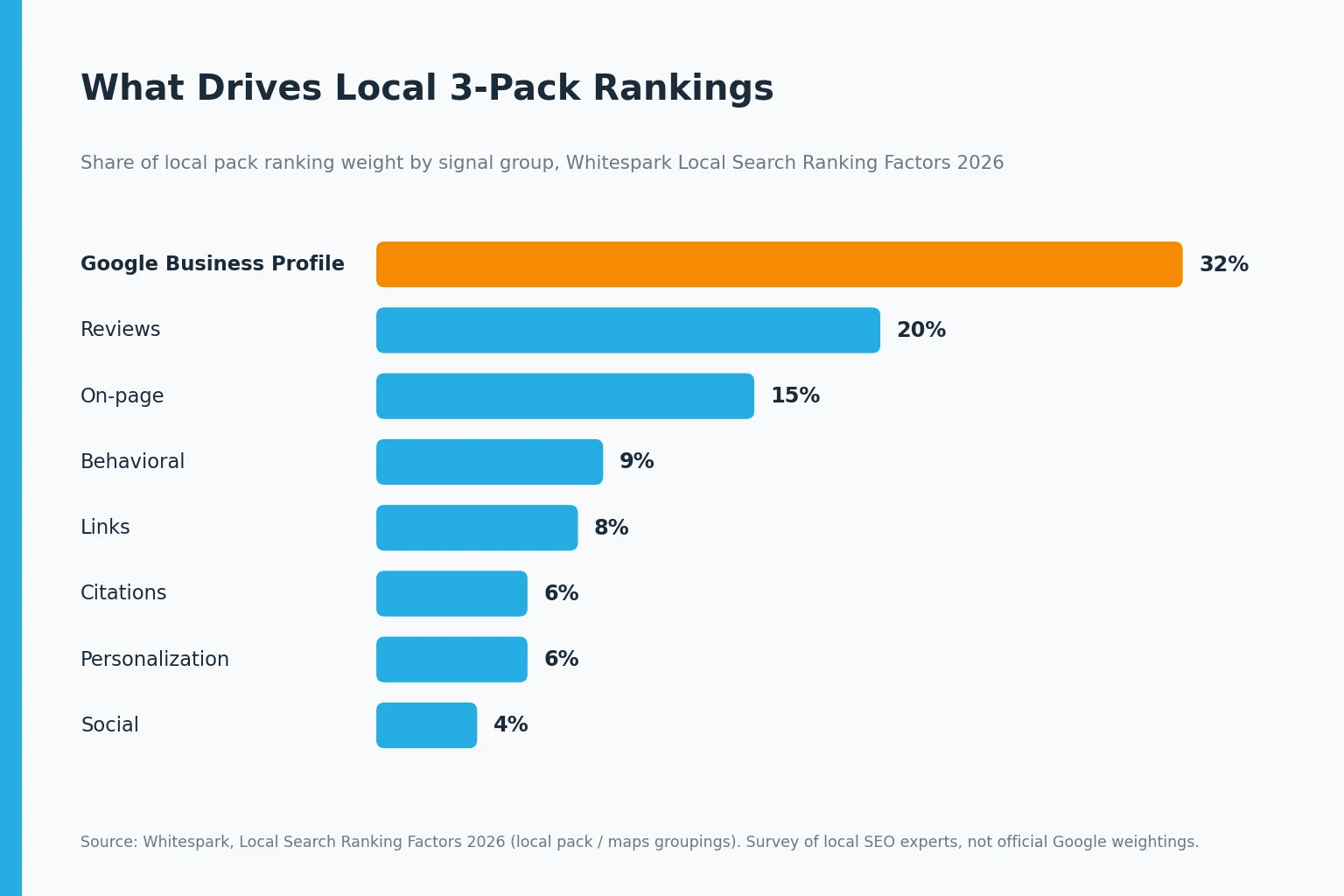
Accurate listings are the part that most often breaks at scale. A dedicated citation management process pushes correct names, addresses, phone numbers, and hours to major directories and cleans up duplicates that confuse customers and search engines.
Reviews and Reputation at Every Location
Reviews influence both rankings and decisions. BrightLocal’s 2026 consumer survey found that 97% of consumers read reviews when evaluating local businesses, and after reading positive reviews, 54% go on to visit the business website. For a franchise, that means every location’s review profile is part of the brand’s sales funnel.
An agency with real multi-location experience builds a review program that makes asking easy for each team, alerts owners to new feedback, and supports consistent responses. Our review management work follows that approach so no location is left unmonitored.
Scalable Paid Advertising and Franchise Lead Generation
Paid search and social ads need careful structure for a distributed network. Agencies build master campaigns with location-specific ad groups, geographic targeting around each trade area, and budgets that can move toward the locations converting best. Tracking conversions down to the individual storefront is what proves the value of marketing fees to owners.
For franchise development, the same discipline applies to a different audience. Investor-focused campaigns should send qualified prospects into a follow-up process, and well-run paid search advertising can be a reliable source of those inquiries when it is geo-targeted to the markets the brand wants to enter.
Brand-Compliant Content for Multi-Location Marketing
Content for franchises has to balance corporate messaging with community relevance. Agencies set up approved templates for posts, offers, and seasonal promotions, then let owners add local details before publishing. Customers get a polished brand that still feels rooted in their neighborhood.
Strong content marketing also gives each location unique material to rank with, rather than copied text that looks identical from city to city.
How to Choose the Right Franchise Marketing Agency for Your Network
Selecting a partner for your whole network requires specific questions and some skepticism. You need a firm that understands royalty structures and franchise sales rules, and that can show a record of scaling brands across different regions and demographics. Look past the sales pitch and evaluate how the agency handles bulk data, approvals, and reporting.
Questions to Ask a Franchise Marketing Agency Before You Sign
Use these steps to compare finalists on the same criteria.
- Audit their multi-location experience. Ask for results from networks with 50 or more locations, and ask to speak with both a franchisor and an individual owner who works with them.
- Evaluate their technology. Ask which platforms manage listings, reviews, and social posting, and whether bulk updates happen without manual data entry.
- Review their reporting. Owners should see results for their own location, such as calls and form leads, not just national impressions.
- Check how they handle territories. Ask how they prevent your locations from competing against each other in paid search and local results.
- Confirm the contract terms. Flexible, month-to-month arrangements, like the month-to-month agreements we offer, lower the risk of a mismatch.
Proof matters more than promises. Ask to see client case studies that show how an agency improved visibility and leads across multiple locations, not just a single storefront.
Franchise Compliance Considerations for Marketing
Marketing a franchise opportunity is regulated. Under the FTC Franchise Rule, a prospect must receive the Franchise Disclosure Document at least 14 calendar days before signing a binding agreement or making any payment, and any financial performance claim must have a reasonable basis and appear in Item 19.
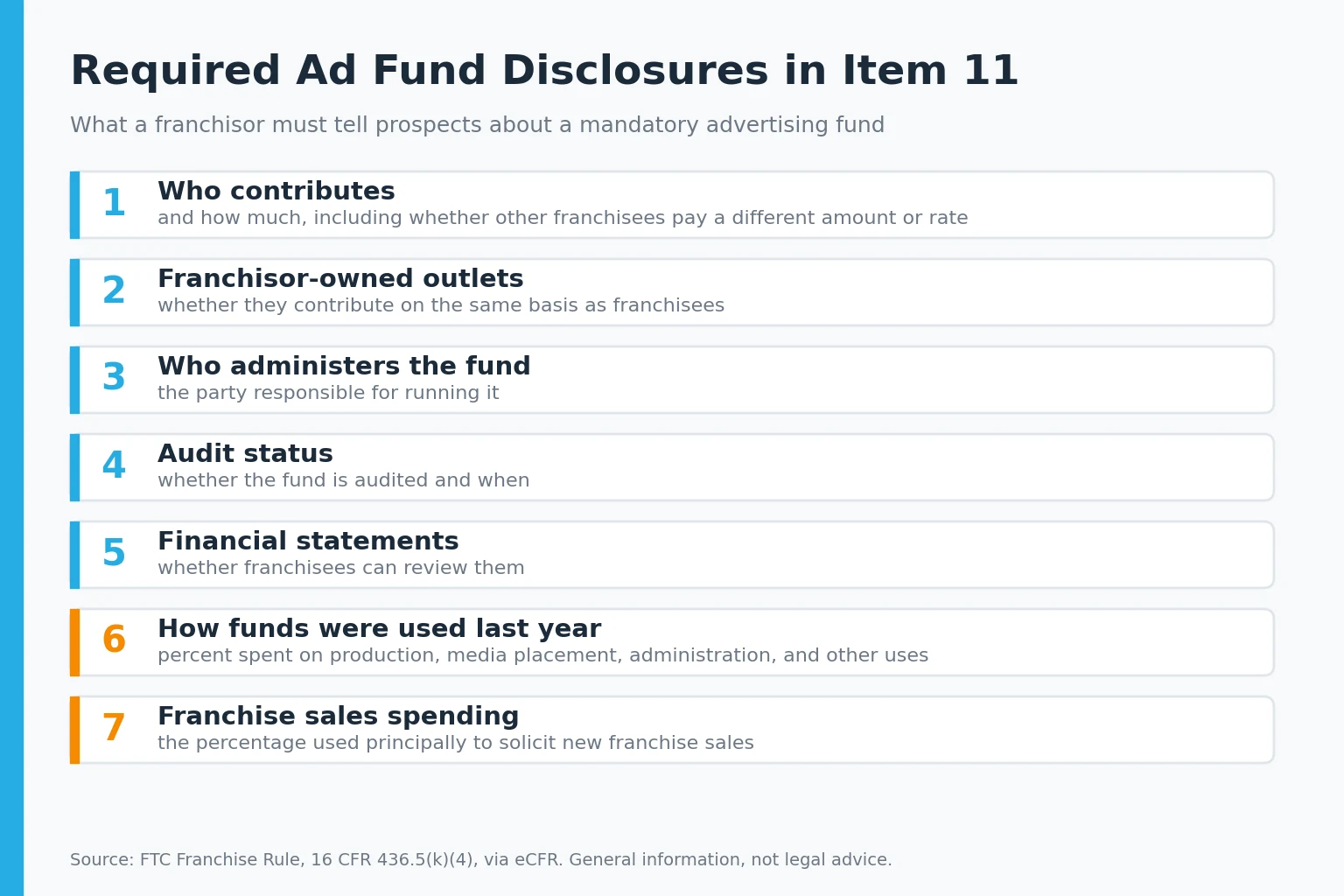
Advertising has its own disclosure. In Item 11, a franchisor with a mandatory advertising fund must explain who contributes, who administers the fund, whether it is audited, how the money was spent in the last fiscal year, and what share, if any, is used mainly to sell new franchises.
This is general information, not legal advice. Have franchise counsel review any advertising that mentions earnings, costs, or investment levels before it goes live, and make sure your agency knows those limits before it writes a single ad.
Measuring ROI and Franchise Marketing Services Performance
Proving the value of a franchise marketing agency takes clear attribution and transparent data. Corporate leaders need to see what the national fund produces. Individual owners need proof that their monthly marketing contributions bring customers through their doors.
Strong agencies solve this with closed-loop tracking that ties digital activity to real outcomes: call tracking, form submissions, direction requests, and, where possible, sales data from the point of sale. Each owner then sees which campaigns actually produce revenue in their territory.
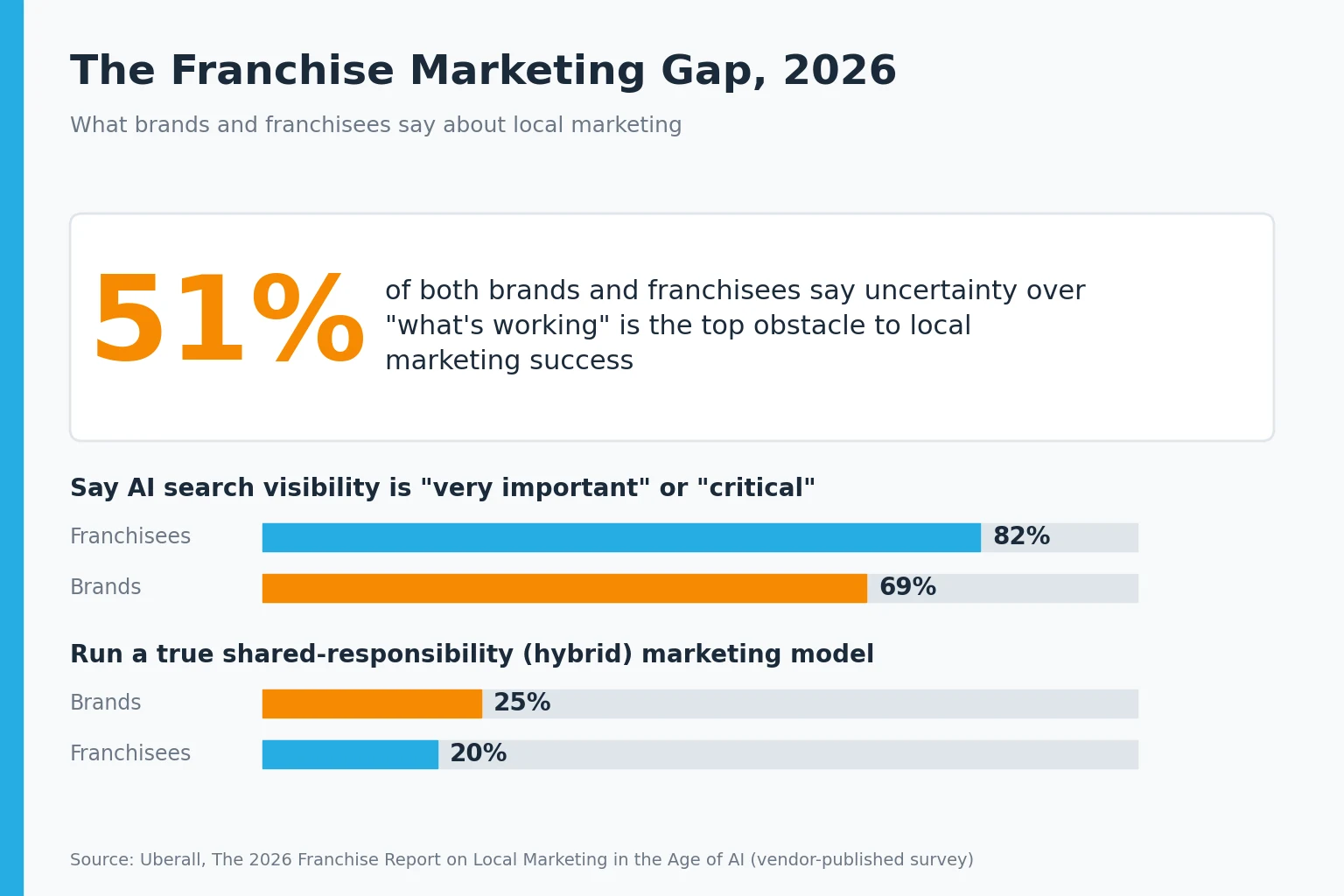
The need is real. In Uberall’s 2026 survey of franchise brands and franchisees, 51% of both groups named uncertainty over what is working as the top obstacle to local marketing success, and only 25% of brands and 20% of franchisees said they run a true shared-responsibility model. An agency that makes results visible by location closes that gap directly.
| Metric | What It Shows | Who Needs It |
|---|---|---|
| Phone calls and direction requests | Local intent turning into visits | Owners and corporate |
| Form and booking leads | Online demand by location | Owners |
| Local pack visibility | Presence for “near me” searches | Owners and corporate |
| Review volume and rating | Reputation strength by location | Owners |
| Cost per qualified franchise inquiry | Efficiency of development campaigns | Corporate |
Scale is part of why this reporting matters. The International Franchise Association’s 2026 Franchising Economic Outlook projects about 845,000 franchised establishments, up from 832,521 in 2025, and FRANdata figures cited there show multi-unit franchisees make up 19.3% of owners while controlling 58.8% of locations. With so many owners operating several units, location-level reporting is how a network keeps them confident in the marketing investment.
What a Franchise Marketing Agency Costs
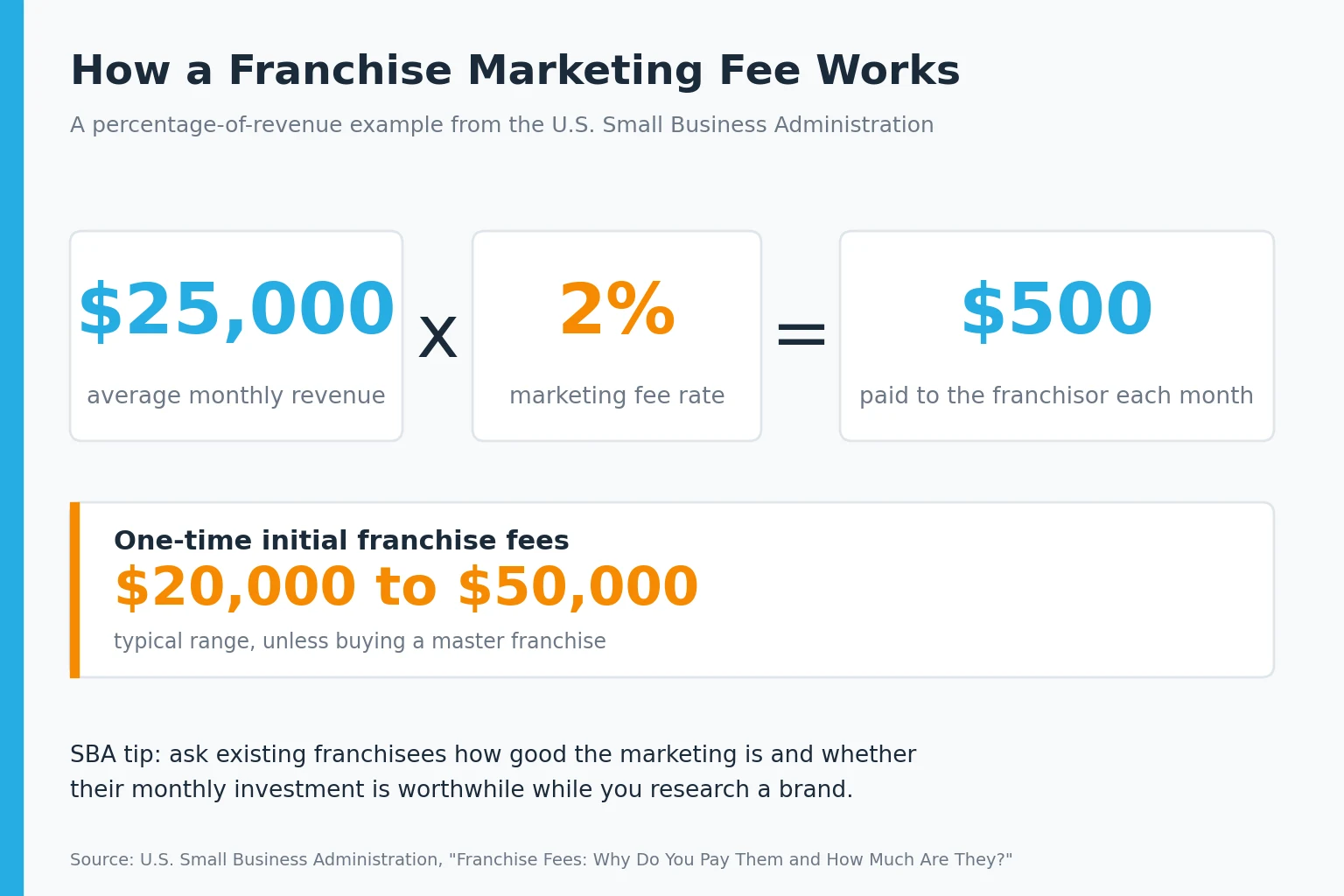
Franchise marketing is usually funded through a percentage of each location’s revenue. The U.S. Small Business Administration explains that marketing fees are typically a percentage of monthly revenue, for example 2% of $25,000 in monthly revenue is $500, and it advises prospective owners to ask existing franchisees whether the marketing is worth it.
Agency pricing depends on the number of locations, the channels involved, and the level of reporting. Packages that combine a website with local SEO support start at $399 per month, while organic SEO programs begin at $1,500 per month.
Networks that want to see how SEO investment is structured can review franchise SEO packages and pricing before they talk to any agency, so they know what a realistic scope looks like.
Brands with many storefronts have more variables to weigh, which is why multi-location SEO costs are scoped by the number of locations and your growth goals rather than a flat rate.
Franchise Marketing Agency FAQs
What is a franchise marketing agency?
A franchise marketing agency is a specialized firm that manages advertising, local SEO, and lead generation for multi-location businesses. It promotes the national brand while driving customers to individual franchise locations.
How much does a franchise marketing agency cost?
Cost depends on the number of locations, the channels used, and the reporting required. Franchise marketing is commonly funded by a percentage of location revenue, and BizIQ marketing packages start at $399 per month with organic SEO starting at $1,500 per month.
Do franchise agencies help sell new franchise locations?
Yes. Many franchise marketing agencies run development campaigns that target prospective owners and investors, helping the franchisor expand into new territories while staying within franchise advertising rules.
How do agencies manage local SEO for franchises?
They use bulk tools and repeatable processes to manage business profiles, listings, reviews, and unique location content. This keeps information accurate and prevents duplicate listings across hundreds of locations.
Why shouldn’t franchisors use a standard local marketing agency?
Standard agencies often lack the systems to manage many localized campaigns without internal competition. They also tend to report national totals instead of results each owner can see for their own location.
How do I measure a franchise marketing agency’s results?
Track calls, form leads, direction requests, local search visibility, and review growth by location, and ask for reporting that connects these actions to real customers wherever possible.
Conclusion: Scaling With the Right Franchise Marketing Agency
Scaling a distributed business takes more than a strong operating model and a recognizable logo. It takes marketing infrastructure that supports corporate expansion and local owners at the same time, with clear reporting that shows each location what its contribution produces.
Choose a partner with proven multi-location experience, ask the hard questions about technology and territories, and insist on results you can see by location. If you are ready to compare options, contact our team to talk through your network’s goals.

Scale Your Franchise With Multi-Location Marketing
Get a clear look at how your locations show up in search today and where the biggest opportunities are.