Local SEO for franchises gives every location in a network a way to be found by the people closest to it, while the national brand keeps its authority. When someone searches for a service nearby, Google weighs distance, relevance, and prominence, so each franchise location needs accurate profiles, useful local content, consistent listings, and a steady flow of reviews to earn its share of that traffic.
- Profiles: Accurate, verified Google Business Profiles with the right primary category are the starting point for map visibility.
- Location content: Each storefront needs its own useful, unique content on one authoritative corporate domain.
- Trust signals: Consistent citations and fresh reviews help customers and search engines believe your listings.
- Measurement: Calls, direction requests, and website clicks by location show what local SEO is really delivering.
Franchise networks face a particular challenge: hundreds of owners, one brand, and search results that are decided one neighborhood at a time. Getting every location to perform takes a repeatable system, and that is what BizIQ builds for multi-location brands.
How Local SEO for Franchises Sends Customers to Each Location
Google says local results are based mainly on relevance, distance, and prominence, and that businesses cannot pay for a better local ranking. For a franchise, that means every location competes with nearby businesses, and sometimes with a sister location a few miles away, so each one needs its own strong signals.
From a Nearby Search to a Store Visit
Local search follows a predictable path, and each step is a place where a location can win or lose a customer.
- A customer searches for a service near them, often on a phone.
- Google shows a map pack and local organic results based on relevance, distance, and prominence.
- The customer opens a Business Profile or a location listing on the corporate website.
- They call, request directions, send a message, or click through to the website.
- The location turns that action into a visit, a booking, or a sale.
Professional local SEO services work on every step in that path, not only the ranking at the top of it.
One Corporate Domain vs. Separate Franchisee Websites
When owners build their own websites, authority gets split across dozens of domains and brand standards become hard to enforce. A single corporate domain with a dedicated, useful destination for each location keeps ranking strength together. It also keeps the network inside Google’s search policies. The fundamentals of franchise SEO start with this structure.
Location Content That Earns Local Traffic

Every successful franchise search strategy begins with a clear site structure. Search engines need to understand how the national brand relates to each branch, and customers need a destination that answers their questions about the closest location. Careful on-site optimization makes that structure easy for both audiences to use.
What Every Location Needs
Each location’s content should be specific enough to help a real customer decide to visit. Include these elements for every storefront:
- The exact business name, street address, and local phone number
- Current hours, including holiday hours
- A description of the services offered at that specific location
- Photos of the storefront and team, and an introduction to the owner or manager
- Driving directions, parking details, and nearby landmarks
- The neighborhoods and cities the location serves
- An embedded map, a clear call button, and a contact form
- Local offers, community involvement, and customer reviews
Avoiding Thin and Duplicate Location Content
Swapping the city name on an identical template is the fastest way to produce weak local content. Google explains that very similar content is grouped and one version is shown, and that some duplication is normal rather than a spam violation. The practical risk is simple: when every location says the same thing, Google has little reason to show yours over a competitor’s.
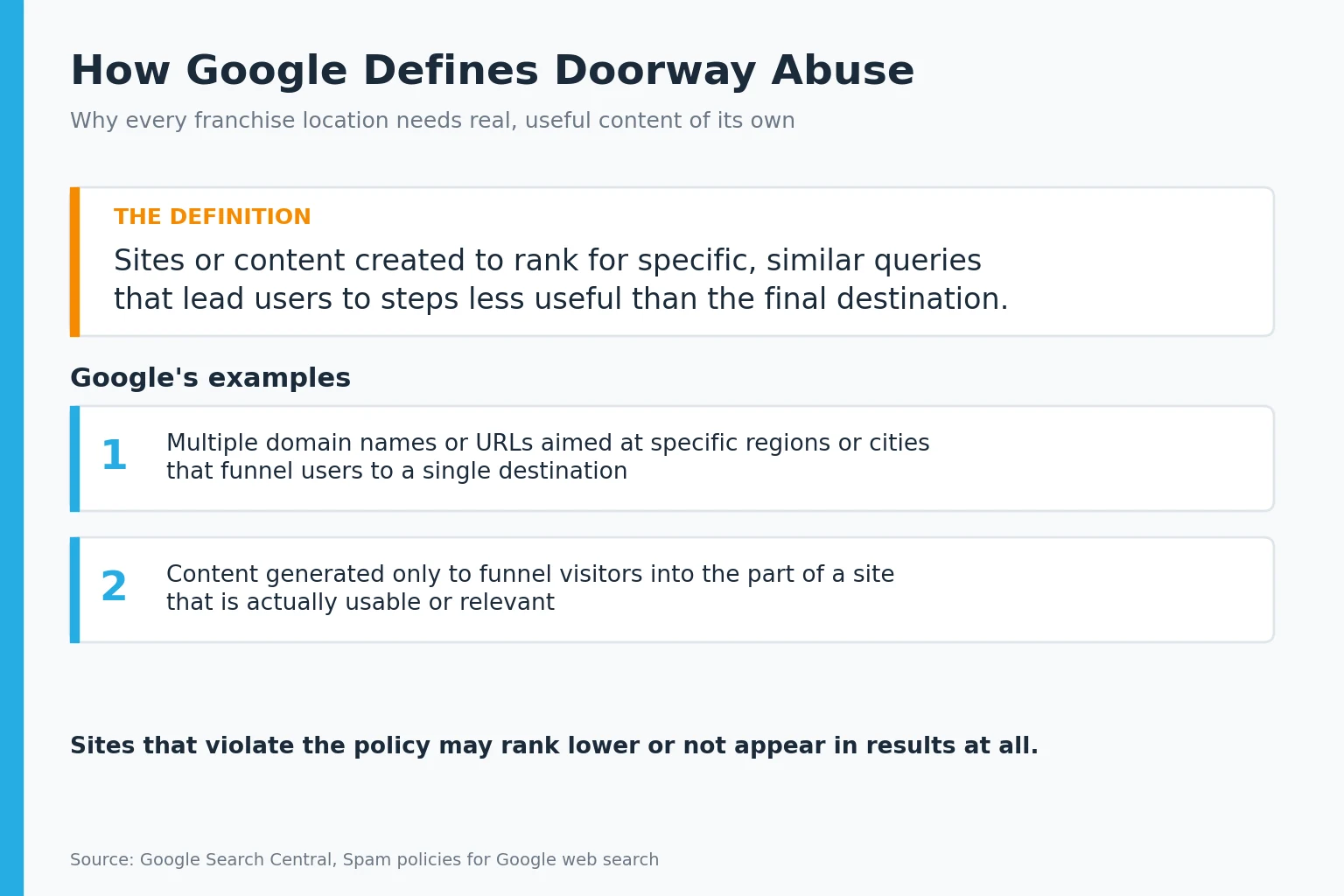
There is also a firm policy line. Google’s spam policies name multiple domain names or content targeted at specific regions or cities that funnel users to one destination as doorway abuse, and sites that violate the policy may rank lower or not appear at all.
The fix is to give every location real, distinct value: local staff, local services, local photos, and local proof. Content that helps a customer in that neighborhood is the opposite of a doorway.
Structured Data for Every Location
Structured data helps search engines read the facts that matter most for local results. Google recommends defining each business location as a LocalBusiness and using the most specific subtype available. Name and address are required, and telephone, a location-specific URL, coordinates, and opening hours are recommended.
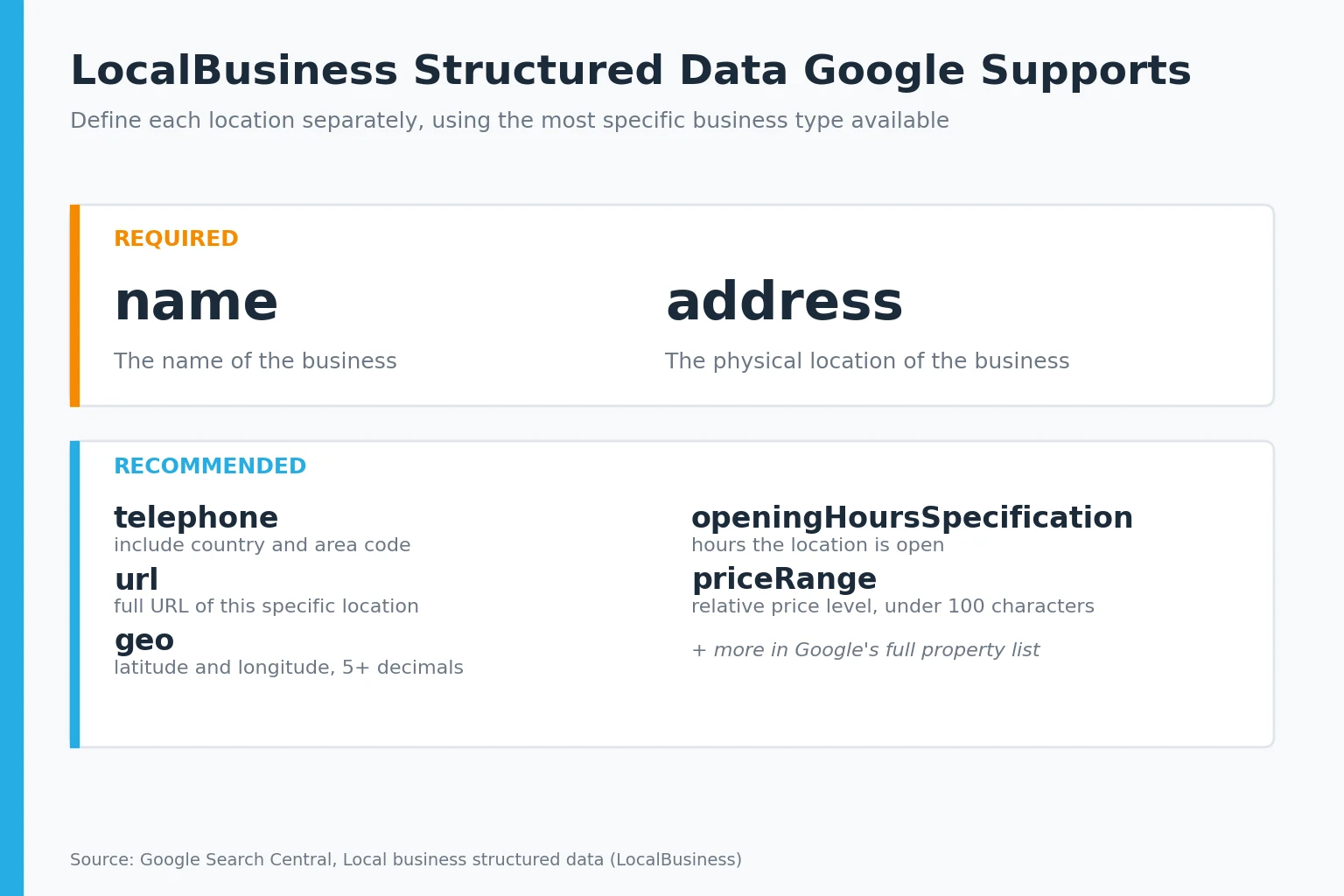
Make sure the markup matches what visitors see on the location content and in the Business Profile, because mismatched details create confusion rather than clarity.
Google Business Profile Management Across the Network
Google Business Profiles drive much of a location’s visibility in the map pack, and managing them one at a time stops being realistic as a network grows. A consistent standard, applied to every location, is what keeps quality high at scale.
Profile Standards That Support Local SEO for Franchises
In Whitespark’s 2026 expert survey, the primary Google Business Profile category ranked as the most influential individual local pack factor, and a wrong primary category was a leading negative signal. Whitespark’s survey reflects expert opinion rather than official Google weightings, but it shows where to look first.
Follow Google’s own representation guidelines as well. The business name should match real-world signage without added location descriptors, each profile should use a phone number that connects to that individual location whenever possible, and virtual offices and remote mailboxes are not eligible.
Our Google Business Profile setup and optimization process builds these standards in from the first day of a new location.
Bulk Verification and Access Control
Businesses with 10 or more profiles can request bulk verification. Duplicate, suspended, and disabled profiles do not count toward the 10, uploading a spreadsheet does not itself send a verification request, and each location should appear on the official website with matching details.
Control matters just as much as verification. Under Google’s access roles, owners can add and remove users and remove the profile, while managers can edit business information and respond to reviews. Corporate should hold the owner role and give franchisees only the access they need, rather than sharing passwords.
Citations and Reviews: Building Local Trust at Scale
Citation Consistency Across Directories
Citations are mentions of a business’s name, address, and phone number on other websites, such as directories, maps, and apps. When those details disagree with a location’s profile, customers get wrong information and search engines lose confidence in the data.
Data aggregators feed location information to many smaller directories, so correcting the source often cleans up several listings at once. A managed citation cleanup and management process also finds duplicates and mismatched phone numbers before they cost you customers.
Review Generation and Replies
BrightLocal’s 2026 survey found that 97% of consumers read reviews when evaluating local businesses, and that 54% visit the business website after reading positive reviews. It also found that 89% of consumers expect owners to respond to reviews, and 81% expect that response within a week.
Franchisees need an easy way to ask satisfied customers for reviews and a simple process for replying, including to negative feedback, in a calm and professional tone. A dedicated program for review generation and response keeps every location active without adding work to the owner’s day.
Local Content Marketing for Every Territory
Creating distinct content for every location takes effort, but it gives search engines and customers clear evidence of real local activity. Corporate teams can supply templates that owners customize with local details, such as community events, sponsorships, neighborhood stories, and customer questions specific to that area.
Strong local content marketing keeps the brand voice consistent while letting each territory speak for itself. Do you encourage franchisees to join the local chamber of commerce or sponsor a youth team? Documenting those partnerships gives customers a reason to trust the location and gives local websites a natural reason to mention it.
How to Roll Out Local SEO Across a Franchise Network

Rolling out a strategy across many regions takes precision and clear documentation. A structured process keeps owners aligned and avoids gaps between locations.
- Audit existing assets. Search for unclaimed or duplicate Google listings, outdated websites, and unofficial social profiles created by current or former owners, then bring them under corporate control.
- Claim and verify every profile. Assign ownership at the corporate level and use access roles for franchisees and agency partners.
- Standardize name, address, and phone details. Use one format for every location on the website, the Business Profile, and every directory.
- Build unique location content. Publish distinct, helpful content for each storefront on the corporate domain.
- Add structured data. Mark up each location as a LocalBusiness with accurate address, phone, hours, and coordinates.
- Set up reporting. Track results by location from the first day so you can see which owners need extra support.
Networks that want a partner for this work can explore franchise growth marketing built around exactly this kind of rollout.
Measuring Local SEO Performance by Location
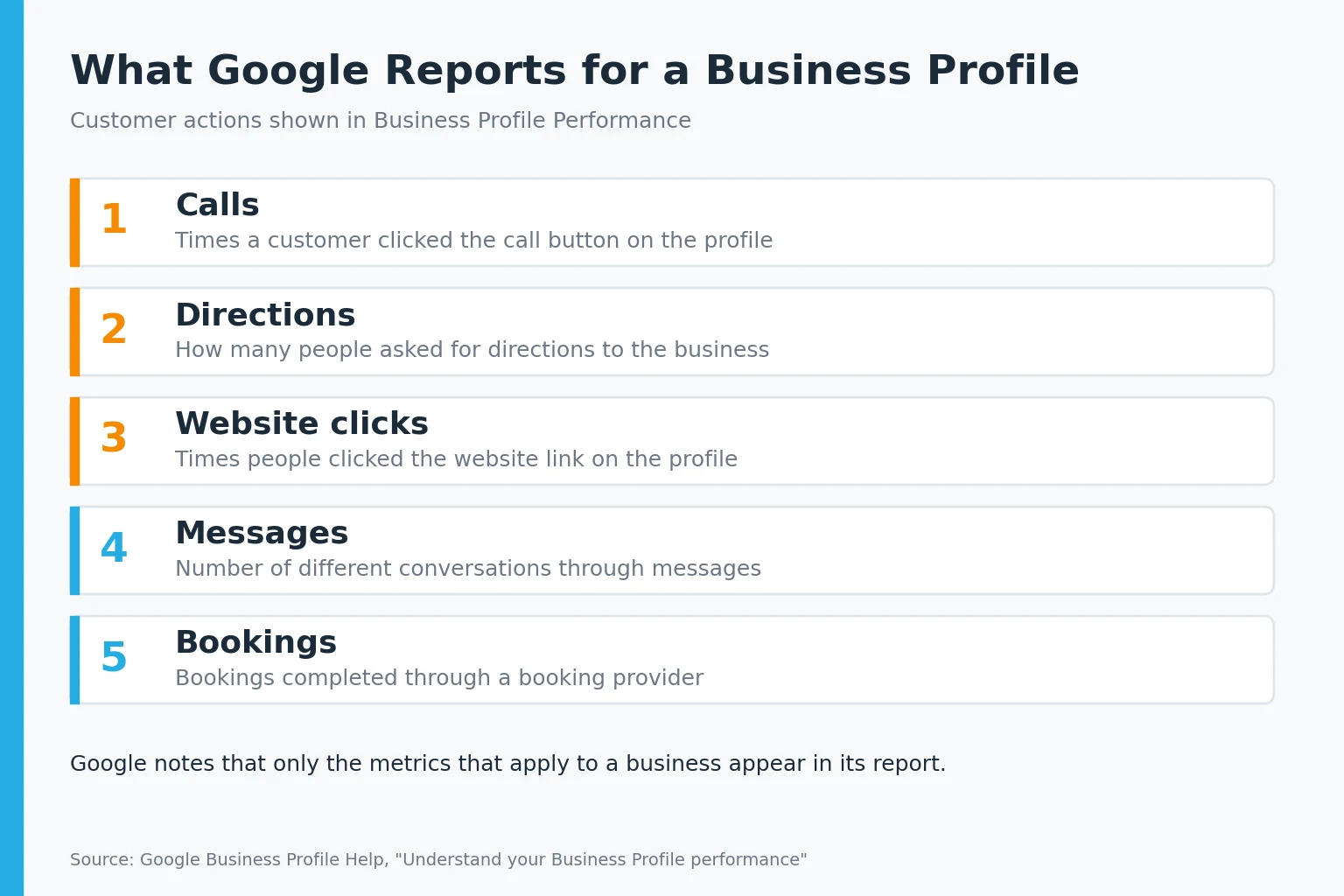
Measuring success means looking beyond website traffic and national keyword rankings. The actions that signal real customer intent happen at the location level, and Google reports many of them directly in each Business Profile.
| Metric | Where to Find It | Why It Matters |
|---|---|---|
| Calls and direction requests | Business Profile Performance | Shows customers moving toward a visit |
| Website clicks | Business Profile Performance | Shows interest in learning more about the location |
| Local pack visibility | Local rank tracking by location | Shows presence for nearby searches |
| Visits to location content | Website analytics | Shows organic demand for each storefront |
| Review count and rating | Business Profile and review tools | Shows reputation strength at each location |
Add distinct tracking parameters to the website link in each Business Profile so your analytics can separate profile traffic from other organic visits. Then bring the data into one dashboard that lets corporate teams spot struggling locations quickly and send support where it will help most.
Budgeting for Franchise Local SEO
Local SEO costs depend on the number of locations, the competition in each market, and the level of reporting you need. Packages that combine a website with local SEO support start at $399 per month, and organic SEO programs begin at $1,500 per month.
To see how an SEO investment is typically structured for a network, review franchise SEO packages and pricing before you compare providers.
Local SEO for Franchises FAQs
What is local SEO for franchises?
Local SEO for franchises is the practice of improving how each franchise location appears in nearby searches and on maps, while keeping the national brand consistent. It combines accurate profiles, unique location content, consistent listings, and reviews.
Should each franchisee have a separate website?
In most cases, no. A single corporate domain with distinct content for each location keeps authority together and brand standards consistent. Google’s spam policies also flag multiple domains aimed at specific cities that funnel users to one destination.
How do we avoid duplicate content across hundreds of locations?
Write distinct content for every location, including local staff, services, photos, and community involvement. Avoid copying one template and changing only the city name.
Can Google Business Profiles be managed in bulk?
Yes. Businesses with 10 or more profiles can request bulk verification, and corporate teams can manage access through owner and manager roles instead of sharing passwords.
How long does local SEO take to show results?
Timelines vary with your starting point, the accuracy of existing listings, and the competition in each market. Progress usually builds over several months rather than days.
Which metrics show whether local SEO is working?
Track calls, direction requests, website clicks, local pack visibility, visits to location content, and review growth for each location, then compare locations to find the ones that need support.
Conclusion: Turning Every Location Into a Local Search Winner
Winning local search across a franchise network takes steady discipline. Balance strict brand standards with the local detail that neighborhood customers look for, and build the foundation in order: verified profiles, useful location content, consistent listings, active reviews, and honest measurement.
If you are ready to see where your locations stand today, contact our team to talk through your network, your markets, and your growth goals.

Strengthen Your Franchise Local SEO Strategy
See how every location shows up in local search today and where the biggest opportunities are.