Author: Senior Home Services SEO Strategist, BizIQ
About the Author: With 15+ years spent helping local contractors win in local search, our Senior Home Services SEO Strategist has worked directly with pool builders, service route operators, and niche contractors across competitive metro markets. Their work educates with evidence, leads with outcomes, and sits at the intersection of technical SEO rigour and the kind of ground-level business thinking that only comes from working alongside small business owners, rather than analyzing them from a distance.
What you’ll take away from this guide:
- Organic SEO leads cost $5 to $75 per acquisition, compared to $120 to $280 for paid construction ads. Unlike paid traffic, they do not disappear the moment your budget runs dry.
- Pool builder SEO and pool service SEO are operationally distinct specialties. Merging them is one of the most common and costly mistakes pool companies make with their digital marketing.
- The Google Local 3-Pack captures 33 to 44 percent of all local search clicks. Owning that real estate, not just appearing in it, is the difference between a full calendar and a slow season.
How can SEO help a Pool Company Attract More Customers?
SEO helps pool companies increase their visibility when homeowners search for pool building, maintenance, cleaning, and repair. By optimizing website content, local search profiles, service pages, and customer reviews, pool companies can rank higher in search results, generate more qualified leads, and grow their customer base consistently.
Every week, homeowners in your market open Google and type exactly what you sell. “Pool builder near me.” “Pool pump repair [city].” “Green pool cleanup.” They are ready to spend money. The question is not whether demand exists. The U.S. pool industry crossed $62 billion in 2025, with care and maintenance accounting for roughly $15 billion annually and the construction market tracking between $15.1 billion and $16.5 billion. Because small businesses are the backbone of innovation and the heartbeat of America, we believe sophisticated marketing belongs to you as well. The real question is who captures that demand, and whether it is you or the competitor two zip codes over who figured out pool company SEO first.
Shared lead platforms will happily sell you a slice of that demand. They will also sell the same lead to four other contractors simultaneously, leaving you in a price war before you have said a single word to the homeowner. That model has a ceiling, and most pool operators hit it faster than they expect.
A successful digital strategy requires a dual-track SEO blueprint: one track for pool builders chasing high-ticket construction contracts, and another for service companies building tight, profitable route density. The tactics diverge significantly between those two business models, and treating them as interchangeable is where most generic marketing advice falls apart. Here’s exactly how to do it, step by step.
The Financial Reality: Organic SEO vs. Paid Lead Generation
Shared lead aggregators are not inherently predatory. They solve a real problem for contractors who need volume fast and do not yet have organic visibility. But the economics erode quickly once you examine them at the job level.
When a lead is sold to three, four, or five competing contractors simultaneously, close rates collapse. Industry data puts shared lead close rates for pool services at 8 to 14 percent, meaning you are paying for six to twelve leads to close one job. At typical shared lead pricing, the effective cost per signed job lands between $450 and $650. For a service call worth $150 to $300, that math doesn’t add up. For a pool build worth $80,000, it is survivable but still deeply wasteful.
Organic search engine optimization changes the equation entirely. A homeowner who finds your website through a Google search, reads your project gallery, checks your reviews, and then calls you: that person has already pre-qualified themselves. They chose you before the conversation started. Once an SEO-driven lead generation engine is established, those inquiries arrive at an average cost per lead of $5 to $75, and they are exclusive. No competing contractor received the same lead. No race to the bottom on price before you have answered the phone.
We are a small business ourselves at BizIQ. Our recommendations are based on what is possible according to historical performance data. We have seen what happens when contractors track their marketing spend at the job level rather than the campaign level. The numbers almost always tell the same story: organic leads close at higher rates, generate better margins, and compound over time as your site’s authority grows, creating a permanent source of exclusive inquiries that does not require ongoing ad spend. Paid traffic stops the moment the budget does.
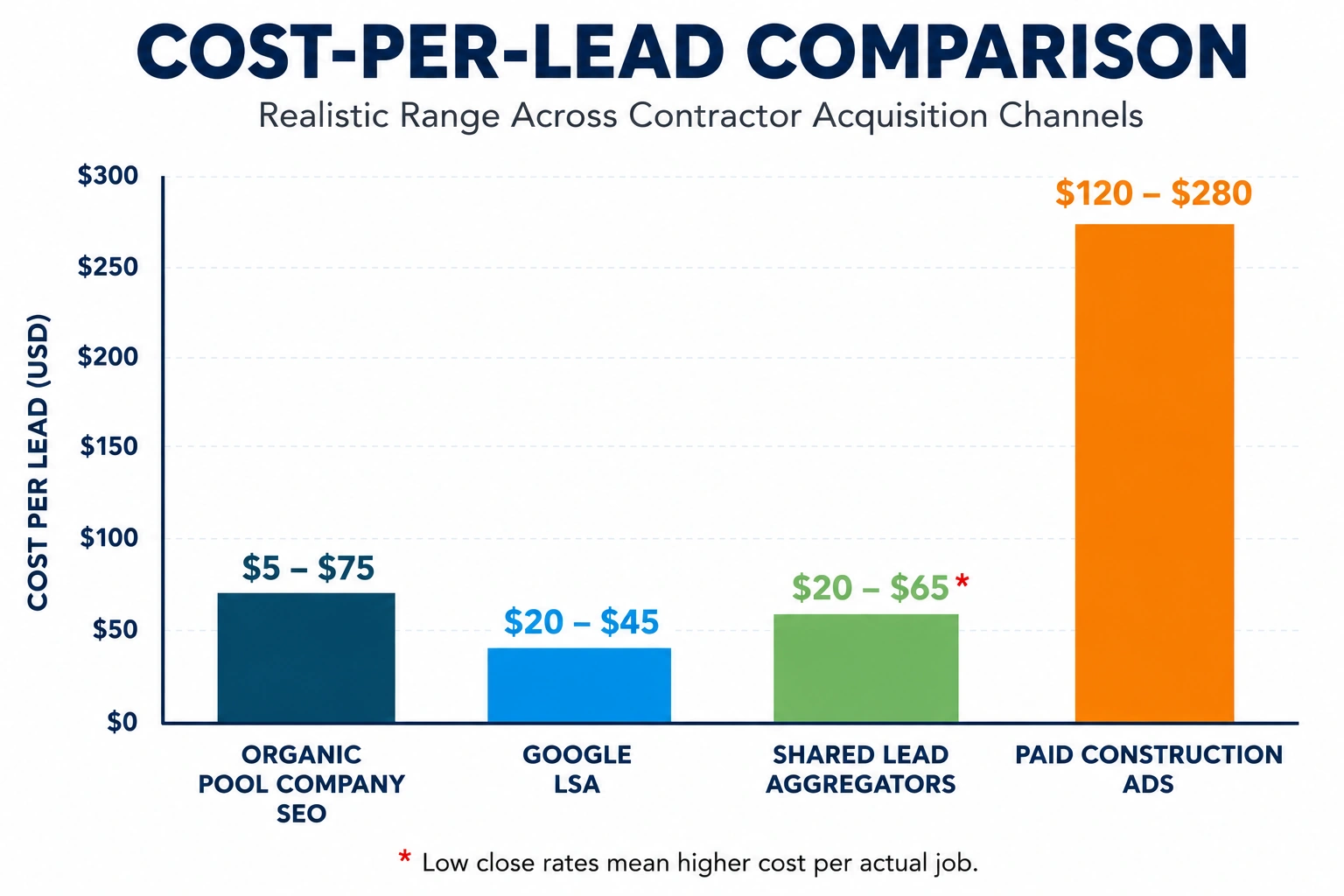
Cost-per-lead comparison showing SEO as the lowest-cost acquisition channel versus LSAs, shared leads, and paid ads.
Track 1: SEO for Pool Builders (High-Ticket, Visual-Heavy)
Pool builder SEO operates in a different competitive environment than service SEO. Average contract values run $50,000 to $150,000, sales cycles stretch four to twelve months, and the homeowner’s decision is almost entirely visual before it becomes financial. They want to see what you have built. They want to picture it in their backyard. Visuals build trust. Your website’s job is to make that imagination as vivid and credible as possible, and Google’s job is to surface your website when those buyers are searching.
That combination of high intent and long consideration phase creates specific tactical requirements:
- Visual Portfolio Optimization: Every project photo is an SEO asset if you treat it that way. Compress high-resolution images for fast loading, then tag them with descriptive, geo-targeted alt text, such as
custom-freeform-pool-scottsdale-az.jpgrather thanIMG_4892.jpg. Google cannot see your photos, but it reads every filename and alt attribute. - Long-Form Cost and Design Guides: Buyers researching a $100,000 pool build spend weeks reading before they call anyone. Articles that answer “How much does an inground concrete pool cost in [City]?” or “What’s the difference between a gunite and fiberglass pool?” engage those buyers at the research stage and put your brand in their consideration set before your competitors even know they exist.
- Subdivision and Community Landing Pages: High-end master-planned communities concentrate your ideal buyers geographically. A dedicated landing page targeting a specific development, with localized copy, project photos from nearby builds, and a clear call to action, converts at a meaningfully higher rate than a generic service area page.
- Lead Generation for Pool Builders: Interactive 3D design galleries, project cost estimators, and strategically placed consultation forms turn passive browsers into active leads. The goal is to give a serious buyer a reason to identify themselves before they are ready to call.
The broader construction SEO framework applies here: content authority, technical foundations, and local signals. Pool builders need to weight visual credibility more heavily than most construction verticals. A homeowner spending six figures on a backyard transformation is making an emotional decision backed by financial logic. Your digital presence needs to honor that.
Track 2: SEO for Pool Service Companies (Recurring Revenue, Route Density)
Service route SEO is a volume game played on a tight geographic board. The goal is not to attract any pool owner: it is to attract pool owners in specific neighborhoods, ideally clustered tightly enough that your technicians can service six or eight accounts on a single street without burning two hours in travel. That operational reality should drive every SEO decision a service company makes. Route density is everything.
Our pool service digital marketing approach is built around exactly this limitation. The tactics that build route density are different from the ones that win construction contracts:
- Hyper-Local Neighborhood Targeting: Generic city-level pages such as “Pool Cleaning in Phoenix” face intense competition and attract leads scattered across a 500-square-mile metro. Neighborhood-specific pages like “Pool Cleaning in Arcadia, Phoenix” attract buyers in a defined geography, letting you build route density organically as rankings improve. Here is what worked for a business like yours: localized, neighborhood-specific optimization.
- Immediate-Need Keyword Mapping: “Pool pump repair near me,” “green pool cleanup [city],” and “pool filter replacement [zip code]”: these are high-urgency, high-intent searches from homeowners with a problem that needs solving today. Ranking for them means capturing customers at peak willingness to book.
- Service-Route Landing Pages: Every city and major suburb in your service area deserves its own page. Not a thin duplicate with the city name swapped out, but a genuinely localized page with neighborhood context, local reviews, and service-specific content. Google can tell the difference, and so can the homeowner reading it.
- Local Search Optimization for Pool Maintenance: Service pages that clearly communicate recurring maintenance packages, pricing structures, and response time commitments reduce friction at the decision point. A homeowner comparing three pool service companies will choose the one whose website answers their questions before they have to ask them.
Pool service SEO compounds in a way that most paid advertising does not. Each neighborhood page you build and rank is a permanent asset. Each review you earn strengthens your local authority. Each returning customer you acquire through organic search adds recurring revenue without adding acquisition cost. The math on route density, when driven by organic search, is genuinely compelling over a two-to three-year horizon.
“A fully optimized, active Google Business Profile with a 4.8-star rating is the single most powerful, cost-effective lead-generation asset a local pool company can own.”
Schedule Your Free SEO & Route Density Audit
We’ll map your current service areas against local search data and show you exactly where you’re losing traffic to competitors, neighborhood by neighborhood. No pitch deck. No pressure. Just a clear picture of the opportunity.
Dominating the Google Local 3-Pack (Where 44% of Clicks Live)
For local service businesses, the Google Local Pack is not one channel among many. It is the primary battleground. Studies consistently show the Local 3-Pack captures 33 to 44 percent of all local search clicks, a share that dwarfs organic blue-link results for most service queries. When a homeowner’s pool pump fails on a Saturday afternoon, they open Google Maps, see three businesses with ratings and a call button, and pick one. They do not scroll to page two. They do not visit five websites.
Google determines Local Pack rankings through three weighted factors: relevance, meaning how well your profile matches what they searched; distance, meaning how close you are to the searcher; and reputation, meaning how well-established and trusted your business is online. You cannot control distance. You can control relevance and reputation almost entirely.
Google Business Profile optimization is where that control lives. Think of your Google Business Profile as your storefront’s digital window: you want it clean, well-lit, and showing the right information. NAP consistency, meaning an identical Name, Address, and Phone number across every directory listing, your website, and your GBP, is essential. A mismatch between your GBP address and your website footer creates a trust signal conflict that suppresses your rankings. Primary category selection matters more than most operators realize; “Pool Contractor” and “Swimming Pool Service” are distinct categories with different ranking implications depending on whether you are targeting construction or maintenance queries.
Reviews are the most visible reputation signal, and the numbers behind them are striking. Moving from a 1 to 2 star rating to a 4 to 5 star rating on a Google Business Profile nearly doubles click-through rate, shifting from roughly 30 percent to 69 percent. That is not a marginal improvement; it is a structural advantage over every competitor in your Local Pack who has not actively managed their reputation. Weekly photo posts of completed pools, seasonal service updates, and consistent Q&A responses all contribute to profile activity signals that Google weights positively.
Our guide to local SEO goes deeper on the full architecture of Local Pack dominance, but the GBP is where most pool companies have the fastest, most measurable wins available to them right now.
Technical SEO: Ensuring Google Can Crawl Your Route Pages
Technical SEO is the part of this conversation that makes most business owners’ eyes glaze over. It does not have to. At its core, technical SEO is about making sure Google can find your pages, read them without errors, and understand what services you offer in which locations. “Crawling” just means Google’s automated systems reading your site the way a person would, except they are doing it across thousands of pages simultaneously and making ranking decisions based on what they find.
The technical foundations that matter most for pool companies are clear. Over 60 percent of pool-related searches originate on mobile devices, which means Google evaluates your site primarily through its mobile version. A website that looks fine on a desktop but loads slowly or breaks on a phone is being penalized in rankings whether you know it or not. If your site takes more than three seconds to load on mobile, a meaningful percentage of visitors will abandon it before it finishes displaying, bouncing back to the search results page to click a competitor.
HTTPS security, clean URL structures for service-area pages, a properly submitted XML sitemap, and structured internal linking between your location pages and your service pages: these are not glamorous, but they are the framework that everything else rests on. A technically broken website cannot be saved by great content or a strong Google Business Profile. The local business optimization checklist we have put together walks through the ten most impactful technical fixes for service businesses, most of which can be addressed without a developer.
Schema markup deserves a specific mention here. Implementing LocalBusiness, Service, FAQ, and Author schema across your pages gives Google structured data to pull into search results directly, enabling rich snippets, star ratings in organic results, and eligibility for AI-generated search overviews. Most pool company competitors have not implemented detailed schema. That gap is a real ranking opportunity.
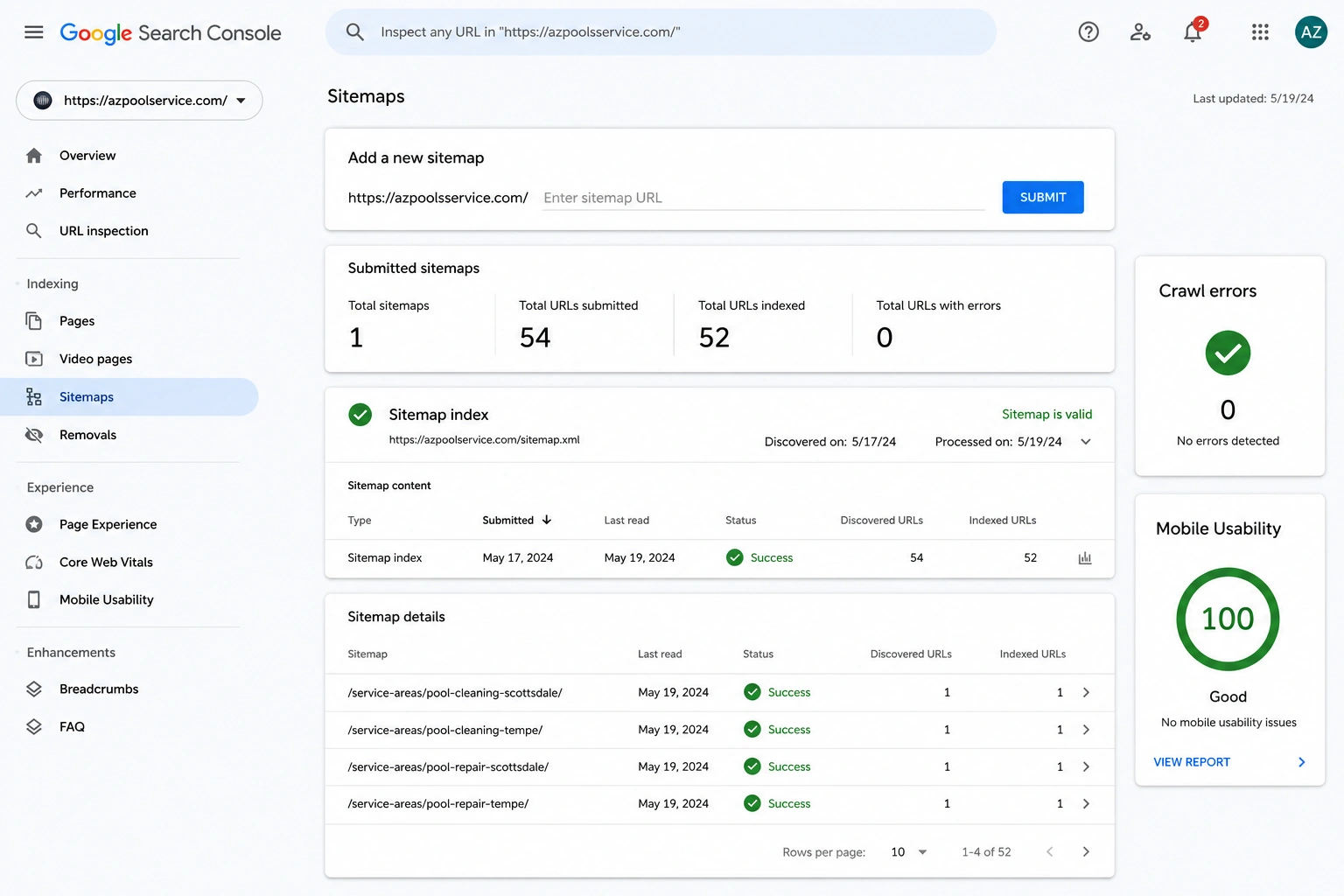
A healthy Google Search Console sitemap with indexed service-area pages, zero crawl errors, and excellent mobile usability.
Content Marketing: Answering the Questions That Drive Bookings
Content marketing for pool companies is not about publishing blog posts for the sake of it. It is about positioning your website as the most useful resource in your market for the questions your buyers are already asking, capturing them at every stage of the decision process, from early research through urgent need.
The distinction between builder content and service content matters here, too. A pool builder’s content strategy should prioritize consideration-phase questions from buyers with a long research window. A service company’s content strategy should weigh immediate-need queries that signal a broken pump or a chemistry problem that needs fixing this week. Both approaches build authority; they just target different moments in the customer journey.
We recommend starting with keyword research for SEO as the process that connects content topics to actual search behavior. Without it, you are guessing at what your buyers type into Google. Guessing is expensive. With it, you are writing directly to proven demand.
High-intent content topics that consistently drive bookings for pool companies:
- “How Long Does Pool Construction Take in [City]?”: Targets buyers in the planning phase who are setting timelines and comparing contractors. Ranking for this query puts you in the conversation before a single competitor has been contacted.
- “Saltwater vs. Chlorine Pools: Which Is Right for You?”: A classic consideration-phase question that attracts buyers who are serious enough to research the details. These readers convert to consultation bookings at above-average rates.
- “Why Is My Pool Water Green? (And How to Fix It Fast)”: An immediate-need service query. Someone searching this phrase has a problem right now and needs a solution provider. A well-optimized page on this topic drives service calls directly.
- “How to Prepare Your Swimming Pool for Winter/Summer in [State]”: Seasonal maintenance content that captures recurring traffic at predictable cycles. It also positions your company as a year-round resource, not just a break-fix option.
The SEO keyword research strategy we use for plumbing companies follows the same architecture: segment by intent, map to the buyer’s stage, and build content that earns rankings and conversions simultaneously. Pool companies can apply the same framework with industry-specific terminology.
Off-Page SEO: Building Local Trust Signals
While on-page optimization gets your website in the game, off-page authority is what wins the championship. Authority drives rankings.
Off-page SEO is the collection of signals from outside your own website that tell Google your business is legitimate, established, and trusted by the local community. The two primary mechanisms are local citations and backlinks, and while neither is complicated in concept, both require consistent execution over time.
Citations are structured mentions of your business name, address, and phone number across directories and platforms. Yelp, Bing Places, Apple Maps, and industry-specific platforms like the Pool & Hot Tub Alliance (PHTA) directory all contribute to your local authority profile. The critical requirement is consistency: every citation must match your GBP and website exactly. Making sure your business name, address, and phone number are identical everywhere online is like giving Google the same address for your office: no confusion, better trust.
Backlinks, meaning other websites linking to yours, function as digital votes. A link from a local news outlet, a community organization, or a regional home improvement resource carries more weight than a link from a generic national directory. One underutilized tactic: sponsoring a local youth sports team or contributing to a community event. School websites, neighborhood association pages, and local news coverage of community events generate exactly the kind of geographically relevant, editorially earned backlinks that Google weights most heavily. It is not a glamorous link-building strategy, but it works, and it builds genuine community presence at the same time.
Our guide to SEO local search strategies covers the full off-page architecture in more depth, including citation audit workflows and outreach frameworks for earning local backlinks without cold-pitching webmasters.
Tracking Your SEO ROI: Metrics That Matter
Vanity metrics are the enemy of good marketing decisions. Focus on revenue. Rankings and impressions tell you something, but they do not tell you whether your SEO investment is generating signed contracts or filled service routes. Those are the only numbers that actually matter to a pool company’s bottom line.
Google Analytics and Google Search Console, connected and configured correctly, give you a direct line to the metrics that count: organic traffic by page, keyword rankings for your target terms, and, most importantly, conversion events. A conversion event is a phone call, a form submission, a booking request. It is the moment a visitor becomes a lead. Tracking those events at the page level tells you which content is generating business and which is generating traffic that never converts.
There’s a case to be made that most pool companies are already sitting on more SEO data than they realize: they just have not connected it to revenue outcomes. A service area page with 400 monthly visitors and zero tracked calls is not a success story; it is a warning signal that something in the page’s conversion path needs attention. The SEO research tools we recommend for ongoing performance tracking make it possible to catch those gaps before they cost you a full quarter of lost leads.
We look at the positive impacts we make on our small business partners, measuring success by signed contracts and filled routes. Not search engine impressions, not keyword positions in isolation, and not traffic from audiences who were never going to call. That focus, focusing on business outcomes rather than marketing outputs, is what separates an SEO strategy that compounds in value from one that looks good in a monthly report and delivers nothing to your bank account.
Frequently Asked Questions
What is the average cost per lead for pool company SEO?
Once an organic SEO program is established, typically after six to twelve months of consistent execution, leads generated through organic search cost between $5 and $75 per inquiry. That figure contrasts sharply with paid search ads, which run $120 to $280 per lead for competitive construction terms, and shared lead platforms, where the effective cost per signed job often reaches $450 to $650 when you account for low close rates. The compounding nature of SEO is what makes the economics so favorable over time: unlike paid ads, which stop delivering the moment your budget pauses, organic rankings continue generating traffic and leads as long as your site maintains its authority.
How long does it take to rank a new pool builder website?
Expect four to nine months to reach page one for competitive local keywords in most markets. That timeline is not random: it reflects how long Google needs to crawl, index, and develop trust in a site’s authority relative to established competitors. Technical fixes and GBP optimization can produce faster wins, sometimes within weeks. Speed matters. But ranking for high-value terms like “pool builder [city]” or “inground pool installation [metro]” requires sustained content development, link acquisition, and consistent on-page optimization over several months. The contractors who start now are the ones who own those rankings when their competitors finally decide to invest.
Do shared leads from Angi or HomeAdvisor work for pool companies?
They can generate volume, particularly for newer companies without organic visibility. The structural problem is that shared leads are sold to multiple contractors simultaneously, typically three to five, which compresses close rates to 8 to 14 percent and forces price competition before you have had a meaningful conversation with the homeowner. For pool service companies where margins are already tight, that model is difficult to sustain profitably. For pool builders, the math is more forgiving given higher contract values, but the race-to-the-bottom dynamic still erodes your positioning. Organic SEO does not eliminate the need for lead generation in the short term, but it builds toward a state where you own your leads rather than renting access to them.
How does route density tie into local SEO for pool service routes?
Route density is essentially a geographic clustering problem, and local SEO is one of the most effective tools for solving it. By building neighborhood-specific landing pages and optimizing for hyper-local keywords, meaning street-level and subdivision-level rather than city-level, you attract customers concentrated in specific zip codes. As those customers convert and leave reviews, your local authority in those neighborhoods strengthens, which attracts more nearby customers, which tightens the route further. A technician who services eight accounts within a two-mile radius generates more revenue per day than one covering the same number of accounts spread across fifteen miles. Local SEO is the mechanism that makes geographic concentration a deliberate strategy rather than an accident.
Can I do pool company SEO myself, or should I hire an agency?
Basic local optimizations, such as claiming and completing your Google Business Profile, ensuring NAP consistency across major directories, and adding location-specific content to your service pages, are genuinely achievable in-house with a few hours of focused effort. The complexity increases significantly when you are competing in dense metropolitan markets, managing technical site architecture across dozens of service-area pages, or building a content program that requires consistent keyword research and editorial execution. At that level, the opportunity cost of doing it yourself usually exceeds the cost of working with a dedicated SEO agency. We work alongside pool companies as an expert peer, not as a vendor handing over reports, which means the strategy we build is one you understand and can evaluate on its actual business merits.
Build the Asset, Stop Renting the Traffic
The pool industry is large enough that demand is not the constraint. Customer acquisition cost is. Every dollar you spend on shared leads or paid ads that stop working the moment you pause the campaign is a dollar that did not go toward building a permanent digital asset: one that generates exclusive, high-intent inquiries at a fraction of the cost, month after month, without requiring you to outbid a competitor every morning.
The dual-track approach in this guide is not academic. It is practical. Pool builders and service route operators have meaningfully different SEO requirements, and conflating them produces subpar results for both. Builders need visual authority, long-form content that intercepts buyers during extended research phases, and location-specific pages that speak to high-income communities. Service companies need hyper-local targeting, immediate-need keyword coverage, and a GBP strategy that makes them the obvious choice when something breaks on a Saturday.
As a small business ourselves, we know that what matters is not what sounds impressive in a strategy deck: it is what shows up as signed contracts and scheduled service calls. That is the standard we hold our work to, and it is the standard we would encourage you to hold any marketing investment to.
We’ll build a custom local SEO strategy around your specific business model, whether you are filling a construction calendar, tightening a service route, or both. No generic playbooks. No shared templates. A strategy built for your market, your competition, and your growth targets.