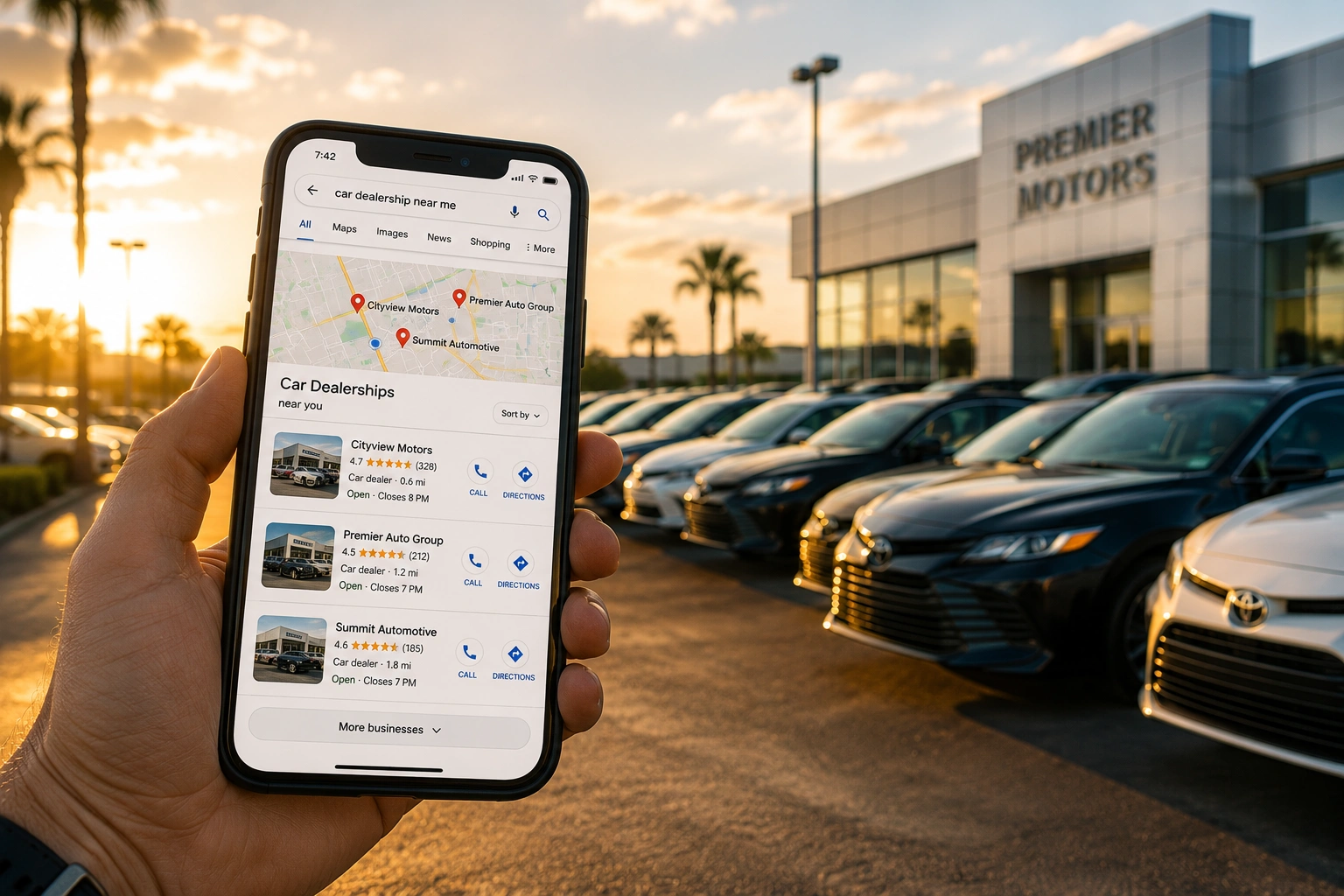
A Google Maps local search for nearby car dealerships connects high-intent shoppers with businesses ready to sell.
What we cover in this guide:
- How to optimize your Google Business Profile and set up nested departments for sales, service, and parts.
- The technical steps to deploy Vehicle Listing Structured Data so your inventory displays directly in search results.
- Why a localized content strategy is your best defense against massive national aggregators.
- How to balance Core Web Vitals with the heavy widgets required on modern dealership websites.
How can Auto Dealers use Local Search to Increase Showroom Foot Traffic?
Your dealership must optimize its Google Business Profile (GBP), target localized vehicle inventory keywords, and maintain accurate citation listings. A complete dealership Local SEO Blueprint also relies on collecting recent positive reviews and using structured data schemas, enabling search engines and AI engines to recommend your inventory.
Over 95% of car shoppers use search engines to research vehicles, compare local dealers, and read reviews before ever setting foot on a physical lot. Yet only 7% of buyers complete their vehicle purchase entirely online. Your digital presence has one chief task: act as the bridge that guides high-intent local searchers straight to your physical showroom or service bays.
Traditional broadcast advertising casts a wide, expensive net that is increasingly difficult to measure. Search Engine Optimization, by contrast, puts your dealership in front of a driver in your city at the precise moment they search “used SUV near me” or “Honda service in [City].” Aligning your website and local listings with Google’s ranking signals lets you capture that traffic at a cost-per-lead that runs 50% to 70% lower than paid advertising channels, and if you want a deeper foundation before diving into tactics, the complete SEO guide from our team is worth bookmarking. Here’s what works and why. It starts with visibility.
Dominate Google Maps with a flawless Google Business Profile (GBP)
Your Google Business Profile is the true front door of your digital showroom. Do not ignore it. Because 76% of consumers who conduct a local search visit a business within 24 hours, your visibility in the local map pack is the single most influential factor of immediate phone calls and driving directions. Most dealerships, though, manage their entire operation under one Google listing, a structural mistake that dilutes search relevance and causes them to forfeit highly profitable service and parts queries to competitors who have figured this out.
Google’s official guidelines explicitly permit dealerships to create nested department profiles for distinct operations. Your main showroom profile is optimized for your primary brand (e.g., “Ford Dealer”), your service center carries the “Auto Repair Shop” category as a separate nested profile, and your parts department is listed as an “Auto Parts Store.” Understanding how to nest department listings correctly is essential for maintaining clean local citations.
Each nested profile requires its own direct local phone number and a dedicated landing page on your local search engine website, not just a tab on your homepage, to prevent keyword cannibalization and capture the high-margin service traffic that most dealerships leave entirely uncontested.
The nesting relationship itself matters. Use Google’s “located within” feature to tie each department profile back to the main showroom listing. Without that connection, Google treats them as unrelated entities, which undermines the geographic authority you are trying to build. Done correctly, this architecture lets a single physical location rank across three distinct, high-intent search categories simultaneously.
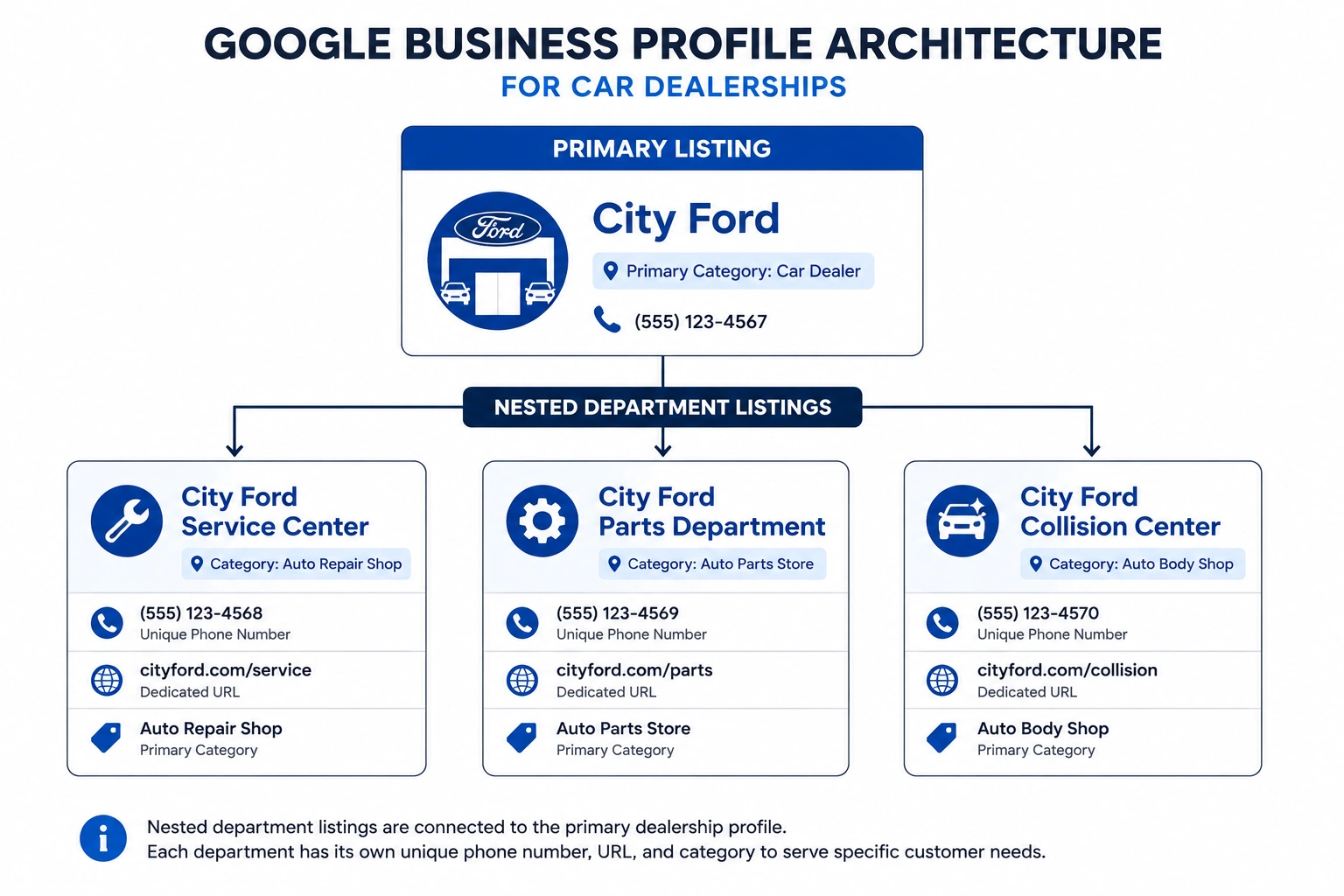
A dealership’s Google Business Profile can include separate department listings for service, parts, and collision repair.
Optimize your vehicle detail pages (VDPs) and eliminate OEM copy
Write original, high-value vehicle descriptions
Generic manufacturer descriptions are a liability. They hurt your rankings. OEM copy is distributed to hundreds of dealerships simultaneously, and when you paste it onto your Vehicle Detail Pages, Google’s helpful content algorithms register the duplication across the entire web, which suppresses your organic search results in favor of the sites that bothered to write something original.
The fix is clear, but it requires discipline. For your top-selling models, write localized introductions that reference real-world context: fuel efficiency relative to local commute distances, how a truck’s tow rating performs on regional terrain, or dealer-installed packages that are unique to your lot. Custom photos of actual inventory, not stock OEM renders, reinforce both the originality signal for search engines and the authenticity signal for buyers who have already seen the same manufacturer images on six other sites. This is one of the highest-leverage, lowest-cost improvements a dealership can make, and most skip it entirely because it requires actual writing effort.
Implement vehicle listing structured data (schema markup)
In late 2023, Google introduced specialized vehicle listing structured data that allows dealerships to feed live inventory directly into search results: price, mileage, fuel type, and availability surfacing before a buyer ever clicks through to your site. You can read more about it on the Google Search Central Blog. The competitive advantage is significant. Qualifying, however, requires meeting three essential requirements.
First, your Google Business Profile must be claimed and verified with the primary category set to vehicle_dealer. Second, the inventory must be physical vehicles available for direct sale in the United States. Third, and where most implementations fail, every Vehicle Detail Page must carry valid JSON-LD schema containing all required properties: brand, model, model year, VIN, price, and availability. Missing a single required property disqualifies the entire listing from rich result eligibility.
Validation is simple. Run each VDP through Google’s Rich Results Test before pushing changes to production, then monitor Search Console’s “Shopping” tab for indexing errors. Don’t rely on your website platform’s built-in schema generator without auditing its output; many automotive CMS platforms produce malformed JSON-LD that passes their own internal checks but fails Google’s parser.
Optimize VDP assets for fast mobile performance
Mobile visits account for 68.5% of all automotive website traffic. Speed is everything. That number has genuine weight when you consider what happens to a buyer who waits more than three seconds for a photo gallery to load: they leave, and they do not come back. Converting vehicle photo galleries from JPEG to WebP format typically reduces image payload by 25% to 35% without visible quality loss, which is the single fastest technical improvement most dealerships can deploy without touching their site architecture.
Lazy-loading for below-the-fold image carousels and vehicle specification tables is the next lever. Browsers load only what is visible in the viewport on initial render, deferring the rest until the user scrolls, which is a meaningful reduction in initial page weight on inventory-heavy VDPs. Faster mobile load times do not just improve rankings; they directly reduce bounce rates and increase the volume of click-to-call conversions from buyers who found what they needed before their patience ran out.
Build local authority through community sponsorships and backlinks
Execute a civic authority link-building playbook
Generic directory submissions are largely outdated tactics. Google’s local ranking algorithm weighs links from geographically relevant, trusted organizations as meaningful votes of confidence, and a link from a local youth sports league’s sponsor page carries far more geographic signal than a listing on a national automotive directory that has sold the same slot to 400 other dealerships.
The playbook is clear: sponsor local high school athletic programs, youth soccer leagues, or community charity events. Secure a link from their official sponsor page back to your dealership’s homepage or a dedicated community landing page, using natural anchor text that includes your city name. These links are hard to replicate at scale, which is exactly what makes them valuable. They build real authority. A competitor can buy the same directory listing you have. They cannot easily replicate a five-year sponsorship relationship with your local little league association. Your local SEO strategy is only as strong as the geographic trust signals feeding it, and civic links are among the cleanest sources of that trust. Our approach does not hype, fear-monger, or oversell. Instead, we focus on earned authority through demonstrated results.
Build local business partnerships and memberships
Chamber of Commerce memberships and local Better Business Bureau listings are fundamental prerequisites, not differentiators, but they matter because they establish your business as a verified local entity in Google’s knowledge graph. The more interesting opportunity is co-marketing with non-competing local businesses: a local tire shop, an independent auto detailer, a driving school. Cross-linking arrangements with these businesses are mutually beneficial, geographically relevant, and genuinely difficult for a national aggregator to replicate.
Pitching local news outlets is underutilized. A charity vehicle donation event, a free car seat safety inspection workshop, or a community drive benefiting a local food bank can generate earned media coverage with natural backlinks from local news domains, links that carry substantial authority and reinforce your dealership’s presence in Google’s entity graph as an active, trusted community institution. These are not just PR wins. They are durable ranking signals.
Is your dealership missing out on local buyers?
We’re a small business ourselves, and we know that local dealerships are the backbone of innovation and heartbeat of America. Let our team of local search experts run a complimentary, in-depth audit of your digital presence. We’ll show you exactly where your competitors are winning and how you can claim your spot at the top of Google Maps.
Secure high-margin revenue with Fixed Ops SEO
While the sales floor absorbs the majority of the marketing budget, your service and parts departments are the true engine of long-term dealership profitability. Most dealerships treat Fixed Ops as an afterthought in their digital strategy, leaving a single “Service Specials” page buried in the navigation, competing for no meaningful search traffic, and generating no organic leads. The gap this creates is enormous, and it is largely uncontested. We have seen this work for businesses like yours, helping our partners capture high-value service business by setting up proper digital structures.
Capturing service traffic requires dedicated, granular landing pages for individual services rather than a catch-all page. “Brake Repair in [City],” “Synthetic Oil Change in [City],” “Transmission Service in [City]”: each deserves its own page with unique content, localized proof points, and a clear call to action. The conversion metrics justify the investment: high-intent organic queries for auto repair convert at 15% to 25%, compared to the 2% to 4% conversion rates typical of broad paid search campaigns. That gap represents recurring, high-margin revenue that flows directly to your service lane without routing through an expensive third-party lead aggregator.
Our team educates with evidence, leads with outcomes, and focuses on the positive impacts we make on our small business partners. We look at the actual numbers to guide our recommendations.
“Dealers who optimize their service pages for local search see an average cost-per-lead of $35 to $75, compared to over $150 for broad paid search campaigns. This makes Fixed Ops SEO one of the highest-ROI investments a dealership can make,” Automotive Marketing Insights notes.
Fixed Ops SEO also provides recession resilience. Vehicle sales are cyclical. Service revenue is not, as people maintain their cars regardless of whether they are buying new ones. A dealership with strong organic visibility for service keywords generates consistent, predictable lead volume that does not evaporate when the new-car market softens. That is a structural advantage worth building deliberately.
Technical SEO: Navigating the core web vitals dilemma
There is an ongoing discussion in automotive marketing about how much site speed truly moves the needle on rankings. A landmark industry study found that 95.5% of top auto dealership websites fail Google’s Core Web Vitals performance standards, a failure rate driven almost entirely by the heavy JavaScript, bloated image galleries, and third-party chat widgets that major automotive website platforms push by default. The number is striking. It is also somewhat misleading if you interpret it as evidence that site speed is the primary ranking lever.
Google’s documentation is clear on this point: Core Web Vitals function as a tiebreaker, not a primary ranking signal. A slow website with highly relevant, unique local content and a strong backlink profile from trusted local organizations will outrank a technically pristine site with thin, generic inventory pages. That said, “it is a tiebreaker” is not a license to ignore performance. When two dealerships have comparable content quality and local authority, which happens often in competitive metro markets, the faster site wins. The practical approach is targeted optimization rather than a platform overhaul. Focus on quick wins.
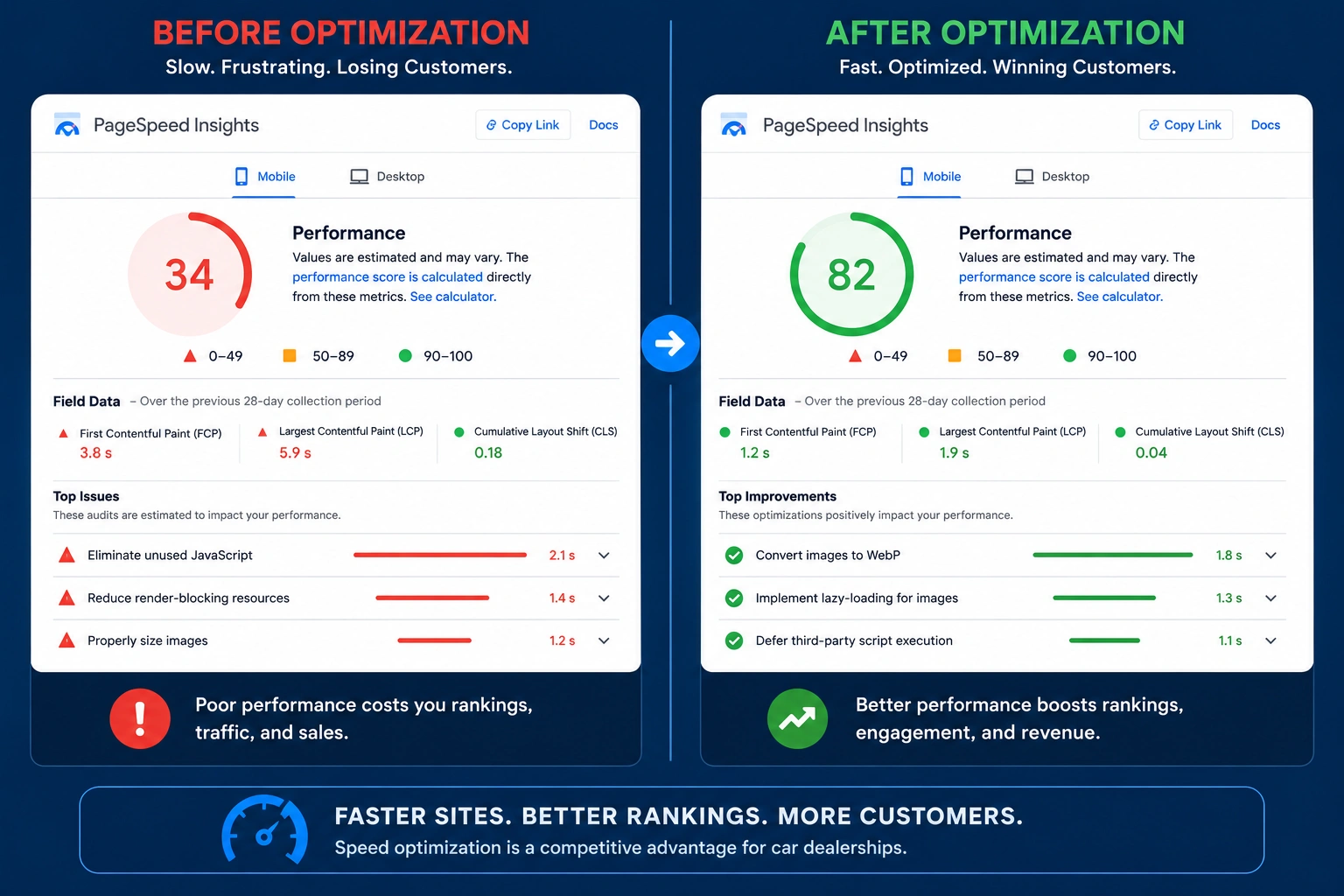
A mobile PageSpeed score improvement from 34 to 82 demonstrates the impact of technical website optimization.
Converting vehicle photos to WebP, implementing lazy-loading on below-the-fold carousels, and delaying the initialization of third-party chat widgets until after the main thread is free: these three changes alone can move a dealership from a PageSpeed score in the 30s to the 70s or 80s without touching the underlying platform. That is the range where Core Web Vitals stop being a liability and start being neutral or marginally positive. Chasing a perfect 100 on a live dealership site with real inventory feeds and trade-in widgets is an unrealistic target; getting out of the red zone is not.
Don’t let a slow website drive mobile buyers to your competitors.
Our technical team specializes in optimizing complex, inventory-heavy dealership websites without sacrificing the tools you need to convert traffic. Let us analyze your site’s speed and user experience.
Future-proofing for AI search and zero-click results
Optimizing for generative engine optimization (GEO)
Search behavior is shifting. Google’s AI Overviews, ChatGPT, Perplexity, and Gemini are increasingly answering automotive research queries directly in the interface, surfacing synthesized answers rather than a list of blue links. For dealerships, this creates a new content necessity: your pages need to be structured so that large language models can parse, trust, and cite them, not just so that Google’s traditional crawler can index them.
Practically, this means structuring content as direct, conversational Q&As that address real buyer questions: “Should I finance through a dealership or a credit union?” “What’s the difference between a certified pre-owned vehicle and a used car?” These are not keyword-stuffing exercises. They are the questions your sales team fields every day, and writing authoritative answers to them, with clear entity relationships and structured data that makes your business’s identity unambiguous, positions your content for inclusion in AI-generated search summaries. Clear entity markup, consistent NAP data across all platforms, and well-structured FAQ schema are the technical foundations of GEO readiness.
Building cross-channel signals and video authority
Google indexes video content directly in search results, and YouTube remains the second-largest search engine in the world. Video drives engagement. Walk-around videos of specific vehicles, customer delivery testimonials, and service department explainers are not just social content, they are discoverable resources that reinforce your dealership’s topical authority and geographic relevance in Google’s entity graph.
Optimizing video metadata is where most dealerships leave ranking value on the table. Video titles, descriptions, geotags, and transcripts should align precisely with your local keyword strategy. A walk-around video titled “2024 Ford F-150 XLT: [City] Ford Dealer” with a transcript that mentions your city, your dealership name, and the vehicle’s key specs gives Google multiple signals to associate that content with your local entity. Active cross-channel presence, consistent posting, consistent metadata, consistent geographic signals, compounding over time in ways that a purely on-site strategy cannot replicate.
How to choose a reliable automotive SEO partner
Navigating the agency marketplace is genuinely difficult. Many vendors make impossible promises, like “guaranteed first-page rankings in 30 days,” or push programmatic packages that amount to submitting your business to low-quality directories and calling it a strategy. These approaches generate reports full of activity metrics while producing little measurable impact on showroom traffic, phone calls, or service appointments.
A trustworthy partner approaches your account the way a knowledgeable colleague would: explaining what they are doing and why, setting realistic timelines, and tying their work directly to outcomes your business truly cares about. They should be fluent in the digital marketing strategies for car dealerships that move the needle, localized content, structured data, civic link-building, not just the ones that are easy to automate. They should also be honest about what PPC management can and cannot accomplish alongside an organic strategy, rather than treating paid and organic as competing budget items. The right agency understands that both channels serve different stages of the buyer journey, and they will help you allocate accordingly.
Transparency is the clearest differentiator. If an agency cannot show you exactly which local backlinks they built this month, where those links came from, and how they connect to your target geography, that is a meaningful gap. If they cannot walk you through the unique content they wrote for your VDPs or explain how your GBP nested department structure is configured, those are services they likely have not delivered. Exploring BizIQ’s car dealership digital marketing services gives you a concrete benchmark for what a transparent, automotive-specific engagement truly looks like.
Key questions to ask your current SEO agency
Ask your agency to show you the exact local backlinks they built for your site this month, and verify that they originate from real, local organizations rather than spammy link networks. Demand proof. Ask them to walk you through the unique descriptions they wrote for your top-selling models, and have them demonstrate how your Google Business Profile nested departments are structured and which categories each profile carries.
Demand a clear attribution report that connects organic search traffic to physical showroom actions, such as phone calls, driving direction requests, and service appointment bookings, not just sessions and impressions. If they cannot produce a straight, jargon-free answer to any of these questions, that is telling feedback. Agencies that deliver real results do not struggle to explain what they have done. The ones that do struggle are usually the ones billing for activity rather than outcomes.
Frequently asked questions about car dealership SEO
How long does it take to see results from car dealership SEO?
Technical fixes, including correcting schema markup errors, updating GBP categories, and resolving crawl issues, can yield ranking improvements in Google Maps within 2 to 4 weeks. A complete local strategy, one that includes content development, link-building, and structured data deployment, typically takes 4 to 6 months to generate significant, compounding organic traffic growth. That timeline reflects how long it takes search engines to crawl new content, index optimized listings, and register the growing weight of your local authority signals.
Why shouldn’t I use the vehicle descriptions provided by the manufacturer (OEM)?
OEM descriptions are distributed to hundreds of dealerships simultaneously. When you copy-paste that content onto your Vehicle Detail Pages, Google’s helpful content systems register the duplication across the web and deprioritize your pages in favor of sites that published original material. Dealerships with unique, localized descriptions consistently outrank those relying on manufacturer text, not because Google penalizes OEM copy in a disciplinary manner, but because originality is a positive ranking signal that generic content simply cannot generate.
What is Vehicle Schema markup and why do I need it?
Vehicle Schema is structured JSON-LD code embedded in your VDP source that translates your inventory data into a format search engines can parse and display directly in results. It tells Google the exact make, model, year, VIN, price, mileage, and availability of each vehicle, enabling your inventory to qualify for Google’s vehicle listing rich results on the search engine results page, before a buyer clicks through to your site. It is one of the few technical implementations that creates a direct, visible competitive advantage in the search results themselves.
Should I create separate Google Business Profiles for my Service and Parts departments?
Yes. Google’s guidelines explicitly allow dealerships to create separate, nested profiles for distinct operations. Doing so lets you target high-value service queries, like “brake repair near me” or “auto parts store open now,” without diluting the primary “car dealer” category of your main showroom profile. Each nested profile should carry its own local phone number, its own category, and its own dedicated landing page URL. Without that structure, you are competing against yourself for search relevance.
What are the most valuable local backlinks for a car dealership?
Relationship-based, geographically specific links outperform generic directory listings by a significant margin. They carry more weight. Prioritize sponsorships of local youth sports teams, memberships in your local Chamber of Commerce, co-marketing arrangements with non-competing local businesses like tire shops or detailers, and earned media coverage from local news outlets covering community events at your dealership. These links are difficult to replicate at scale, which is precisely what makes them durable ranking assets rather than commodity signals.
Dominating your local market requires treating the entire internet as your digital showroom. Optimizing your Google Business Profile with nested department profiles, writing unique inventory descriptions, deploying vehicle listing schema, building authentic local backlinks, and maintaining technically sound VDPs, none of these are optional components of a serious automotive SEO strategy. They are the entry requirements for competing in a market where national aggregators have unlimited content budgets and your advantage is geographic specificity and community trust.
Sophisticated marketing belongs to independent and franchise dealerships too. You can compete. These steps, executed consistently and measured honestly, are the most reliable path to sustainable, long-term growth, the kind that does not evaporate when your paid ad budget runs dry.
Ready to outrank your competitors and drive more local buyers to your lot? We recommend starting with a clear, evidence-based strategy tailored to your unique market. Schedule a live, personalized demo of our local automotive SEO solutions today, and let’s discuss how we can help your dealership shine.