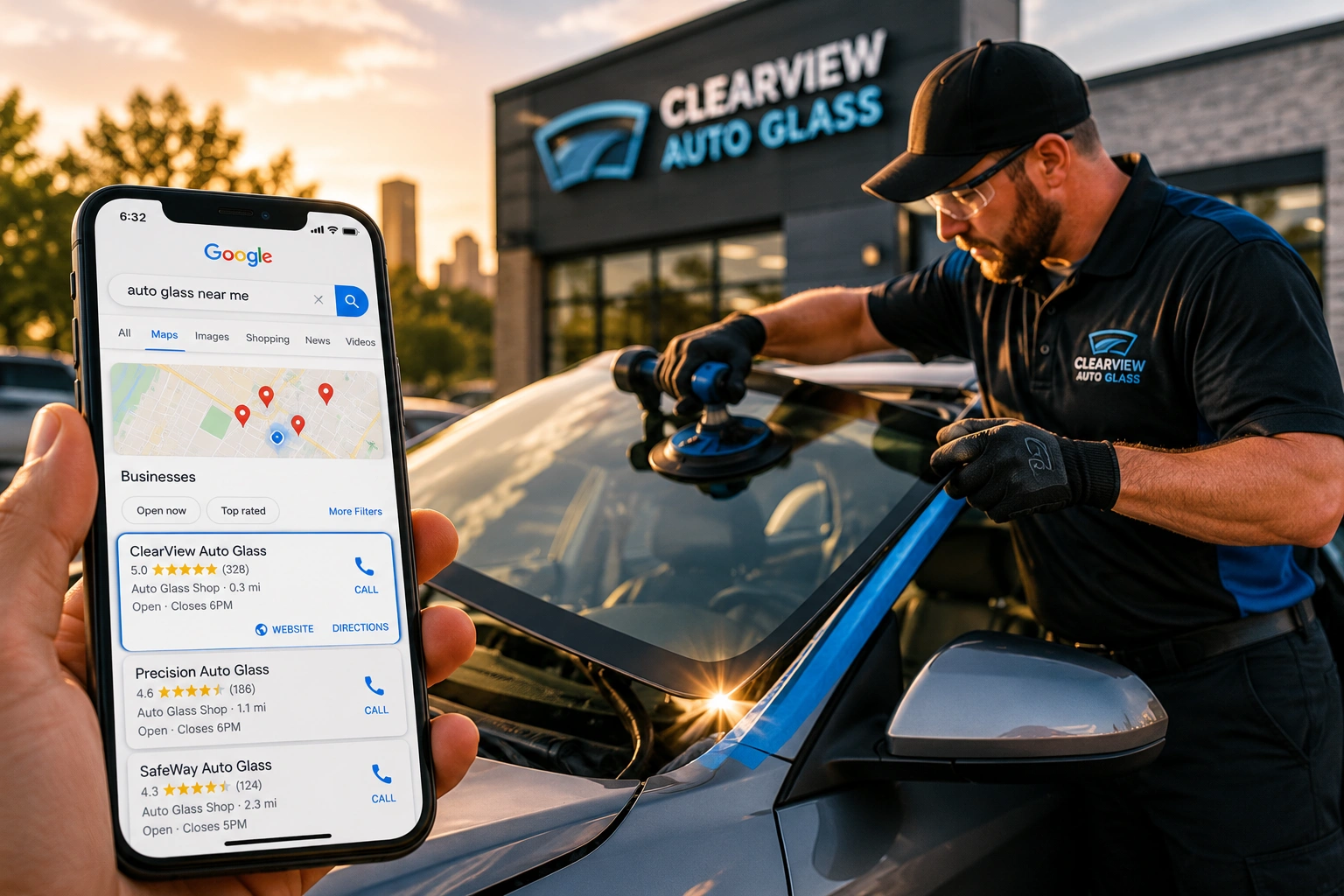
Local search visibility helps auto glass businesses connect with customers at the exact moment service is needed.
By the BizIQ Local SEO Editorial Team We are a team of dedicated local marketing specialists who stand beside small business owners as equals. We combine years of hands-on technical expertise with a deep understanding of the automotive service industry to help local shops grow sustainably.
- Master Google Maps: Learn how to optimize your Google Business Profile to capture the 86% of searchers looking for immediate, local windshield repair.
- Target High-Ticket Niches: Discover how ranking for ADAS calibration keywords can open up high-margin retail jobs and lucrative B2B fleet partnerships.
- Navigate the Proximity Penalty: Get proven strategies for mobile-only auto glass businesses to rank safely without risking profile suspension.
- Prepare for AI Search: Understand how to structure your website’s content and schema markup to win citations in Google’s AI Overviews.
How can Auto Glass Shops Capture High-Intent Leads and Dominate Local Search Rankings?
Your auto glass shop must optimize its Google Business Profile (GBP), target localized glass replacement keywords, and maintain accurate citation listings. An SEO Playbook that rises above all others requires generating recent and consistent customer reviews and deploying structured service schema, ensuring search engines and AI platforms easily cite your mobile or in-shop services.
When a driver gets a rock chip or a cracked windshield on the highway, they do not spend days researching options. They pull over, search for “windshield replacement near me” on their phone, and call the first reputable shop they see. According to industry data, 86% of “auto glass repair near me” searches trigger the Google Map Pack, bypassing traditional organic listings entirely. Because windshield damage represents an urgent, high-friction problem, searchers show rapid decision-making behavior. If your business is not visible in those top three local map results, you are effectively invisible to the vast majority of local customers. You miss out completely.
At BizIQ, we are a small business ourselves. We see local shops as the heartbeat of America, driving our local communities forward. We also know that digital marketing can feel overwhelming and expensive, especially when you are focused on running a busy shop. Many auto glass owners worry that they will waste hard-earned money on marketing strategies that do not translate into genuine phone calls. That is why we take an evidence-based approach to Auto Glass SEO. We believe that sophisticated marketing belongs to you too, and we are here to stand beside you, not above you, to explain here’s what works and why. By aligning your online presence with real-world customer behavior, we can help you build a reliable, long-term lead generation engine that reduces your dependency on costly paid ads.
Why Auto Glass SEO Is Your Shop’s Most Critical Lead Generation Engine
Understanding the Urgent Nature of Automotive Local Search Intent
Windshield damage does not behave like most purchase decisions. There is no comparison shopping phase, no extended consideration window, no waiting until the weekend. Decisions happen fast. A cracked windshield is a safety issue and, in many states, a legal one, which means the customer’s decision timeline shrinks from days to minutes. That urgency shapes everything about how your shop needs to appear online.
When someone searches “windshield replacement near me” or “auto glass repair near me,” they are not browsing. They want a phone number, a location, and a signal that you can help them today. Google Maps surfaces exactly that information in the Map Pack, the three-business block that dominates the top of local search results, and it does so before a single organic listing appears. Automotive local search intent in the auto glass category is among the most commercially concentrated of any service vertical, precisely because the purchase trigger is involuntary. Nobody plans to need a windshield replacement.
This is why local search engine optimization for auto glass shops is not a nice-to-have. It is the primary mechanism by which customers find you during the moments they are most ready to spend money. Ranking in the Map Pack aligns your digital presence with that compressed decision window in a way that no billboard, mailer, or social media ad can replicate.
The Long-Term ROI of Organic SEO vs. Paid Advertising
Paid search gets you in front of customers immediately, and there is a legitimate place for it in an early-stage growth strategy. But the economics of paid advertising in the auto glass space have grown costly. Cost-per-click rates for competitive terms like “windshield replacement” in mid-sized markets can run $15 to $30 per click, and clicks are not leads. Those costs add up.
Organic search compounds differently. A recent case study for Only 1 Auto Glass documented a 12% organic conversion rate from search traffic, which is roughly three to four times the industry average for paid campaigns. That figure reflects something important: people who find you through organic local search have already filtered themselves. They searched, they saw your profile, they read your reviews, and they chose to call. The intent is pre-qualified in a way that paid clicks rarely are.
Another case study for Auto Glass Zone reinforces this. Organic search accounted for 61.83% of the shop’s total online conversions, not just traffic, but genuine leads, outperforming every paid channel combined. By the second year of a mature auto glass SEO campaign, cost per lead typically settles between $30 and $60. Paid search rarely touches those numbers without significant budget discipline and ongoing management overhead. The compounding nature of organic visibility means that every piece of optimized content, every earned review, and every structured citation you build today continues generating leads without additional spend.
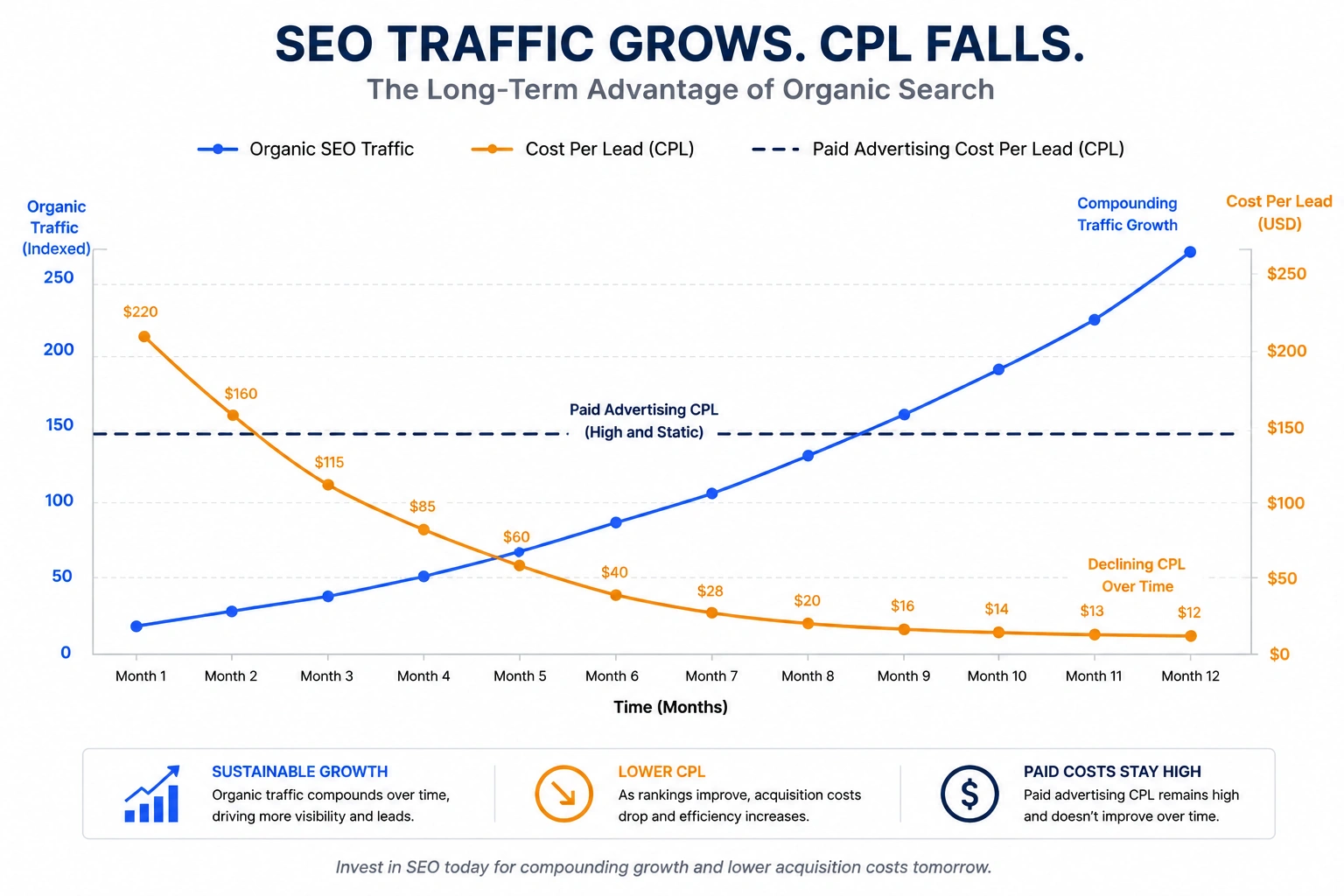
As organic SEO traffic compounds over time, cost per lead declines while paid advertising costs remain consistently high.
Step-by-Step Google Business Profile Optimization for Auto Glass Shops
Setting the Foundation with Categories and Services
According to a recent Local Search Ranking Factors Report, your Google Business Profile carries approximately 32% of the total algorithmic weight for Map Pack rankings. No other single optimization lever comes close. Which means if your GBP is incomplete, miscategorized, or stale, everything else you do, including your website, citations, and backlinks, is working against a structural ceiling.
Category selection is where most shops quietly lose ground. It is an easy mistake. Setting your primary category to “Auto Repair Shop” instead of “Auto Glass Shop” weakens your local relevance signal for every glass-specific search query. Google uses the primary category as a core disambiguation signal; it tells the algorithm what your business fundamentally does. The more specific and accurate that signal, the stronger your Map Pack eligibility for the searches that truly matter to your revenue. Our foundational guide on Google Business Profile optimization walks through the category selection process in detail, but the short version is this: precision beats generality every time.
Category selection is only the starting point; the Services section is chronically underused. Listing “windshield replacement,” “rock chip repair,” and “ADAS calibration” as explicit service entries gives Google additional entity signals to match your profile against relevant queries. It also gives customers scanning your profile a faster path to confirming you offer what they need, which matters enormously when the decision window is measured in seconds. Implemented changes to category alignment often see results within a 30 to 60-day tracking window.
Actionable GBP Optimization Checklist
A complete, well-maintained profile is not a one-time setup task. It is an ongoing operational signal. These are the elements that move the needle most reliably:
- NAP consistency: Your business name, address, and phone number must be character-for-character identical across your website, GBP, and every local directory where your shop appears. Even minor formatting discrepancies, like “St.” vs. “Street” or a missing suite number, weaken the trust signal Google uses to verify your legitimacy.
- Business description: Write it to serve the customer, not the algorithm. A description that naturally includes phrases like “windshield glass replacement near me” and references your service process reads as authentic rather than stuffed. Two to three sentences that answer “who you are, what you do, and why you’re worth calling” is the right frame.
- Weekly photo updates: Geo-tagged photos of completed jobs, your technicians at work, and your physical location function as a freshness signal. Profiles with regular photo activity consistently outperform dormant ones in local ranking studies.
- Messages enabled: Rapid-decision searchers want the path of least resistance. Enabling the Messages feature gives them a direct channel to your shop without requiring a phone call, which some customers, particularly younger demographics, actively prefer.
For a deeper breakdown of profile maintenance tactics, our advanced Google Business Profile SEO tips guide covers the settings most shops overlook. Small details make a difference.
Navigating the Mobile-Only vs. In-Shop Dilemma and Proximity Penalties
The Proximity Penalty for Service Area Businesses (SABs)
Mobile-only operators occupy an awkward position in local search. Ranking is harder. The service model makes operational sense: lower overhead, flexible dispatch, and broader geographic reach, but Google’s Map Pack algorithm was not designed with SABs as the primary use case. Physical storefronts receive a structural ranking advantage because Google can verify their location with greater confidence. That verification gap is what practitioners call the proximity penalty, and it is a genuine obstacle, not a myth.
Google’s guidelines are clear on one point: if you do not serve customers at your physical location, the guidelines require hiding your address and configuring a service area instead. Listing a P.O. Box, a virtual office, or a residential address as a storefront violates those guidelines directly. The consequence is not a ranking dip: it is profile suspension, which can take weeks or months to resolve and costs you leads the entire time. Mobile windshield repair SEO requires working within these constraints, not around them.
The practical path forward involves leaning harder on the signals that SABs can control: review volume, service-area page depth, and citation consistency across directories that accept service-area configurations. Some mobile operators have found success partnering with local auto body shops or tire centers to establish a compliant physical co-location, but that arrangement requires careful documentation to pass a Google verification challenge.
Building Strong Service-Area Pages to Offset Proximity Issues
Service-area pages are the most scalable tool available to mobile operators who cannot rely on a storefront’s proximity signal. A dedicated page targeting “mobile windshield repair in [City Name],” built with genuine local content rather than templated copy, creates an organic ranking asset that compounds over time. The key difference is specificity. Pages that reference local landmarks, neighborhood names, common local road conditions, or community partnerships read as locally authoritative to both search crawlers and human visitors.
Duplicate or near-duplicate city pages are a trap. They do not work. Google identifies thin, templated content reliably, and the penalty for it, whether a manual action or an algorithmic demotion, can set back months of work. Each service-area page needs its own angle: a unique customer scenario, a locally relevant reference, or a specific service detail that makes the page genuinely useful to someone in that area. Our local SEO guide on local SEO strategies covers the content architecture for service-area pages in more depth, including how to structure internal linking between them to distribute authority efficiently.
Local SEO for auto glass shops operating as SABs is harder, but not unwinnable. It just requires a different playbook: one built on content depth and review authority rather than physical proximity.
Targeting High-Ticket Niches: ADAS Calibration and Fleet Services
Capturing High-Margin Jobs with ADAS Calibration Keywords
Advanced Driver Assistance Systems (ADAS) calibration is no longer an optional upsell. On most vehicles manufactured after 2018, windshield replacement requires a mandatory recalibration of forward-facing cameras and sensors embedded in or near the glass: lane departure warning, automatic emergency braking, and adaptive cruise control. Skip the calibration, and the system fails. That is a liability issue for the shop and a safety issue for the driver.
What makes this operationally significant for SEO is the search behavior it creates. A customer searching “windshield camera calibration near me” or “ADAS calibration after windshield replacement” is not price shopping. They have a specific, technical need, and they need a shop that can perform the service. The advanced driver assistance system market size is expanding rapidly as newer vehicle fleets age into the replacement window, which means demand for calibration services is growing while local supply remains thin. Many independent shops have invested in the equipment but have not built the digital infrastructure to capture the inbound demand.
Search volume for calibration-specific terms is lower than “windshield replacement”, but that is precisely the point. Low volume in local SEO often correlates with high commercial intent and minimal competition. A shop in a mid-sized market targeting “ADAS calibration [City]” can rank on page one within 60 to 90 days with a well-built dedicated landing page, while the same shop might spend 12 months chasing a top-three position for “windshield replacement.” The average calibration job runs $300 to $600. The margins are high. Capturing even three or four of those per week through organic search changes the revenue profile of the business meaningfully. These are exactly the keywords for windshield repair businesses that most operators are leaving uncontested.
Securing Lucrative B2B Fleet Glass Management Partnerships
Fleet accounts operate on a different logic than retail customers. They value efficiency. A fleet manager for a regional delivery company or a municipal vehicle pool is not making an emergency decision: they are evaluating vendors based on turnaround time, billing simplicity, and service reliability. The content that converts them is not the same content that converts a driver with a cracked windshield on the side of the road.
Dedicated landing pages for “Fleet Glass Management” and “Commercial Auto Glass Services” serve a dual purpose: they capture direct organic traffic from fleet managers searching for vendors, and they signal to Google that your shop operates across multiple service categories, which broadens your topical authority. We recommend addressing fleet-specific concerns on these pages directly, covering guaranteed response windows, consolidated invoicing, and mobile dispatch to vehicle yards, rather than repurposing retail-facing copy. Fleet relationships generate recurring, predictable revenue that softens the seasonal volatility most glass shops experience in slower months. Building the digital infrastructure to attract those accounts is a long-term investment with a disproportionate return.
“Many auto glass shops ignore ADAS calibration keywords because of lower search volumes. But in local SEO, low volume often means high commercial intent and minimal competition. Ranking for these terms is how you capture the most profitable, high-margin jobs in your local market.” : BizIQ Local SEO Strategist
On-Page Content Architecture and Local Schema Markup
Structuring Dedicated Service Pages for Search Engines and Humans
A single “Services” page listing everything your shop does is not a content strategy. It is a missed opportunity. Search engines, and the AI systems that increasingly act between search engines and users, reward specificity. A dedicated page for windshield replacement, a separate page for rock chip repair, and a standalone page for ADAS calibration each create an independent ranking asset targeting a distinct cluster of search queries. That architecture is how you rank your windshield repair shop on Google across multiple revenue-generating terms simultaneously, rather than competing with yourself on a single catch-all page.
The structural requirements for these pages are not complicated, but they are non-negotiable. Clear H2 and H3 headings that mirror the language customers use in search queries. A mobile-first layout with a click-to-call button above the fold. Concise, direct copy that answers the customer’s core question: “Can you fix my specific problem, and how quickly?” within the first two paragraphs. These are not design preferences; they are conversion mechanics. They drive phone calls. The local service industry benchmark for website-to-lead conversion sits between 3% and 6%, but mobile-optimized pages with prominent call triggers can push visitor-to-call rates above 30%. That gap is almost entirely attributable to page structure, not traffic volume.
Windshield repair SEO at the page level also means thinking about what the page earns beyond rankings. A well-built service page that answers common questions, explains the process, and addresses insurance coverage concerns becomes a trust asset that converts skeptical visitors who would otherwise bounce. If you are evaluating agencies on their ability to build these pages effectively, our guide on how to choose an SEO company for automotive service businesses outlines the specific capabilities worth vetting.
Implementing Schema Markup for Machine-Readable Trust Signals
Schema markup is where a lot of shops either skip the step entirely or implement it incorrectly and assume the job is done. JSON-LD is the format Google recommends, and it works by embedding structured data directly in your page’s HTML, providing data that tells search crawlers exactly what your business is, where it operates, what services it offers, and how to contact you. It does not change what the page looks like to a human visitor. It changes what the page communicates to a machine. It works behind the scenes.
For an auto glass shop, the minimum effective schema implementation includes LocalBusiness markup on your homepage, covering your NAP, operating hours, and service area, and Service schema on each individual service page. The Service schema is particularly valuable for ADAS calibration pages because it allows you to specify the service type, associated vehicle categories, and price range in a structured format that AI search engines can extract and cite directly. Google Search Console is the right tool for auditing your schema implementation after deployment; the Rich Results Test within Search Console will flag errors and warnings before they affect your indexation. Catching a malformed JSON-LD block early prevents the scenario where you have spent weeks building a page that Google cannot reliably parse.
Automotive SEO services that include schema implementation as a standard deliverable, rather than an add-on, are worth the investment. The compounding effect of clean, validated structured data on search engine indexing is measurable over a 90-day window, and it becomes increasingly important as AI-driven search engines rely more heavily on structured signals to generate cited answers.
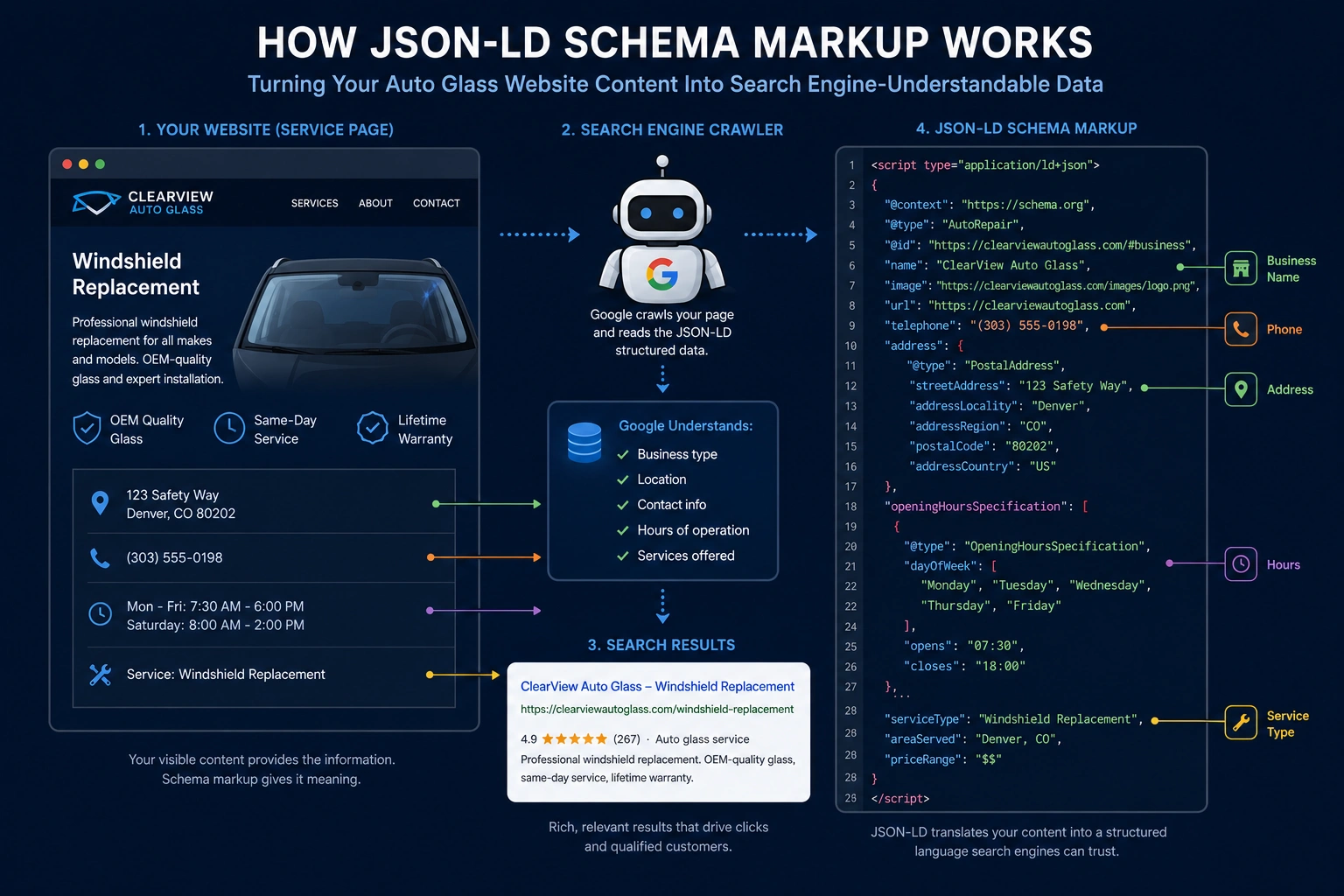
JSON-LD schema helps search engines understand business information by translating website content into structured data.
Technical SEO can feel complex, but here’s what you need to know: we handle the hard part so you don’t have to. At BizIQ, we don’t believe in knowledge gatekeeping. We implement advanced schema markup, build high-converting landing pages, and optimize your site’s technical foundation to ensure you rank where it matters. Let’s discuss how we can scale your shop’s visibility. Explore Our Automotive SEO Services
Review Velocity and Quality: The Ultimate Local Trust Signal
Implementing an Automated Review Generation System
Reviews account for roughly 20% of the local ranking algorithm weight, according to a recent Local Search Ranking Factors Report. That is not a minor signal: it is the second-largest ranking factor behind GBP optimization, and it is one of the few factors where a small, independent shop can outperform a national chain through operational discipline alone.
The shops that consistently outrank their competitors on review volume are not doing anything exotic. They have removed the friction from the ask. They make it easy. An automated SMS sent within 30 minutes of job completion, while the customer is still in the parking lot and thinking about the experience, generates response rates that a follow-up email three days later cannot approach. The timing matters because the emotional peak of a positive service experience is immediate and short-lived. Catching customers in that window is the difference between a 4.2-star profile and a 4.8-star profile, and that gap is visible to every potential customer who compares you against a competitor.
Windshield repair SEO strategies that ignore review generation are leaving a structural ranking advantage on the table. Beyond the algorithmic weight, reviews that organically include terms like “fast,” “same-day,” “insurance claim,” or “mobile service” function as user-generated keyword signals, a form of citation that reinforces your relevance for the exact queries your customers are typing.
Handling Reviews and Building Long-Term Trust
Responding to reviews is not optional in reputation management. It is an active ranking signal. Google’s documentation clearly notes that responding to reviews improves your business’s local visibility, and the behavioral data supports it: potential customers read owner responses, particularly on negative reviews, to assess how the business handles problems.
A negative review handled well, acknowledged promptly, addressed specifically, and resolved where possible, often converts more skeptical visitors than a page of five-star ratings. The response demonstrates operational accountability in a way that marketing copy cannot. This builds trust. Keep responses concise, avoid defensive language, and resist the urge to argue the facts publicly. The audience for your response is not the reviewer; it is the next hundred people who read the thread.
Embedding your strongest reviews directly on service pages, particularly reviews that mention specific services like ADAS calibration or insurance claim assistance, creates a secondary trust layer for visitors who arrive through organic search. Our guide on optimizing local business listings covers the technical implementation of embedded reviews and how to structure them for maximum conversion impact. Local SEO citation building for auto glass shops extends beyond directory listings; your review profile is itself a citation network, and it compounds with every new entry.
Preparing for AI-Driven Local Search (AIO and GEO)
Optimizing Content for Google’s AI Overviews and Conversational Queries
The search results page has changed more in the past 18 months than in the previous decade. AI is driving this shift. Google’s AI Overviews now appear above the Map Pack for a growing share of informational and commercial queries, combining answers from multiple sources and citing the pages they drew from. For auto glass shops, this creates a new ranking surface, one that most competitors have not yet optimized for, which makes it an early-mover opportunity rather than a crowded race.
Voice search optimization for auto repair and AI-driven local SEO strategies both converge on the same structural principle: content that answers a specific question directly, in plain language, within the first 50 words of a response is the content that gets extracted and cited. The two-tier format works consistently: a bolded, immediate answer at the top of an FAQ entry or service explainer, followed by the detailed, process-oriented explanation for readers who want depth. That structure serves both the AI crawler pulling a snippet and the human visitor who clicked through to learn more.
The queries that trigger AI Overviews in the auto glass space tend to be question-based: “Does insurance cover windshield replacement?” “How long does ADAS calibration take?” “What is the difference between windshield repair and replacement?” Shops that have built content answering these questions with clear, direct, well-structured responses are already appearing in AI-generated answers. Shops that have not are invisible to an increasingly large share of the search results page.
Building Topical Authority Through Entity Relationships
AI search engines do not rank pages. They rank entities: businesses, topics, and concepts that they understand well enough to trust as authoritative sources. For an auto glass shop, building that entity authority means creating content that covers the full lifecycle of the auto glass customer experience: the initial damage assessment, the insurance claim process, the replacement procedure, the ADAS calibration requirement, and the post-service safety verification.
Each piece of content that addresses a distinct node in that lifecycle strengthens the entity relationship between your shop and the topic of auto glass service. Over time, Google’s understanding of your business shifts from “a shop that uses the word windshield a lot” to “an authoritative local source on auto glass services.” That shift is what drives citations in AI Overviews and sustained rankings across a broad cluster of related queries. It builds real authority.
Question-based headings are the most reliable structural signal for AI extraction. A heading like “Does insurance cover windshield replacement?” followed immediately by a direct, accurate answer gives AI crawlers a clear extraction target. The search engine indexing process for AI-driven engines prioritizes content that is both topically deep and structurally clear, not one or the other. Shops that invest in this content architecture now are building a moat that will be significantly harder for competitors to cross in 12 to 18 months.
Measuring Success: Key SEO Benchmarks and Cost Per Lead
Tracking the Right Metrics in Google Analytics and Search Console
Third-party keyword tools are useful for directional research, but they consistently miss hyper-local query demand. A search like “windshield repair [specific neighborhood]” or “does State Farm cover windshield replacement in [city]” may show near-zero volume in a keyword tool while generating dozens of monthly searches that your competitors are quietly capturing. Google Search Console is the only tool that shows you the real queries driving impressions and clicks to your site, which makes it the primary diagnostic instrument for any serious google search console SEO audit.
The metrics worth tracking weekly are not complicated: total impressions, click-through rate by query, average position for your core service terms, and, most importantly, the conversion events tied to organic traffic in Google Analytics. Phone calls triggered from organic visitors, form submissions from service pages, and direction requests from your GBP listing are the numbers that connect SEO activity to business outcomes. Vanity metrics like total traffic or keyword rankings are only meaningful in relation to those conversion events. Focus on real leads.
The standard website-to-lead conversion benchmark for local service businesses sits between 3% and 6%. If your organic traffic is converting below that floor, the problem is almost always page structure or mobile experience, not traffic volume. Optimizing for mobile with a persistent click-to-call button can push visitor-to-call rates above 30% on high-intent pages. That is not a marginal improvement; it is the difference between a campaign that pays for itself and one that does not.
Understanding the True Cost of Auto Glass Lead Generation
Mature auto glass lead generation SEO campaigns consistently deliver cost-per-lead figures between $30 and $60 by the second year of implementation. That range assumes a well-executed strategy: complete GBP optimization, dedicated service pages, clean schema, and active review generation, in a local market with moderate competition. In highly competitive metro markets, the CPL may run higher in year one as the campaign builds authority, but the path is reliably downward as organic rankings stabilize.
Paid search does not follow that path. Every lead from a paid campaign costs what it costs, regardless of how long you have been running ads. There is no compounding, no equity accumulation, no asset being built. The moment you pause the budget, the leads stop. The flow dries up. Organic SEO builds a different kind of infrastructure, one where the work you do in month three continues generating returns in month 18, and where the cost per lead decreases as your authority grows rather than remaining static. We measure our success by the positive impacts we make on our partners.
For shops evaluating whether to manage SEO in-house or partner with a specialist, our analysis of top SEO companies for collision repair provides a useful framework for assessing what a capable auto glass SEO agency should deliver. The automotive service vertical has specific local search dynamics that generalist agencies frequently underestimate, particularly around GBP category signals, ADAS content architecture, and the insurance-related query clusters that drive a disproportionate share of high-intent traffic. SEO for auto glass companies requires that vertical fluency, not just technical competence.
Frequently Asked Questions
How long does it take for Auto Glass SEO to generate leads?
Most auto glass shops see initial Map Pack movement within 30 to 60 days of optimizing their Google Business Profile. The earliest gains typically come from correcting category mismatches, completing the Services section, and publishing geo-tagged photos, which are changes that Google can process and re-rank against relatively quickly.
Establishing consistent, mature organic lead generation is a longer arc. It takes time. Three to six months of continuous on-page optimization, citation building, and review collection is the realistic timeline for a shop moving from minimal visibility to a stable top-three Map Pack position. In highly competitive markets, such as major metro areas with multiple established competitors, that timeline can extend to nine months. The compounding nature of organic SEO means the results accelerate over time rather than plateauing, which is the fundamental difference between this channel and paid advertising.
Should a mobile-only windshield repair shop list a physical address on Google?
No. Google’s guidelines are clear: if you do not serve customers at your physical location, the guidelines require hiding your address and configuring a service area instead.
Listing a P.O. Box, a virtual office address, or a residential address as a storefront is a guideline violation that can trigger immediate profile suspension. The recovery process is slow and unpredictable, and the leads lost during suspension are unrecoverable. Do not risk it. The safer and more sustainable path is to configure your service area accurately, build strong service-area landing pages for your primary markets, and invest aggressively in review volume to offset the proximity disadvantage that SABs face in the Map Pack algorithm.
Does targeting ADAS calibration keywords drive high-value jobs?
Yes, and the opportunity is larger than most shops realize. The potential is huge. ADAS calibration is required after windshield replacement on most vehicles manufactured after 2018, which means the demand is structurally embedded in every replacement job that involves a camera-equipped vehicle.
Because many independent shops either lack the calibration equipment or have not built the digital infrastructure to market the service, the competitive field for calibration-specific search terms remains thin in most local markets. A shop that builds a dedicated ADAS calibration page and maintains a complete GBP entry for the service can realistically rank in the top three local results within 60 to 90 days. At $300 to $600 per calibration job, capturing three or four additional calibration leads per week through organic search represents a meaningful revenue addition, and it positions the shop as a referral destination for other local mechanics who lack the equipment.
How do we optimize our website to rank in Google’s AI Overviews?
Answer customer questions directly, in plain language, within the first 50 words of your response, then follow with the detailed explanation.
AI crawlers extract content that is structurally clear. Structure is key. A heading phrased as a question (“Does insurance cover windshield replacement?”) followed immediately by a clear, accurate answer gives the extraction algorithm exactly what it needs. Beyond content structure, implementing validated FAQPage schema markup on your FAQ sections signals to Google that the content is explicitly formatted for question-and-answer extraction, which increases the probability of citation in AI-generated responses. Use Google Search Console’s Rich Results Test to verify that your schema is error-free before publishing.
How do we choose the right SEO partner for our auto glass business?
Look for an agency that understands the specific local search dynamics of the automotive service industry, not just general SEO mechanics.
The auto glass vertical has distinct ranking factors: GBP category precision, ADAS content architecture, insurance-related query clusters, and the proximity challenges facing mobile operators. An agency that treats your shop like a generic local business will miss all of those details. Do not settle. Transparent reporting matters too: we recommend looking for clear visibility into exactly which queries are driving traffic, which pages are converting, and what the cost per lead looks like month over month. At BizIQ, we have helped more than 200 small businesses build sustainable organic lead generation engines. We approach every engagement with the understanding that your marketing budget is not abstract capital: it is money you earned doing skilled work, and it deserves a measurable return. We believe in earned authority through results, and we are committed to making a positive impact on our partners.
To avoid the limitations of paid advertising and secure your shop’s market share, here is your practical next step: audit your Google Business Profile. Verify that your primary category is set to “Auto Glass Shop,” audit your NAP consistency across the top 15 local directories, and publish three dedicated service pages targeting windshield replacement, rock chip repair, and ADAS calibration. Local SEO is not a one-time task: it is a long-term investment that builds a compounding asset for your business. Consistency is key. We are here to stand beside you every step of the way.
Ready to dominate your local market and drive consistent, high-value leads? Don’t let complex technical SEO hold your business back. At BizIQ, we specialize in helping local auto glass shops like yours outrank the competition and grow sustainably. Let’s build your custom Auto Glass SEO strategy together.