
Every house cleaning client makes a significant, largely unspoken decision before they ever book your service: they decide whether to hand a stranger the keys to their home, their private spaces, and their peace of mind. When potential clients search Google for local cleaners, price is rarely the deciding factor. They are scanning for proof: proof that your team is safe, meticulous, and trustworthy enough to be inside someone’s home unsupervised. Trust is everything.
If you are like most owners, you probably feel awkward asking for reviews. You want to grow, but you worry: how do I get more Google reviews in a way that doesn’t make me look desperate? Meanwhile, you look online and see that your competitors have more reviews, which makes it harder to win new jobs.
Your Google Business Profile is like your storefront window: it is what people see first, and if it is empty, they keep walking. Investing in house cleaning SEO services can make all the difference in getting potential customers to stick around. A five-star average with twelve reviews from two years ago does not move the needle anymore. Recency matters. What converts a skeptical homeowner is a steady stream of detailed, recent feedback that describes the actual work: the baseboards, the shower glass, the folded towels on the bathroom counter. Here is what works to turn your daily cleaning jobs into a self-sustaining local visibility engine, without being pushy.
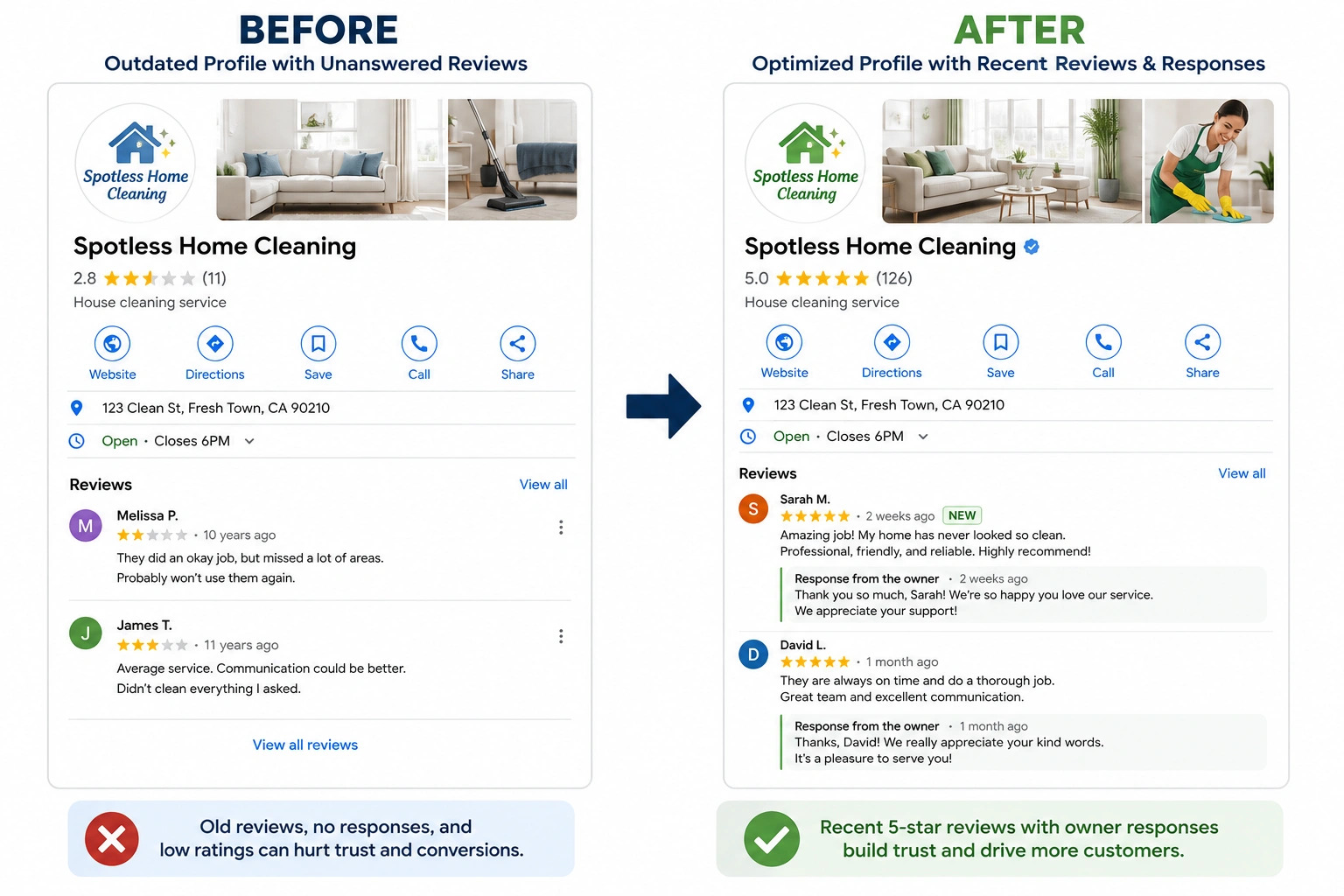
Responding to customer reviews and keeping your Google Business Profile current builds trust and improves first impressions.
Why Google reviews are the ultimate currency of trust for house cleaners
Residential cleaning occupies a distinct category in local services. We are not selling a haircut or a restaurant meal; we are selling access to private spaces, and the emotional stakes of that transaction are considerably higher than most service categories. Generic five-star ratings do not dissolve that anxiety. Detailed, specific, localized reviews do.
Google’s official local ranking documentation identifies three pillars that determine local search placement: relevance, distance, and prominence. Of the three, prominence is the one we can actively build. Review count, average score, and, crucially, the specific text within those reviews all feed directly into how Google measures your business’s authority within a geographic market. When a client writes that your team “scrubbed the grout lines in the master bath and wiped down every cabinet door,” they are not just flattering you; they are feeding Google the semantic signals it needs to rank your profile for high-intent queries like “deep house cleaning” or “thorough maid service near me.”
Think of your review profile the way you would think about neighborhood reputation. One satisfied client tells a few friends. A structured acquisition system multiplies that word-of-mouth at scale and deposits it exactly where prospective clients are already searching. Asking for reviews is like asking a satisfied customer to tell a friend: timing matters. Furthermore, managing your Google reviews and writing responses is free advertising that costs you nothing but a few minutes. Investing in house cleaning SEO services builds the infrastructure, but a live, growing review profile is the fuel that makes that infrastructure perform.
The math of Map Pack rankings: How many reviews do you need?
There is no universal target number, and anyone who gives you one without referencing your specific local market is guessing. Every market is different. What matters is your review density relative to the competitors ranking above you in your target zip codes, not some random national benchmark.
That said, competitive patterns do emerge across markets:
- Baseline credibility: 50 to 100 reviews establishes enough social proof to compete for standard first-page organic listings.
- Map Pack top three: In most mid-to-large markets, the cleaning companies holding the top three Map Pack positions carry 150 to 500+ reviews.
- Local Services Ads dominance: Securing a consistent top LSA placement typically demands 200 to 400+ reviews with sustained monthly velocity.
- The recency factor: Whitespark’s Local Search Ranking Factors study flags review recency as a top-tier signal. Five new reviews per month, sustained over a year, outperforms a one-time spike of 100 reviews collected three years ago, by a significant margin.
Velocity matters more than volume. A competitor with 80 reviews and zero activity in the past six months is genuinely beatable by a business with 60 reviews and a consistent stream of four to five new ones each month. When we are mapping our strategy around getting found on Google Maps, that relative density calculation is where we should start, not with a round number someone mentioned in a forum.
The two-touch timing strategy: When to ask for maximum impact
Timing a review request is less about finding some mythical perfect moment on a calendar and much more about catching a client when their emotional response to your hard work is still fresh and highly positive. Ask too early and they haven’t experienced the full value. Wait a week and the clean home has become the new normal, meaning our request competes with everything else in their inbox.
Four moments consistently produce the highest response rates:
- The first clean “wow” moment. The contrast between your professional standard and whatever the client was living with before is sharpest after the first or second visit. Ask immediately.
- The loyalty milestone. For recurring clients, a once-a-year request framed around their long-term relationship with your company produces some of the most persuasive reviews you will ever earn. A testimonial that reads “they’ve cleaned my home bi-weekly for three years” carries more conversion weight than a dozen generic five-stars.
- The move-out clean. Send the request the same afternoon the job closes. The relief of a security deposit secured is a powerful motivator, and that window is short.
- The deep clean or post-renovation clean. The before-and-after transformation is striking within the first 24 hours. That is your window.
Each of these moments has a different emotional texture, which means your outreach message should shift slightly for each. A move-out client is relieved. A loyalty-milestone client feels appreciated. A first-clean client is impressed. Match the tone of your request to the emotional state of the recipient.
Asking without the awkwardness: Scripts your cleaners will use
Leaving review acquisition to chance, or worse, to an awkward doorstep pitch, is how most cleaning businesses stall out at thirty reviews and stay there. The fix is not a motivational speech to your team. It is a simple, non-pushy way to ask that your cleaners can deliver naturally after a spoken confirmation of satisfaction.
One rule before the ask: your cleaner should only request a review after the client has walked through the home and explicitly said they are happy. Tying the request to their stated satisfaction removes pressure from both sides of the conversation. It keeps things natural.
A script that works for a local cleaning company:
“I’m so glad you’re happy with how the kitchen and baseboards turned out today! Reviews help other local families trust us before they book. I’ll text you a quick, guided link if you’d be willing to share your honest experience.”
This is short, specific, and positioned as a favor to the community, not a favor to the business. A systematic approach to review acquisition gives your staff the exact structure they need to carry out this process consistently after every single job without feeling like they are forcing a sales pitch on a happy customer.
The blank box problem: How guided prompts retrieve specific details
Open a blank Google review box in front of most people and they freeze. They get writer’s block. They want to help, but they do not know what to say, so they default to “great service!”, which does almost nothing for your local SEO. The reviews that really move your ranking contain specific service language: room names, task descriptions, and behavioral details about your team.
Solving this is simple. In your follow-up SMS or email, include one or two guided questions before the review link:
- “What was your favorite part of today’s clean: the spotless shower glass, the folded towels, or the clean baseboards?”
- “Did our team arrive on time and respect your pets or kids?”
You are not writing the review for them. You are jogging their memory with the specific details that translate into keyword-rich, semantically useful feedback. When a client writes that your team “arrived on time, cleaned around the dog, and left the baseboards spotless,” Google reads that as a highly relevant signal for searches like “pet-friendly house cleaning” or “reliable maid service.” That is where the technical side of reviews for cleaning company local map ranking becomes genuinely significant.
Staying FTC-compliant: The golden rules of review incentives
The temptation to speed up review acquisition with a discount or gift card is understandable. Resist it. Both Google and the Federal Trade Commission have enforcement mechanisms that can remove your reviews, restrict your profile, or suspend your listing entirely: and the April 2026 policy updates introduced automated detection that acts faster than a manual appeal can resolve.
Under the FTC’s Consumer Reviews and Testimonials Rule and Google’s current policies, four practices are explicitly prohibited:
- No Pay-for-Play: Discounts, free cleanings, gift cards, or cash in exchange for a rating, regardless of whether you specify “five stars”, constitute review manipulation.
- No Review Gating: You cannot pre-screen customers and send the Google review link only to those who indicate they’re satisfied. Every client gets the same link, regardless of sentiment.
- No Staff-Name Prompts: Instructing clients to mention a specific employee by name in their review violates policy. Organic mentions are fine; scripted prompts are not.
- No On-Premises Pressure: Your team should not solicit reviews while still inside the client’s home, and setting up a shared tablet or kiosk for on-site review submission is explicitly prohibited.
There is a compliant path for rewarding your team that many owners overlook: internal quality metrics. Focus on internal standards. Post-service satisfaction surveys, random quality inspections, and client retention rates are all legitimate performance indicators that can base an employee incentive program without touching Google’s platform. Keep the internal reward system entirely disconnected from the public review pipeline.
Replying with discretion: How to respond to positive and negative feedback
Every reply you write to a Google review is a public-facing advertisement for your professionalism. Most cleaning businesses treat responses as an afterthought. That is a missed opportunity.
For positive reviews, thank the client by name, reference the specific service they mentioned, and keep it warm without being excessive. One thing to be deliberate about: never reveal details about their home, schedule, or address that they did not voluntarily include in the public review. Discretion is part of the service you are selling.
Negative reviews require a different discipline entirely. The instinct to defend your team point-by-point is understandable and almost always unhelpful. Acknowledge the frustration, state your commitment to quality, and move the conversation offline with a direct phone number or email. Prospective clients reading that exchange are not judging whether you were right; they are judging how you handle mistakes.
If you encounter a review that appears fraudulent, a name that does not match any client in your database, a suspiciously generic complaint, or a pattern that suggests a competitor, start with a clear review reputation management strategy before escalating. You can also take direct steps to remove fake Google reviews by flagging them through your Google Business Profile dashboard and submitting an appeal with documented evidence.
Building the review machine: Automating requests post-job
Manual review requests fail at scale. A cleaner finishes a job, drives to the next one, and the follow-up text never gets sent. Multiply that across a team of five and a full week’s schedule, and you have left dozens of potential reviews on the table every month.
The fix is removing human judgment from the trigger. Automation is key. Field service platforms like MaidCentral, NiceJob, and CleaningOS integrate directly with your scheduling system to fire SMS and email requests within one to two hours of job completion, automatically, for every client, every time.
The workflow is simple:
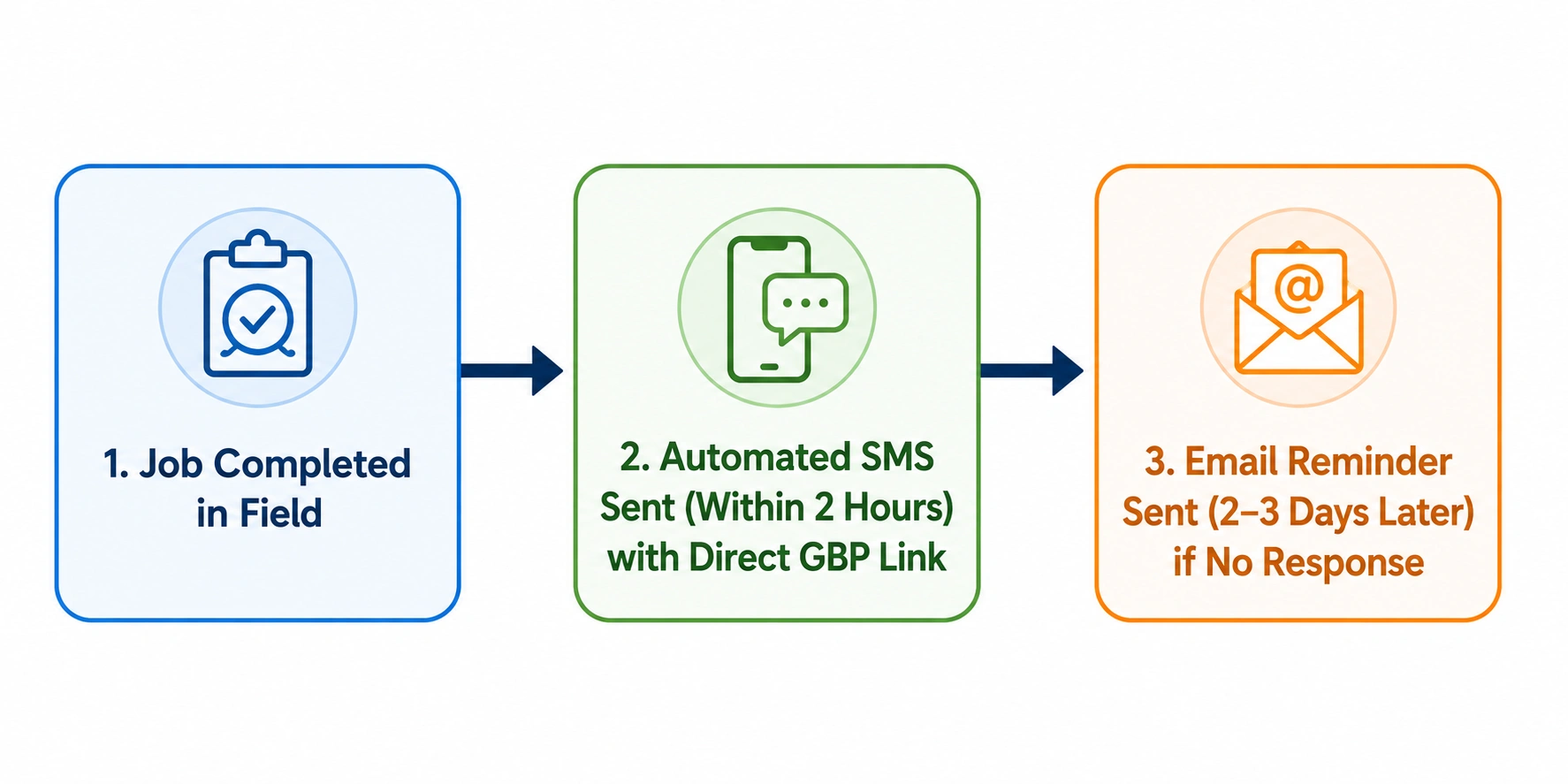
A simple automated follow-up workflow helps businesses consistently request Google reviews without manual effort.
That two-touch sequence, SMS first, email follow-up if no action, captures the clients who respond immediately and reminds those who saw the first message and got distracted. The result is a steady, organic review flow that signals to Google exactly what you want it to see: an active, high-demand business that real customers keep coming back to.
Frequently asked questions about cleaning company reviews
How do Google reviews improve the ranking of my cleaning company?
Google reviews directly influence the “prominence” and “relevance” pillars of Google’s local search algorithm. High-quality, frequent reviews containing specific keywords, like “deep house cleaning” or “maid service”, signal to Google that your business is active, trusted, and highly relevant to local search queries, boosting your position in the Map Pack.
Can I offer a discount on a future cleaning in exchange for a Google review?
No. Offering discounts, free add-ons, or any financial compensation in exchange for a Google review violates Google’s Maps User Contributed Content Policy and the FTC’s Consumer Reviews and Testimonials Rule. You may only ask for honest, unbiased feedback without conditioning any reward on a positive rating.
How should I handle a negative Google review from an unhappy client?
Respond within 24 hours with a calm, professional, non-defensive message. Acknowledge their experience, state your company’s quality standards, and provide a direct phone number or email address to resolve the issue offline. Once resolved, you may politely ask the client if they would be open to updating their review.
What is “review gating” and why is it risky for my local SEO?
Review gating is the practice of pre-screening customers and only sending Google review links to those who indicate they had a positive experience, while directing unhappy customers to a private feedback form. Google strictly prohibits this practice, and violating it can result in the suspension of your Google Business Profile and the loss of all accumulated reviews.
How often should I ask recurring cleaning clients for a review?
Ask recurring clients at most twice: once early in the relationship, after the first or second clean when the contrast between your work and their previous standard is sharpest, and once at a meaningful milestone, such as their one-year anniversary, to capture a testimonial about your long-term reliability.
Your next step toward local dominance
A top-ranking house cleaning business on Google does not require a massive ad spend or technical hassle. It requires translating the trust you earn on the job site, the clean baseboards, the respectful team, the consistent arrival time, into digital proof that Google’s algorithm can read and reward. It takes consistent effort.
The results vary, but we’ve seen this work for similar businesses within a few months of building a consistent review flow. Before you scale that effort, make sure the storefront those reviews are pointing to is fully optimized. Our guide on Google Business Profile optimization walks through exactly what needs to be in place before your review volume starts converting into booked jobs.
If you are ready to take the guesswork out of your marketing, let’s build a custom plan together. Explore our local search strategies and see how our reputation management, citation building, and local SEO services work together to put your cleaning business in front of the clients actively searching for you.