Quick-Reference: The 10 High-Intent Keyword Clusters Covered in This Guide
- House cleaning near me
- Maid service near me
- House cleaning services [city]
- Deep cleaning services near me
- Move out cleaning service near me
- Weekly house cleaning service
- Same day house cleaning
- How much does house cleaning cost
- House cleaning checklist
- Eco friendly cleaning services
Your phone should be ringing
Running a residential cleaning operation is already a full-time job before we even factor in marketing. So when someone tells you to “invest in SEO,” it is easy to nod along and then do nothing: because the advice is almost always too vague to act on.
We want to skip the vague part. Here’s what works. Targeting the right house cleaning keywords, cleaning service keywords, and maid service keywords attracts people who are ready to book, not just browse. Every cluster here is mapped to a specific page type, a search intent, and a revenue outcome. If your website is currently missing these terms, we believe you are leaving a measurable number of booked jobs on the table each month.
The power of localized search intent
Understanding transactional vs. informational intent
Not all search traffic carries the same weight. A person typing “how often should I deep clean my house” is in a different mental state than someone typing “deep cleaning services near me” at 7 PM on a Thursday. The first is curious. The second has already decided to hire someone and is choosing between you and your competitor. They need help now.
We believe that search engine optimization and digital marketing should be practical, not academic. This is the core of user intent seo: matching your content directly to the buyer’s mindset. When you are setting up your service pages, you might ask, what is a landing page in this context? It is a dedicated page designed to convert a specific type of visitor: in this case, people searching for house cleaning near them.
Transactional intent covers queries where the user is ready to act immediately, including searches with “near me,” a specific city name, or action-oriented language like “book” or “quote.” Informational intent covers queries where someone is researching costs, comparing options, or building a checklist before committing. Both matter, but they serve different stages of the decision funnel and belong on different pages of your site.
Balancing both across your website is what prevents keyword cannibalization, which is the situation where two of your own pages compete against each other in search engine results, splitting your authority and diluting your rankings. Search intent mapping is the structural discipline that keeps this from happening.
The impact of local SEO on lead generation
Applying local search internet strategies is the most cost-effective way for an independent cleaning operation to compete. Google automatically localizes results for queries that include “near me” or even just an implied location based on the user’s device. That means a well-optimized local page can outrank a national franchise for the keywords that actually convert in your market.
By focusing on what your neighbors search for, you align your site with our target audience definition: local homeowners who need immediate, reliable help. Applying local SEO search strategies and optimizing your Google Business Profile together drive over 60% of total leads for local home service businesses. That is not a marginal channel; it is the primary one. It drives growth.
Local search intent and leads
A cleaning business serves a specific geographic radius. This is your edge. That constraint is a distinct advantage in search. Google uses IP addresses, GPS data, and device location to deliver hyper-local results, which means a user searching “house cleaning” in your city is already being filtered toward businesses in your area. Local visibility is the primary driver of organic revenue for residential cleaners: not abstract tech metrics, not link building volume, and not endless content quantity.
Near me and city modifiers
“House cleaning services near me” generates approximately 90,500 monthly searches in the United States, according to Semrush 2026 data. People using that phrase are not window shopping. They want to hire. They have a specific need, a general timeline, and they are evaluating whoever shows up first. City-specific modifiers work the same way: “house cleaning services [city]” captures searchers who want local confirmation before they call.
Dedicated landing pages optimized for these modifiers are critical. A single generic homepage trying to rank for every variation will underperform against a competitor who has built a focused, localized page for each primary service area, as search engines prefer highly relevant local landing pages over broad, generic homepages.
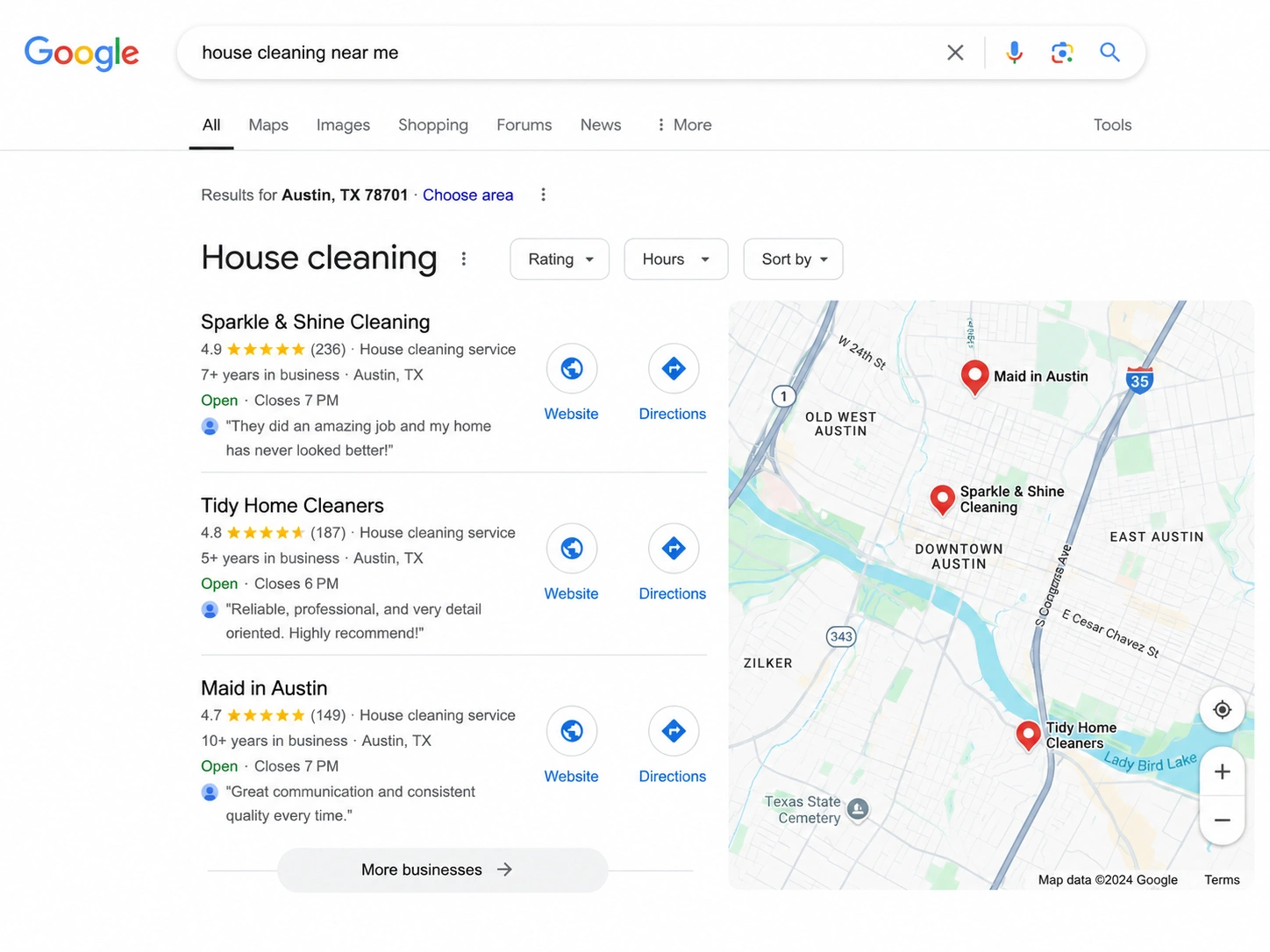
The Google Map Pack highlights top local cleaning businesses, making visibility and strong reviews essential for attracting customers.
High-intent keyword clusters for recurring services
Targeting recurring revenue with maintenance keywords
Recurring contracts, like weekly, bi-weekly, or monthly agreements, are the financial backbone of a stable cleaning business. One-time jobs generate revenue; recurring clients generate predictable cash flow. They are your lifeline. The keyword strategy for these services reflects that distinction. Users searching for maintenance-oriented terms are not in crisis mode: they are evaluating reliability, trustworthiness, and consistency.
The intent shift matters for how you build these pages. Trust signals, such as background check disclosures, insurance documentation, and client tenure statistics, carry more weight on a recurring service page than on a one-time booking page, because clients are inviting a stranger into their private space on a regular basis. The person searching “weekly maid service” is thinking about letting someone into their home every week. We recommend addressing that implicitly through the content, not just through a badge in the footer.
Optimize your primary recurring service pages around these clusters:
weekly maid service(1,900 monthly searches)bi weekly cleaning(70 monthly searches)monthly house cleaning(800 monthly searches)regular house cleaning service(260 monthly searches)
The volume on bi-weekly and regular terms looks modest nationally, but these are high-commitment queries. Someone searching “regular house cleaning service” has already decided they want ongoing help. That is a different conversion dynamic than a one-time booking.
Specialized high-value keyword clusters
Capturing high-margin specialty jobs
Specialty services carry higher average order values and, critically, they function as acquisition channels for long-term recurring clients. A customer who books a move-out clean and has a good experience is a strong candidate for weekly service at their new address. Deep cleaning works the same way; it is often the first interaction a new client has with your business. It builds trust.
Mapping these terms to dedicated, specialized landing pages is essential. A single “services” page that mentions deep cleaning, move-out cleaning, and standard maintenance in the same breath gives search engines no clear signal about which service is the focus, which ultimately dilutes your search rankings and confuses potential customers. Separate pages prevent that confusion and allow each service to rank independently.
According to a LeadDuo 2026 market report, move-out cleaning services average between $250 and $600. Deep cleaning typically runs $200 to $500+ depending on square footage and condition, according to the Tidy 2026 cost guide. Those price points justify the investment in dedicated, well-optimized pages.
The highest-volume specialty clusters to target:
deep house cleaning services(27,100 monthly searches)move out cleaning services(22,200 monthly searches)post construction cleaning(5,400 monthly searches)apartment cleaning services(8,100 monthly searches)
Want to see how your website currently ranks for these keywords that actually convert?
Start by optimizing your site for local SEO.
Why cleaning services dominate search conversions
The 17.65% conversion rate benchmark
Cleaning services convert at a rate that most other home service trades cannot approach. Benchmark data from 2025 to 2026 puts cleaning, maid, and butler services at a 17.65% conversion rate on search ads and landing pages, which is more than double the home services industry average of 7.33% to 7.8%.
That figure deserves some context. Plumbing converts at 7.63%. Roofing sits at 3.70%. The gap is not accidental. Cleaning is a recurring, non-emergency need with a relatively low decision barrier: people know what they are getting, the price range is predictable, and the service is easy to evaluate through reviews. When someone lands on a well-optimized cleaning page, the friction between “I found this business” and “I booked this business” is lower than almost any other trade.
Financial value of conversions
A standard house cleaning visit averages between $174 and $256 nationally, according to Thumbtack 2026 data. Flat-rate standard cleaning ranges from $120 to $280 per visit depending on home size and frequency, based on Housecall Pro 2026 data. At a 17.65% conversion rate, even a modest traffic volume translates into a disproportionate number of booked jobs. The math is simple. A page receiving 200 qualified monthly visitors could realistically generate 35 bookings; if even a fraction of those convert to recurring clients, the compounding revenue effect is substantial, creating a predictable stream of income that supports your business growth over time.
Industry comparisons
The conversion advantage cleaning services hold over other trades makes house cleaning company digital marketing one of the highest-ROI investments in the home services category, allowing small operators to generate consistent leads without relying on expensive paid advertising campaigns. For comparison:
- Cleaning & maid services: 17.65%
- Window cleaning: 13.58%
- Handyman services: 13.45%
- Painting: 10.80%
- Plumbing: 7.63%
- Roofing: 3.70%
Cleaning services have a structural advantage rooted in high purchase frequency and immediate need. A homeowner does not need a roofer every month. They might need a cleaner every week.
“Focusing on keywords that actually convert is the single most cost-effective way to scale a residential cleaning business because it captures clients at the exact moment of decision-making.”
How to map keywords to your website pages
Structuring your site for search engine crawlers
This is where keyword research search engine optimization becomes highly practical. Keyword mapping is the practice of assigning one primary keyword cluster to each dedicated page on your site. One page, one focus. While the practice sounds simple, most cleaning websites violate this principle constantly: they mention deep cleaning, move-out cleaning, and recurring service on the same homepage and wonder why none of those terms rank.
To understand how Google views your site, it helps to understand what is a web crawler. A web crawler is an automated bot that scans your pages to understand their meaning. A clean, logical site architecture makes search engine indexing straightforward because the crawler can easily categorize your services. Integrating this into your overall content strategy and seo ensures you do not confuse the crawler by targeting the same keyword on multiple pages.
The hierarchy works like this: your homepage targets broad local terms (“house cleaning near me”, “maid service near me”). Individual service pages target specific offerings (“deep cleaning services”, “move out cleaning service”). Location pages target specific cities or suburbs (“house cleaning services [city]”). This structure gives search engine indexing a clear, unambiguous signal about what each page covers.
For a practical starting point, the guide on keyword research for small businesses walks through how to identify and prioritize the right clusters for your specific market.
Search engine crawling and indexing
A web crawler reads your site the way a librarian catalogs a book: it needs clear signals to understand what each page is about and where it belongs, otherwise your content gets lost in the digital archives. When multiple pages on your site target the same keyword cluster, the crawler cannot determine which one to surface in search results. That ambiguity hurts all of them.
Clean site architecture eliminates that problem. When your “deep cleaning” page is the only page on your site optimized for deep cleaning terms, the crawler assigns that page full authority for those queries. Search engine indexing rewards clarity; it penalizes redundancy. The businesses that rank consistently are not necessarily the ones with the most content; they are the ones with the most logically structured content.
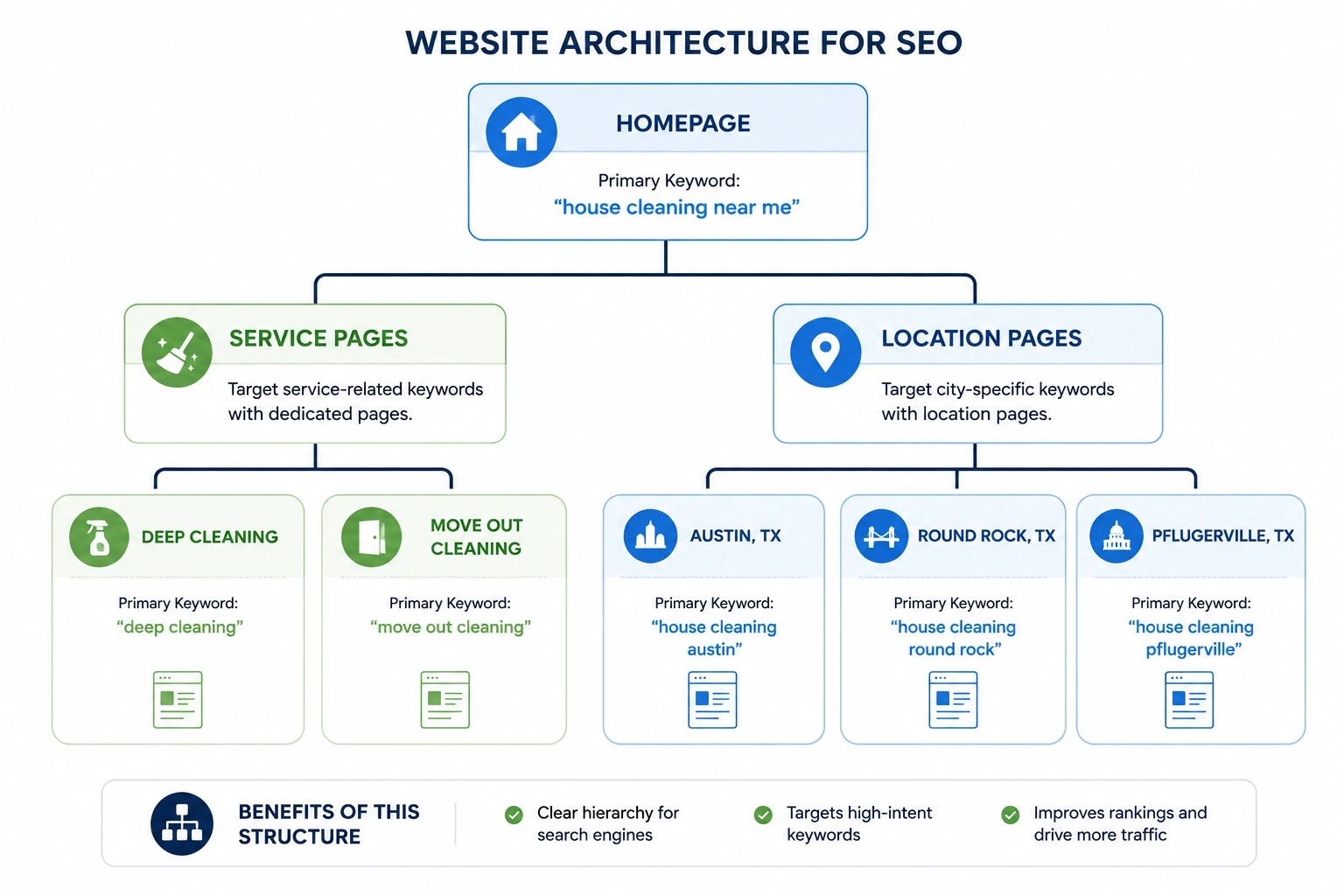
A well-structured website hierarchy helps search engines understand your services and locations, improving local SEO performance.
Check out our Local SEO checklistto get started.
Common keyword optimization mistakes to avoid
Avoiding keyword cannibalization and stuffing
Keyword stuffing, which means forcing exact phrases into your content at an unnatural density, was a viable tactic in 2008. Search engines now penalize it explicitly. Write for humans. More importantly, it makes your pages read like they were written for a robot, not a person. The goal is natural integration: your primary keyword should appear in the H1, meta title, and first 100 words, then recede into the content where it fits organically.
The debate around “maid service” versus “house cleaning” is worth acknowledging. Some search practitioners argue these terms are distinct enough to warrant separate pages; others contend that Google’s semantic understanding treats them as near-synonyms, making consolidation the smarter play for building search authority. There is no universally correct answer: it depends on how your business positions each service and whether your local market searches for one term more than the other.
Programmatic SEO, the practice of generating hundreds of thin, automated city pages, is increasingly a liability rather than an asset. Google’s Helpful Content guidelines have made it progressively harder for templated, low-effort location pages to rank. Fewer, more deeply customized local pages with unique reviews, team photos, and community-specific content consistently outperform high-volume thin-page strategies.
Mistakes that actively suppress your rankings:
- Keyword stuffing (forcing exact phrases organically into content)
- Targeting national terms without local modifiers
- Overlapping keywords across multiple pages (keyword cannibalization)
- Creating thin, automated city-specific pages without unique content
Take a look at our step-by-step guide to optimizing local business for search engines to ensure your website is perfectly calibrated for search.
On-page SEO: here’s what works for maid services
Optimizing key on-page elements
Placement matters as much as presence. Your primary keyword should appear in the H1, the meta title, and within the first 100 words of the page, not buried in paragraph four after three sentences of preamble that do nothing to help the reader or the search engine. After that, let it appear naturally where the content calls for it.
Mobile responsiveness is not optional. Over 60% of local service searches happen on mobile devices, and Google uses mobile-first indexing to evaluate your site. A page that loads slowly or renders poorly on a phone is losing bookings before a single word is read. Usability and search performance are not separate concerns; they are the same concern viewed from different angles.
Booking calls-to-action should appear above the fold and after every major content section. We do not recommend aggressive pop-ups, but rather clear, high-contrast buttons that make the next step obvious. The affordable local SEO solutions available to small cleaning businesses mean there is no reason to delay implementing these basics while waiting for a large budget.
Technical on-page optimization
You do not need to purchase expensive seo keyword research tools or a domain authority checker to see if your efforts are working; you just need to check web traffic and see if your phone is ringing. You also do not need high-priced link building services to start ranking locally. Keep it simple. Just apply the basics consistently to each page.
Title tags, header structure, image alt text, and internal linking: these are not advanced tactics. They are table stakes that a surprising number of cleaning websites still get wrong. Google Search Console is the most direct tool for identifying which pages are being indexed, which queries are driving impressions, and where click-through rates are underperforming relative to your rankings.
Maximizing your local search visibility
Dominating the Google Map Pack
The Google Map Pack, which displays the three local business listings that appear at the top of localized search results, drives the majority of mobile clicks for “near me” queries. Appearing there requires a fully optimized Google Business Profile: accurate NAP (Name, Address, Phone) data, complete service descriptions, regularly updated photos, and a consistent stream of genuine reviews.
Citation consistency across directories (Yelp, Angi, HomeAdvisor, local chamber listings) reinforces your local authority signals. Think of your Google Business Profile like your storefront window on Main Street: if the lights are off, nobody walks in. Keep the lights on. If the information is outdated or the listing looks neglected, potential clients move on before they ever reach your website. The Supreme Clean SEO case study illustrates how a focused local optimization effort translates directly into measurable lead volume for a residential cleaning business, proving that even small local operators can dominate search results with the right strategy.
Reviews and local search signals
Online reviews function as digital referrals at scale. Google Maps ranks local businesses using three primary signals: proximity (how close you are to the searcher), relevance (how well your profile matches the query), and prominence (how well-established and reviewed your business appears). You cannot control proximity, but relevance and prominence are entirely within your influence. Focus on what you can control.
Actively requesting reviews from satisfied clients, using a simple post-service text or email, compounds over time. A business with 200 reviews and a 4.8-star average occupies a fundamentally different competitive position than one with 12 reviews, even if the underlying service quality is identical. Optimizing your local presence is the fastest path to consistent inbound call volume.
Frequently asked questions about maid service keywords
What are the best SEO keywords for cleaning services?
The most productive keywords are keywords that actually convert, including “house cleaning near me”, “maid service near me”, and localized city-specific variants like “house cleaning services [city]”. These capture users at the exact moment they are ready to hire, rather than users who are still in the research phase.
How do I get more local customers for my cleaning service?
Optimize your Google Business Profile, build dedicated local landing pages for each primary service area, and target “near me” search queries with localized content. Local SEO and Google Business Profile optimization drive over 60% of total leads for home service businesses; it is the most effective channel available to independent operators.
Do I need a website to grow my cleaning business?
Yes. A website functions as your permanent digital storefront. It builds credibility. Over 60% of local service searches occur on mobile devices, and without a mobile-optimized site, you are invisible to the majority of high-intent searchers in your area. Social media profiles and directory listings supplement a website: they do not replace it.
Is paid advertising better than SEO for cleaning services?
Paid ads generate immediate traffic and work well for quick lead generation or launching in a new service area. SEO builds compounding visibility over time with a lower cost per acquisition as the strategy matures. A balanced digital marketing approach typically combines both, using paid ads for immediate volume and SEO for long-term cost efficiency.
What is the best way to get cleaning jobs online?
The best way is to target keywords that actually convert on dedicated service pages, maintain a strong and actively managed presence on Google Maps, and ensure your website features clear booking forms above the fold. Transparent pricing information, showing that standard cleaning ranges from $120 to $280 per visit, filters out low-budget inquiries and attracts qualified prospects who are ready to commit. Taking control of your website’s SEO does not have to be overwhelming. Start by selecting one keyword cluster from this guide, with your core recurring service terms as a practical first target, and optimize a single page around it. Update the H1, rewrite the meta title, add a localized modifier, and place a clear booking CTA above the fold. Watch what happens to your Google Search Console impressions over the following four to six weeks.
As local visibility grows and bookings accumulate, expand to specialty service pages. Build out your deep cleaning page, then your move-out page. Take it slow. Add location pages for your two or three highest-value service areas. The architecture compounds; each well-mapped page reinforces the others, and the site as a whole becomes easier for search engine indexing to categorize and surface, which ultimately leads to higher rankings and more consistent inbound leads.
If you want help implementing these strategies, our team is always here to partner with you. Read our top tips for marketing service-based businesses or contact us today to speak with a local SEO expert.