
Running two distinct service lines under one roof is a real operational advantage, until it becomes a liability on your website. Most dual-trade contractors who invest in plumbing SEO and HVAC SEO at the same time discover the same friction point: their site is working against itself. Pages compete for overlapping queries, internal links scatter authority in every direction, and Google ends up uncertain about what the business specializes in.
The result is lower rankings for both trades, which means your business misses out on local emergency calls when homeowners need help fast and your competitors end up taking those high-value jobs instead. This happens not because your work or content is poor, but because your site structure is confused.
How should plumbing and HVAC contractors structure their website for better SEO?
As a plumbing and HVAC contractor, you can solve this conflict by organizing your website properly with clear service categories, dedicated service pages, localized city pages, and supporting content that links logically throughout the site. By organizing how your pages fit together, both at the URL level and through deliberate internal linking, you can signal clear expertise for each trade. This protects both your HVAC pages and your plumbing pages from duplicate content issues, building a single digital asset that grows in value over time.
Here is what this approach delivers when executed correctly:
- Prevent signal dilution between your HVAC pages and your plumbing pages.
- Maximize local Map Pack visibility despite Google Business Profile category limitations.
- Eliminate duplicate content risks across multi-location service-area pages.
Demystifying site structure for dual-trade contractor websites
A well-organized site structure functions like a well-organized shop. Customers and search engines can locate what they need without wandering through mismatched aisles. For dual-trade contractors, this means drawing clear, structural boundaries between your plumbing and HVAC services before a single word is written.
When Google looks at your site, it should encounter two distinct, expert departments: not a single blended service offering with confusing signals. What Google sees on your site is evaluated at both the page and directory levels. A homepage that attempts to rank at the same time for “emergency HVAC” and “emergency plumbing,” without a supporting structure beneath it, dilutes both signals. Neither page gets the full weight it could carry, making it harder to capture urgent calls.
Your site structure determines how search engines evaluate your business. The relationships between your pages, which folders they live in, how they link to each other, what anchor text connects them, together tell search engines a story about your expertise. When that story is fragmented, rankings plateau. When it is coherent, your authority compounds.
Organizing how your pages fit together does not mean hiding content from your customers. Both plumbing and HVAC pages remain fully accessible to users. The discipline is in the routing, which means you must guide both search engines and potential customers through logical pathways that keep your heating services completely separate from your drain cleaning offers. We want to ensure that every internal link reinforces the right trade rather than bleeding across trade lines.
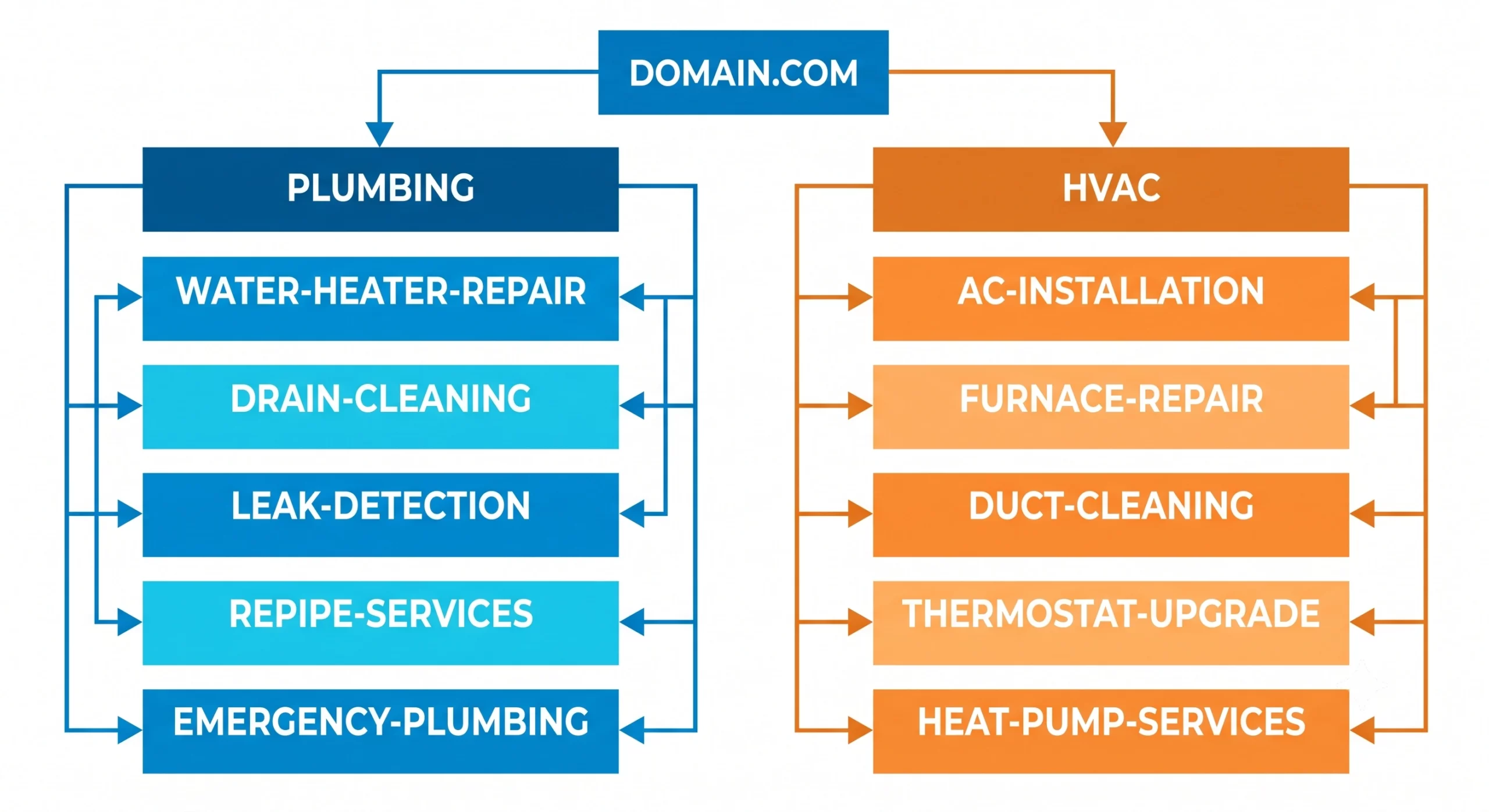
A siloed website architecture keeping internal links contained within Plumbing (blue) and HVAC (orange) categories to build topical authority.
Physical vs. virtual site structure: the structural blueprint
Physical and virtual structures work together: one defines where your pages live, the other defines how they communicate. They must match. This is crucial. Getting both right is what separates a site that ranks for one trade from one that ranks for both, ensuring that Google never gets confused about which service you are offering in a specific neighborhood when an emergency call comes in.
Physical structure: URL directory structure
Establishing clear subdirectories off the root domain is the foundation. Your plumbing services live under /plumbing/ and your HVAC services live under /hvac/. No exceptions, no shortcuts. Keep them separate.
Individual service pages nest within these directories, such as /plumbing/water-heater-repair/, /plumbing/drain-cleaning/, /hvac/ac-installation/, and /hvac/furnace-tune-up/. This URL structure does two things at the same time: it gives search engines a clear map of your services, and it passes directory-level signals down to every child page within that section.
Using separate pages for each trade ensures that you do not force your furnace content to share a stage with your pipe work. When you keep these services in their own folders, you prevent your pages from competing with each other.
Placing service pages directly off the root domain, like /water-heater-repair/ sitting alongside /ac-installation/ with no directory context, is one of the most common structural errors on dual-trade sites because it forces search engines to evaluate every single page in isolation rather than as part of an organized, expert department. It is not damaging on its own, but it forfeits the compounding authority that a clean hierarchy provides.
Virtual structure: internal linking architecture
The governing rule is strict: plumbing pages link only to other plumbing pages, and HVAC pages link only to other HVAC pages. When you link from /plumbing/pipe-repair/ to /hvac/ac-repair/ using generic anchor text like “our services,” you are routing authority away from the plumbing section and muddying the HVAC signal at the same time. Neither page benefits. Avoid this mistake.
Anchor text precision matters here as much as link destination. Within your plumbing pages, anchors should reflect the specific service or topic of the destination page, not generic phrases. This is how authority builds up at the trade level rather than spreading thin across the domain. For a detailed breakdown of anchor text strategy and keyword targeting within service page hierarchies, the guide to plumbing SEO covers the exact methodology we’ve seen work for businesses like yours.
Your homepage and navigation menus are the only valid exceptions to this rule. The homepage can and should link to both main trade pages, /plumbing/ and /hvac/, because it functions as the central hub for the domain. What you want to avoid is service-level pages crossing trade lines.
Navigating the Google Business Profile category conflict
Google Business Profile allows only one primary category per listing, which creates a real challenge for dual-trade operators. This is a common issue. We see it often. The category you select directly influences which Map Pack queries your profile surfaces for, and there is no clean workaround that eliminates the tradeoff entirely, which means you must make a strategic choice based on which trade drives the most profitable leads for your business.
Primary category selection
Select your higher-revenue trade as the primary GBP category. Choose wisely. If HVAC generates 65% of your annual revenue and carries higher average ticket values, that is your primary category. If plumbing is your volume driver with stronger local search demand in your market, it leads. This works.
The selection should also account for competitive density. In markets where HVAC contractors are heavily saturated, the Map Pack for HVAC queries is harder to crack. Prioritizing plumbing as your primary category in that context, even if HVAC is your revenue leader, may generate more incremental Map Pack visibility. There is no universally correct answer: it depends on your specific market conditions and margin structure.
Your homepage’s on-page signals should reinforce whichever trade holds the primary category. If you select “Plumber” as your primary GBP category but your homepage leads with HVAC messaging, you are sending conflicting signals to the local algorithm, which can cause your rankings to drop for both services in local search results.
Secondary category optimization
Add your secondary trade as an additional GBP category. Do this first. Then go further: optimize your GBP services list with granular descriptions for both plumbing and HVAC offerings. A services list that reads “Plumbing, HVAC” is a missed opportunity. One that reads “Water Heater Installation, Drain Cleaning, Sewer Line Repair, AC Installation, Furnace Repair, Heat Pump Maintenance” gives Google’s local algorithm significantly more to work with when local homeowners search for those exact terms during an emergency.
Publish regular GBP updates that highlight both services. Keep them fresh. Don’t alternate between them on a rigid schedule; instead, respond to seasonal demand. A post about AC tune-ups in April and a post about water heater efficiency in October both serve the local algorithm while staying relevant to users.
Review gathering strategy
Reviews are underused as a local ranking signal for dual-trade businesses. They carry weight. Actively request reviews that mention trade-specific terms like “AC repair,” “drain cleaning,” or “furnace installation.” These keyword-rich reviews reinforce your authority within the local algorithm.
When responding to reviews, use localized, trade-specific language. Be specific. A response that references the specific service performed and the neighborhood where the job occurred does more for local visibility than a generic thank you. Showcase these reviews on your HVAC pages and your plumbing pages, not just on a single aggregate testimonials page, so that potential customers immediately see relevant proof of your expertise when they land on your service pages. This is a core part of local SEO for home service companies.
Ready to eliminate signal dilution and move up in your local market?
Get a detailed, custom-scoped analysis of your site’s structure with our local SEO fundamentals and implementation audit. Our team will map your current site structure and provide a clear plan to maximize your local visibility across both trades.
The compounding authority of a unified domain
Running a single website for both plumbing and HVAC services outperforms two separate domains in virtually every competitive market. This is not a preference: it is a structural result of how domain authority accumulates. It is simple math.
Every backlink your plumbing pages earn raises the authority of the entire site, which directly benefits your HVAC rankings. Every piece of HVAC content that earns engagement and dwell time strengthens the domain-level trust signals that your plumbing pages draw from. Two separate domains split this compounding effect in half, forcing you to build authority from scratch for two different web addresses instead of letting all your hard work benefit a single domain. More precisely, they split it in a way that leaves both sites weaker than a single consolidated domain would be.
The PlumbSmart Plumbing, Heating and Air Conditioning case study demonstrates this consolidation advantage in a real market context, where a unified domain strategy drove measurable growth across both services at the same time, not sequentially.
There is also a practical consideration that often goes undiscussed: NAP consistency. Running two separate domains for the same business creates citation management complexity. Your Name, Address, and Phone number need to be consistent across hundreds of directory listings, review platforms, and data aggregators. One domain means one NAP footprint to manage. Two domains means two, and any inconsistency between them degrades your local authority for both.
The mobile performance argument reinforces this further. Roughly 60% of home service searches occur on mobile devices, where Core Web Vitals and page speed directly affect both rankings and conversion rates. Concentrating your technical optimization effort on one high-authority domain is more efficient than splitting it across two weaker properties.
“A single well-structured website outperforms two separate domains for plumbing and HVAC SEO in every market we have operated in. Two domains split your authority, dilute your backlink profile, and create NAP consistency problems.” (BizIQ Home Services Team)
Structuring dual-trade city pages without doorway penalties
Expanding geographic reach through city-specific service-area pages is standard practice for home service contractors, and it is also one of the highest-risk areas for duplicate content issues if executed carelessly.
Google’s doorway page guidelines target pages that exist solely to funnel traffic from a location-based query without providing real local value. A page titled “Plumber in [City Name]” that contains the same 300 words as every other city page, with only the city name swapped out, is a textbook doorway page. It may rank initially, but it is structurally fragile and increasingly penalized as Google’s algorithms mature.
Penalty-free location pages require localized substance. Do not skip this. Each page should incorporate unique local content: customer reviews from that specific service area, references to local landmarks or neighborhoods, and service descriptions that reflect the actual infrastructure conditions or common issues in that geography. A page for Phoenix HVAC services that mentions the specific strain that desert heat cycles place on condenser units is more locally authentic, and more algorithmically durable, than one that simply inserts “Phoenix” into a generic template.
This approach aligns directly with proven local SEO strategies for service businesses that prioritize geographic specificity over volume-based page production.
Service-area pages for plumbing must live within the /plumbing/ directory (for example, /plumbing/phoenix/) and HVAC service-area pages must live within the /hvac/ directory (for example, /hvac/phoenix/). Placing all location pages in a flat /locations/ directory, regardless of trade, collapses the site structure you have built and re-introduces the signal dilution problem you were trying to solve.
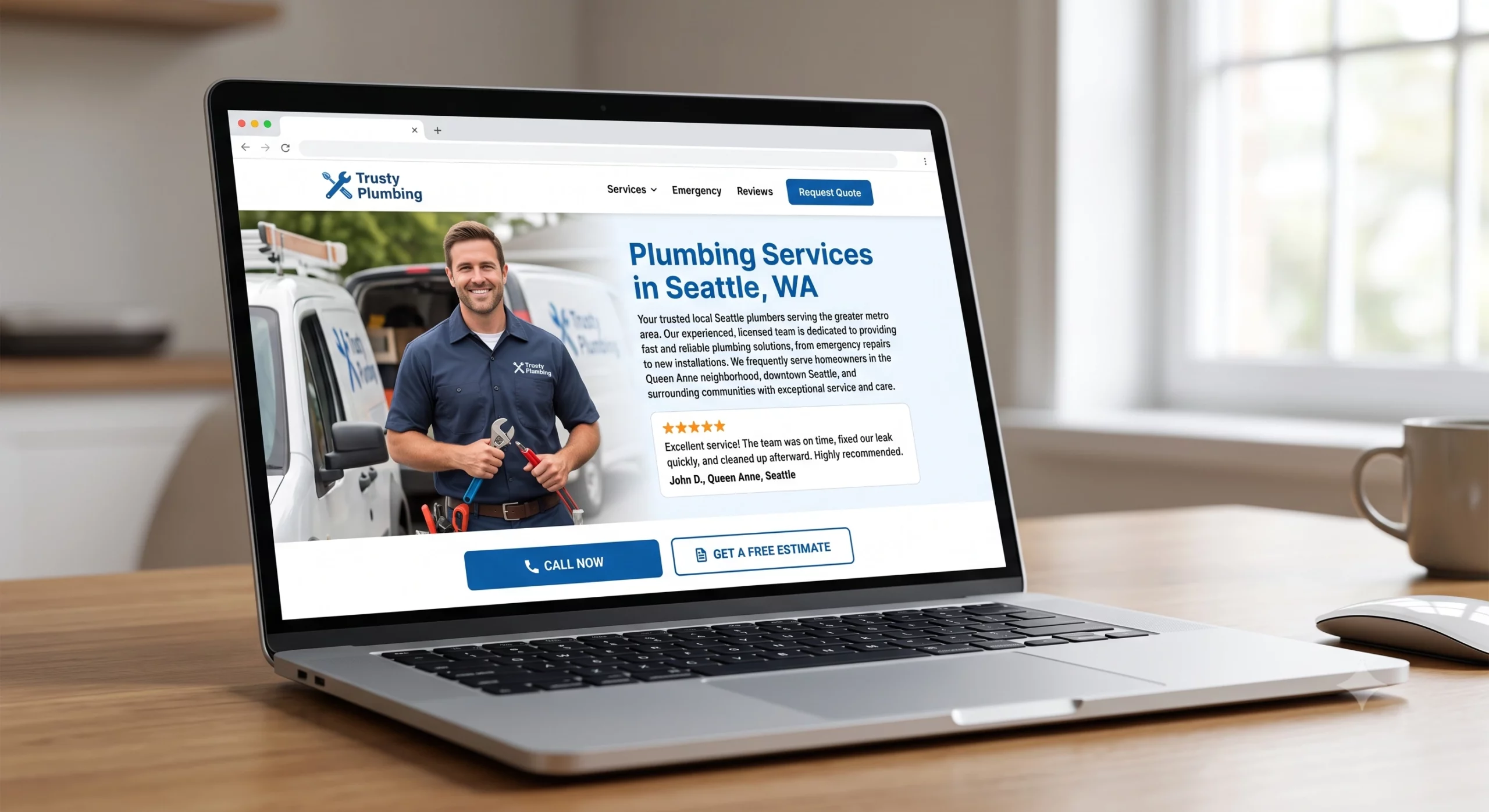
Laptop mockup of localized local plumbing service page with review and CTA buttons for SEO illustration.
Want to see how your site’s structure compares to the top competitors in your market? Request a custom-scoped proposal and territory protection with our team to secure your local market position today.
Technical SEO foundations and schema markup for dual-trade sites
The technical layer of a dual-trade site is where many otherwise well-structured sites lose ground. Physical structure and clean internal linking create the right conditions for ranking, but schema markup, canonical tags, and mobile performance are what allow those conditions to fully materialize in search results. These details matter. Do not ignore them.
Schema markup implementation
Dual-trade sites have a specific schema opportunity that single-trade sites do not: the ability to declare two distinct local business entity types within a single domain. Implementing technical SEO foundations and schema markup means deploying both Plumber and HVACBusiness local entity types, nested within a parent LocalBusiness schema that carries your shared NAP data.
This nested structure gives search engines explicit, machine-readable confirmation that your business operates in both trades, without mixing the two. Each entity type can carry its own service descriptions, service areas, and review aggregates. This keeps things clean. This reinforces the same separation your URL structure and internal linking already establish.
Ensure your schema markup includes NAP data that precisely matches your Google Business Profile. Accuracy is key here. Even minor discrepancies, like a suite number formatted differently or a phone number with or without parentheses, can undermine the local entity signals you are trying to build.
Mobile page speed optimization
Emergency service queries are almost entirely mobile. Speed is everything. A plumbing or HVAC site that loads in over three seconds on a mobile connection is losing urgent leads to faster competitors before a single word of content is read, because distressed homeowners dealing with a flooded basement or broken air conditioner will not wait around for a slow page to load.
Compress images aggressively, use browser caching, and eliminate render-blocking JavaScript and CSS from above-the-fold content. Core Web Vitals, including Largest Contentful Paint, Cumulative Layout Shift, and Interaction to Next Paint, are not abstract technical metrics. They correlate directly with both rankings and conversion rates for mobile emergency traffic.
Canonical tag strategy
Canonical tags become critical on dual-trade sites with location pages, because the volume of near-similar URLs creates real duplicate content exposure. These HTML tags tell Google which version of a page is the master copy, preventing duplicate content issues.
Set self-referential canonical tags on all primary service pages to establish them as the authoritative source. For location pages, canonicalize each trade-specific page to itself, not to the main trade page, to preserve the individual ranking potential of each location.
Audit your canonical tags quarterly. Do not neglect this. Redirect chains, CMS updates, and pagination parameters can silently corrupt canonical configurations in ways that do not surface in standard analytics but do affect crawl efficiency and ranking stability by sending search engine bots down endless loops that waste your crawl budget.
Aligning content calendars with seasonal demand cycles
Plumbing emergencies distribute fairly evenly across the calendar year: burst pipes spike in winter and sewer line issues tend to cluster in spring, but the demand floor stays relatively consistent. HVAC demand is far more unpredictable: it compresses into sharp peaks around the first heat wave of summer and the first cold snap of fall, with extended shoulder periods in between.
A content calendar that treats both trades identically will underserve both. HVAC maintenance guides and pre-season tune-up content need to publish six to eight weeks before peak demand, not during it, when users are already in emergency mode and your competitors have already captured the informational traffic. Plumbing content, by contrast, can anchor the shoulder seasons when HVAC search volume is low, keeping your domain’s overall engagement metrics healthy year-round.
This seasonal calibration is a core component of effective HVAC contractor SEO strategies, and it is one of the areas where running two separate services, one website gives operators a structural advantage over single-trade competitors. A plumbing-only site goes quiet in the HVAC peak season. Your site does not have to. This is your edge.
The content calendar should also account for high-ticket plumbing upgrades, such as water heater replacements, whole-home repiping, and water filtration systems. These tend to convert better in the spring and fall when homeowners are less distracted by heating and cooling emergencies and more receptive to planned investment conversations.
Executing a dual-trade site structure audit
A site structure audit is less exciting than a content strategy session, but it is where the real ranking advantage is found. Most dual-trade sites that plateau in search have structural issues that no amount of new content will overcome.
Start with a full crawl using Screaming Frog or a comparable tool. This is the first step. Export your complete URL list and map every internal link by source page, destination page, and anchor text. What you are looking for: plumbing pages linking to HVAC pages with generic anchor text, service pages sitting outside their designated directories, and location pages that share near-identical body copy across trade lines.
Cross-reference your crawl data against your Google Business Profile configuration. Your primary GBP category should align with the trade that receives the most prominent homepage treatment and the deepest development. Misalignment between your GBP primary category and your site’s topical emphasis is a common source of Map Pack underperformance that does not show up in standard rank tracking.
Incorporate the top plumbing SEO keywords for 2025 during this audit to identify content gaps: service topics your competitors are ranking for that your pages do not yet address. A gap in your plumbing pages is a gap in your plumbing authority, regardless of how strong your HVAC content is. The two folders reinforce the domain, but they do not substitute for each other. Each needs individual attention.
A thorough audit of a mature dual-trade site with hundreds of pages and years of accumulated internal links can surface more issues than a small team can address in a single sprint. Prioritize by impact: fix cross-linking errors and canonical tag problems first, then address content gaps, then refine location page uniqueness. These structural corrections help secure ranking for both trades without conflict, compounding faster than you would expect.
Frequently asked questions about dual-trade SEO
Will running both plumbing and HVAC SEO hurt my rankings for either trade?
Not if your site structure is built correctly. Clean content separation, proper physical URL structure, and strategic internal linking allow both trades to rank independently at their full potential. The risk is not in running dual-trade SEO: it is in running it without structural discipline. A site that mixes plumbing and HVAC signals without clear boundaries will underperform for both; a site with clean page separation will compound authority for each trade at the same time.
Can my Google Business Profile rank for both plumbing and HVAC?
Yes, with realistic expectations about how the local algorithm weights primary versus secondary categories. Your primary category carries more Map Pack influence, so it will typically drive more visibility for that trade. The secondary category does contribute, particularly when your services list, GBP posts, and review content reinforce it, but it will not perform at the same level as the primary. That is a structural limitation of the GBP system, not a failure of execution.
Do I need separate websites for plumbing and HVAC?
No. A single well-structured website outperforms two separate domains in almost every market. Consolidating your services onto one domain allows your backlink authority and trust signals to compound, benefiting both trades at the same time. Two separate domains divide your link equity, double your citation management burden, and leave both sites weaker than a unified property would be.
How long does it take to see results from a dual-trade SEO campaign?
One trade typically gains traction faster, depending on your existing domain authority and the competitive density of each trade in your market. By months three to six, both trades generally produce meaningful organic call volume. Full Map Pack traction across both services in competitive markets typically takes nine to fifteen months. This timeline assumes the structural work is done correctly from the outset, not retrofitted after months of mixed-signal content.
How do I prevent duplicate content on my plumbing and HVAC location pages?
Avoid automated template spinners entirely. Each location page must carry unique local content: customer reviews from that specific service area, references to local landmarks or neighborhood-specific infrastructure conditions, and service descriptions that reflect the actual context of that geography. The test is simple: if you removed the city name from the page, would any of the remaining content be specific to that location? If not, the page is not locally differentiated enough to avoid doorway page risk.
Structuring a dual-trade website requires a precise balance of physical folders, virtual linking, and local optimization. By implementing a clean site structure, you eliminate signal dilution, sharpen your Google Business Profile visibility, and build a compounding marketing asset that single-trade competitors cannot replicate. The work is methodical, not mysterious, and the structural advantages it creates are durable in ways that content volume alone never is.
Partner with BizIQ for expert digital marketing for home service companies and secure exclusive ZIP code protection for your business today. Start by auditing your current pages to see if your HVAC and plumbing services are on separate URLs or combined.