
What you’ll take away from this guide:
- The 90-Day Lead-Time Rule: Publishing seasonal content when the weather changes is a costly mistake. Search engines need 2 to 3 months to crawl, index, and rank new pages: and your competitors who understand this are already ahead of us.
- Permanent Site Architecture: Seasonal service pages are long-term digital assets. Deleting them at the end of a season doesn’t clean up your site; it dismantles the authority we spent months accumulating. Keep them live.
- Siloed Content Structure: Organizing your website like a well-structured tool shed, with core service pages as pillars and seasonal blog posts as the specialized equipment hanging off them, is how we signal deep topical expertise to Google’s crawlers.
- Diversified Service Targeting: Transitioning search visibility from summer lawn care to winter snow removal and holiday lighting isn’t automatic. It requires deliberate planning, timed execution, and a clear understanding of when your local market starts searching. Timing is everything.
The Cost of Reactive Marketing
Most of us in the landscaping business manage our digital marketing the same way we manage our equipment: we pull it out when we need it and put it away when the season ends. A snow removal page goes live in December. A spring cleanup campaign launches in March. It feels reasonable: why promote a service nobody wants yet?
Planting grass seed in the middle of a summer drought follows the same logic. You are doing the right thing at the wrong time, and the conditions will never let it take root. Turf needs weeks to germinate and establish a root system before it can withstand heat, foot traffic, and competition from weeds. Your website works exactly the same way. A page published in April won’t rank in time to capture the spring rush because Google hasn’t had enough time to crawl it, evaluate it against competing pages, and assign it a meaningful position in the search results.
Ranking for seasonal services requires optimizing your website 60 to 90 days before historical search volume peaks. That is not a guideline: it is a structural constraint of how search engines operate. The businesses capturing the bulk of spring lawn care leads in April started their SEO groundwork in January. The ones who waited until the ground thawed are fighting for scraps.
We get it: you are busy running your business, not studying search algorithms. The good news is you do not need to be a tech expert. You need a few smart systems that work with your seasonal rhythm. A structured, forward-looking approach to lawn care seo, one that treats your content calendar like a planting schedule rather than a reactive to-do list, can stabilize your revenue across all four seasons. This is simply a small business helping small business, sharing what truly works.
Contextualizing the Seasonal Search Calendar Challenge
Google’s indexing pipeline is not instantaneous. When we publish a new page, Googlebot has to discover it, usually through an internal link or your XML sitemap, fetch and render the HTML, process the content to understand its topical relevance, and then evaluate it against every competing page targeting similar queries before assigning a ranking position. That entire sequence, from publication to meaningful organic visibility, typically takes 30 to 90 days for a new page on a moderately authoritative domain. For a newer site with fewer inbound links, it can take longer.
This is why reactive publishing fails so regularly in the green industry. A snow removal page published during the first blizzard of the season misses the early-booking window entirely. Commercial property managers and HOA decision-makers do not search for snow contractors when it is already snowing: they search in October and November, when they are locking in service agreements for the coming winter. By the time your page earns a competitive ranking, that procurement window has closed.
The competitive seo landscape for local lawn care compounds this problem. Local search results are dominated by the map pack, those three Google Business Profile listings that appear above the organic results, and the top three organic positions. Both are heavily influenced by domain authority, review velocity, and the depth of your topical content. A competitor who has maintained a well-optimized spring cleanup page since last year already has a 12-month head start on authority accumulation. Publishing a competing page in March puts you at a structural disadvantage before you have written a single word.
The data makes the stakes concrete. The 10-week spring window from April through May accounts for 60% to 70% of annual new maintenance client acquisitions for green industry companies. Missing even a portion of that window because your pages were not indexed in time is a material hit to your annual growth trajectory. Capturing that window requires laying the groundwork during the winter months, when most of your competitors have mentally checked out of their marketing.
The Ninety-Day Lead-Time Rule in Landscaping SEO
Strategic Focus: Early Season Keyword Targeting
The 90-day buffer is not random. It maps directly to the three-stage process your content must complete before it generates leads: indexing, authority accumulation, and ranking stabilization.
Indexing is the fastest part, as Googlebot will typically discover and process a well-linked new page within a few days to a few weeks. Authority accumulation is slower. Google evaluates a page’s relevance and trustworthiness by analyzing the quality of its content, the internal links pointing to it, and the external sites linking to it over time. A page that was published yesterday has none of that history. A page that has been live for three months, received internal links from your homepage and service hub, and accumulated a handful of mentions from local directories has a measurable authority advantage.
Reactive publishing, dropping a snow removal page when the first forecast calls for accumulation, misses the early-booking segment entirely. These are the clients who plan ahead: commercial accounts, property management firms, and residential clients who had a bad experience last year and are determined not to be caught without a contractor again. They are searching in October. Your page needs to be ranking in October, which means it needs to be published in July or August.
There is a case to be made that the 90-day rule is in fact conservative for highly competitive local markets: in dense metro areas where multiple established landscaping companies are already competing for the same seasonal terms, a newer or less authoritative domain may need a 4 to 5 month runway to build enough ranking momentum to appear on the first page before peak demand. Here is exactly how to do it.
Actionable Advice: Launching Content 90 Days Ahead
The practical workflow starts with historical search data. Do not guess. Google Search Console shows us when impressions for your existing seasonal pages begin climbing: that inflection point is your publication deadline, counted backward by 90 days. For services you have not targeted before, Google Trends provides a reliable proxy for when regional search interest historically begins to rise.
The scheduling logic follows a clean rotation: write in winter for spring, write in spring for summer, write in summer for fall, write in fall for winter. It feels counter-intuitive to be drafting summer irrigation content in February, but that is precisely the discipline that separates businesses with stable year-round organic traffic from those riding the seasonal rollercoaster.
For existing seasonal pages, those that already have some ranking history, a content refresh 60 days before the season starts is often more effective than publishing a new page. Update the statistics, add a new FAQ block, expand a thin section, and change the publication date. Keep it simple. This signals freshness to Google’s crawlers without sacrificing the gathered authority of the original URL. Pair the refresh with a burst of new internal links from your homepage and recent blog posts to accelerate re-crawling.
Building early internal links to upcoming seasonal pages is one of the most underutilized acceleration tactics in landscaping SEO. When we publish your summer lawn care guide in February, we immediately link to it from your homepage, your main lawn care service page, and any recent blog posts covering related topics. Those links tell Googlebot that this page is important and worth crawling promptly, which compresses the indexing timeline.
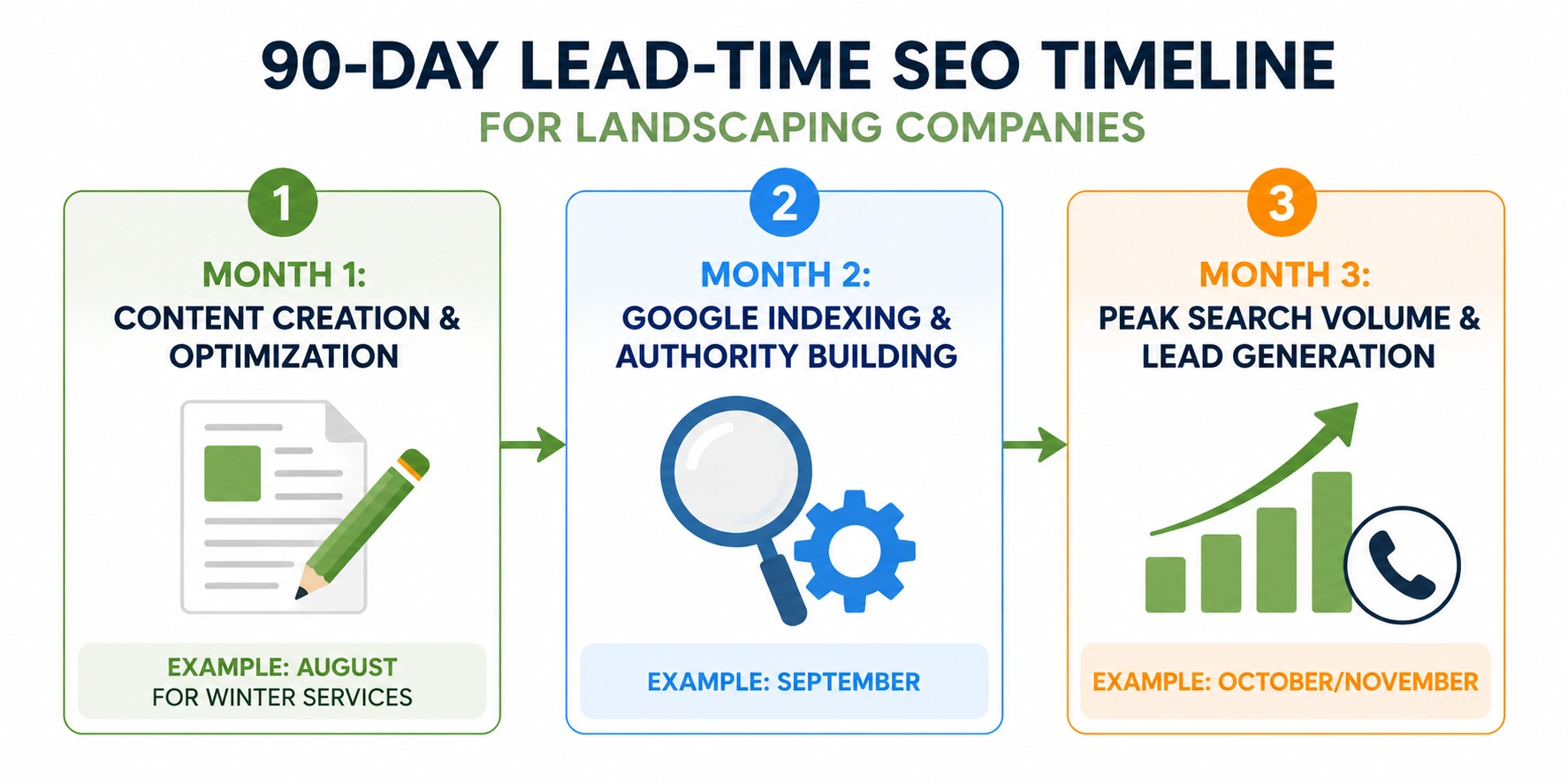
A simple three-stage SEO timeline shows how strategic content leads to stronger search visibility and lead generation after 90 days.
Spring and Summer Turf Traffic: Capitalizing on Peak Demand
High-Intent Spring and Summer Keywords
Spring and summer represent the highest search volume period for most lawn care and landscaping businesses, but volume alone does not determine which keywords deserve your attention. The terms worth targeting are the ones where commercial intent is clear, where the searcher is actively evaluating providers, comparing local rates, and preparing to request a quote rather than just gathering free DIY lawn care tips. Focus on intent.
- Lawn Aeration Service: Homeowners searching for aeration are typically past the research phase. They know their soil is compacted, they have probably tried aerating themselves, and they want a professional to handle it. These queries carry strong transactional intent and convert at a higher rate than informational lawn care searches.
- Irrigation Repair and Maintenance: Late spring generates a surge of sprinkler system startup queries as homeowners discover leaks, broken heads, and controller failures that developed over winter. Summer dry spells produce a second wave. A dedicated irrigation page that targets both the startup and repair segments captures traffic across a longer window than a single-service page.
- Summer Lawn Fertilization Schedule: This keyword cluster bridges the gap between DIY searchers and service buyers. A detailed guide on summer fertilization, covering nitrogen timing, heat stress considerations, and the difference between slow-release and quick-release formulations, builds topical authority while naturally positioning your fertilization service as the professional alternative to guesswork.
- Weed Control and Crabgrass Pre-emergent: Pre-emergent timing is hyperlocal and time-sensitive, which makes these queries highly actionable. A homeowner searching for crabgrass pre-emergent in late March is making a decision this week. Pages that address the specific application window for your region, rather than offering generic national guidance, will consistently outperform broader competitors on local search results.
- Landscape Design Services: Targeting high-value transactional searches for front yard landscaping ideas and low-maintenance landscape ideas attracts clients with larger project budgets and longer decision timelines. This is a great opportunity to market your landscaping business to clients who are researching ideas and preparing to invest in their properties.
If your spring time marketing campaigns are not anchored by pages that target these specific queries, we are generating brand awareness without capturing the leads that awareness should produce. That is a wasted opportunity.
Fall and Winter Transitions: Securing Off-Season Revenue
Off-Season Service Comparisons and Keywords
The shift from summer to fall is where most landscaping websites stall. Seasons change, and so does what your customers need. The summer service pages stay live but go stale. Traffic drops. No new content gets published. The Google Business Profile does not get updated. And by the time the first frost hits, the business is already behind on capturing the fall and winter demand for high-margin services like commercial snow removal and holiday light installation that could have bridged the revenue gap.
- Fall Leaf Cleanup Services vs. Spring Cleanups: These two services share a surface similarity, both involve clearing debris from a property, but they target entirely different user intents. Spring cleanup searchers are motivated by renewal: they want their property ready for the growing season. Fall cleanup searchers are motivated by urgency and property protection: leaves left on turf over winter cause fungal disease, and gutters packed with debris cause water damage. Separate pages for each service, with copy that speaks directly to those distinct motivations, will consistently outperform a combined seasonal cleanup page.
- Snow Removal Services Near Me: Commercial clients and HOA managers searching for snow plowing and salting contracts are active in October and November, well before the first accumulation. A permanent, well-optimized snow removal page that has been live since August has a significant ranking advantage over a competitor who publishes theirs in December. To grab holiday traffic and early winter service bookings, your snow removal content needs to be indexed and ranking before your market even checks the forecast.
- Holiday Light Installation Cost: Holiday lighting is one of the highest-margin seasonal services available to landscaping companies, and it is dramatically underserved in most local markets. Homeowners searching for professional installation are price-sensitive but convenience-driven: they want to know what it costs before they call. A page that addresses pricing transparently, shows portfolio photos, and includes a clear booking path will convert at a higher rate than a generic holiday lighting service page. Starting your holiday season campaigns in September gives your content the runway it needs to rank before November demand peaks.
- Winterization and Sprinkler Blowouts: These are time-critical searches. When nighttime temperatures start dropping below freezing, homeowners who have not winterized their irrigation systems are searching with genuine urgency. A page that ranks for sprinkler blowout queries in late October is capturing leads with an immediate purchase intent: the conversion window is measured in days, not weeks.
- Hardscape Design and Planning: Winter is when high-budget clients plan large-scale installations. A client who wants a new patio, retaining wall, or outdoor kitchen installed in May starts researching contractors in January or February. Targeting hardscape design queries during the winter positions your business to capture these high-value projects during the planning phase, rather than competing for them in the spring when every other landscaping company is also pitching.
There is no clean formula for how aggressively to pivot your site’s focus toward off-season services: it depends on your market, your service mix, and your revenue goals. But the businesses that grow during your slow season consistently share one trait: we treat the off-season as a marketing opportunity, not a waiting period.
Ready to Eliminate the Winter Slow Season?
Don’t let your revenue dip when the temperature drops. Let’s build a forward-looking digital marketing for landscaping companies strategy that keeps your phones ringing year-round. Schedule a free strategy session with our team today.
Permanent Site Architecture vs. Temporary Landing Pages
The Danger of Deleting Pages
Deleting a seasonal page at the end of its peak period feels like good housekeeping. It is not. Every URL on your website accumulates authority over time through a combination of inbound links, internal link equity, user engagement signals, and indexing history. When you delete that URL, you do not just remove the page: you destroy everything it had accumulated.
The mechanics are straightforward, but the results are severe. Do not do it. A deleted page returns a 404 error, which means any external site linking to it is now pointing to a dead end. Those backlinks, which may have taken months or years to earn, stop passing authority to your domain. Internal links pointing to the deleted page become broken, which degrades crawl efficiency and user experience simultaneously. And the keyword rankings the page had earned reset to zero; when we republish a new page at the same URL next season, Google treats it as a fresh page with no history.
According to the Landscape Leadership SEO Guide, maintaining a clean, permanent site structure is critical for search engine crawlers to understand your business’s seasonal offerings. The LawnSavers case study illustrates what happens when we do the opposite. By maintaining a permanent page for Christmas light installation rather than cycling it in and out of the site, LawnSavers grew its off-season November leads from 122 to 516: a more than fourfold increase. That growth did not come from a single campaign push. It came from compounding authority on a URL that stayed live long enough to earn it.
Permanent pages also serve a practical lead-generation function during the off-season. A spring cleanup page that remains live in November can carry a “Join the Waitlist” call-to-action rather than a “Book Now” button. Early-booking clients, the ones who had a bad experience with their last contractor and are determined to lock in service early, will convert on that waitlist form. By the time spring arrives, you have a pre-qualified list of clients who are already committed.
Managing Seasonal Navigation and Internal Links
Keeping seasonal pages live does not mean crowding your main navigation with services that are months away from being relevant. The solution is dynamic navigation management: remove out-of-season pages from your header menu while keeping them accessible to search engine crawlers through footer links, HTML sitemaps, and internal links from related service pages.
Your homepage should function as a dynamic billboard, with the primary featured links pointing to the upcoming season’s core offerings. In January, that means spring cleanup, lawn aeration service, and fertilizer programs. In August, it means fall leaf cleanup, overseeding, and early snow removal. Plan ahead. These homepage links serve two purposes simultaneously: they direct human visitors toward services they will need soon, and they pass link equity to the pages we need to rank before peak demand arrives.
Footer links and HTML sitemaps are the crawl path for out-of-season pages. They are essential. Googlebot follows links: if a page has no links pointing to it from anywhere on your site, it will eventually drop out of the index. A simple footer section listing all service pages, organized by category, ensures that every page on your site remains crawlable year-round regardless of what is featured in the main navigation.
Updating the call-to-action on out-of-season pages is a detail that most businesses overlook, but it affects conversion rates. A “Book Now” button on a snow removal page in July creates friction: the visitor knows they do not need this service yet, and the mismatch between the CTA and their current intent reduces trust. Changing it to “Get on Our Priority List” reframes the page as a forward-looking resource rather than a mistimed sales pitch, and it captures early-booking leads that would otherwise leave without converting.
“SEO is not a faucet you can turn on when the season starts; it is a well you must dig before you are thirsty. If you delete your seasonal pages when the weather changes, you are throwing away the very shovel you used to dig that well.” , BizIQ Local Search Specialist
The Year-Round Landscaping SEO Calendar
Mapping Content to the 12-Month Cycle
A seasonal content calendar is not a rigid editorial schedule; it’s a strategic framework that aligns your publishing activity with the predictable arc of your customers’ search behavior. The goal is to ensure that every time a homeowner or property manager in your market starts researching a service, your pages are already indexed, ranked, and waiting for them.
Q1 (January to March) is the most strategically important quarter for most landscaping businesses, and the most commonly wasted. Search volume for outdoor services is low, which creates the false impression that marketing effort should be low too. In practice, Q1 is when we should be most active: publishing spring cleanup guides, refreshing your lawn aeration service pages, launching early-season fertilizer campaign content, and building internal links to every page we need to rank by April. The businesses that dominate spring search results in your market started their Q1 content push in January.
Q2 (April to June) is execution mode. Your spring content should already be ranking; our job now is to convert that traffic and begin publishing the summer content that needs to be indexed by July. Weed control guides, irrigation maintenance pages, and landscape design service content all need to go live during this window. Q2 is also when your Google Business Profile should be at its most active: weekly posts, fresh project photos from spring cleanups, and responses to every new review.
Q3 (July to September) is the most unexpected quarter for content strategy. Summer is peak season operationally, which means marketing often gets deprioritized. But July and August are exactly when we need to be publishing fall cleanup content, overseeding guides, winterization pages, and early snow removal services near me targeting. The businesses that capture the fall and winter search windows are the ones who did their content work during the summer heat.
Q4 (October to December) shifts focus to commercial snow removal, holiday lighting, and winter hardscape planning. It is also the right time to do a slow season site revamp : auditing your site architecture, fixing technical SEO issues, and building out the spring content that needs to be live by January. Q4 is our infrastructure quarter.
One important caveat: regional climate variation makes a national seasonal calendar a starting point, not a prescription. Spring lawn care searches peak in February in Texas; they do not peak until May in Minnesota. We can use tools to identify seasonal keyword trends specific to your market, and adjust your publishing schedule based on realistic expectations. A calendar built on your local historical data will always outperform one built on national averages.
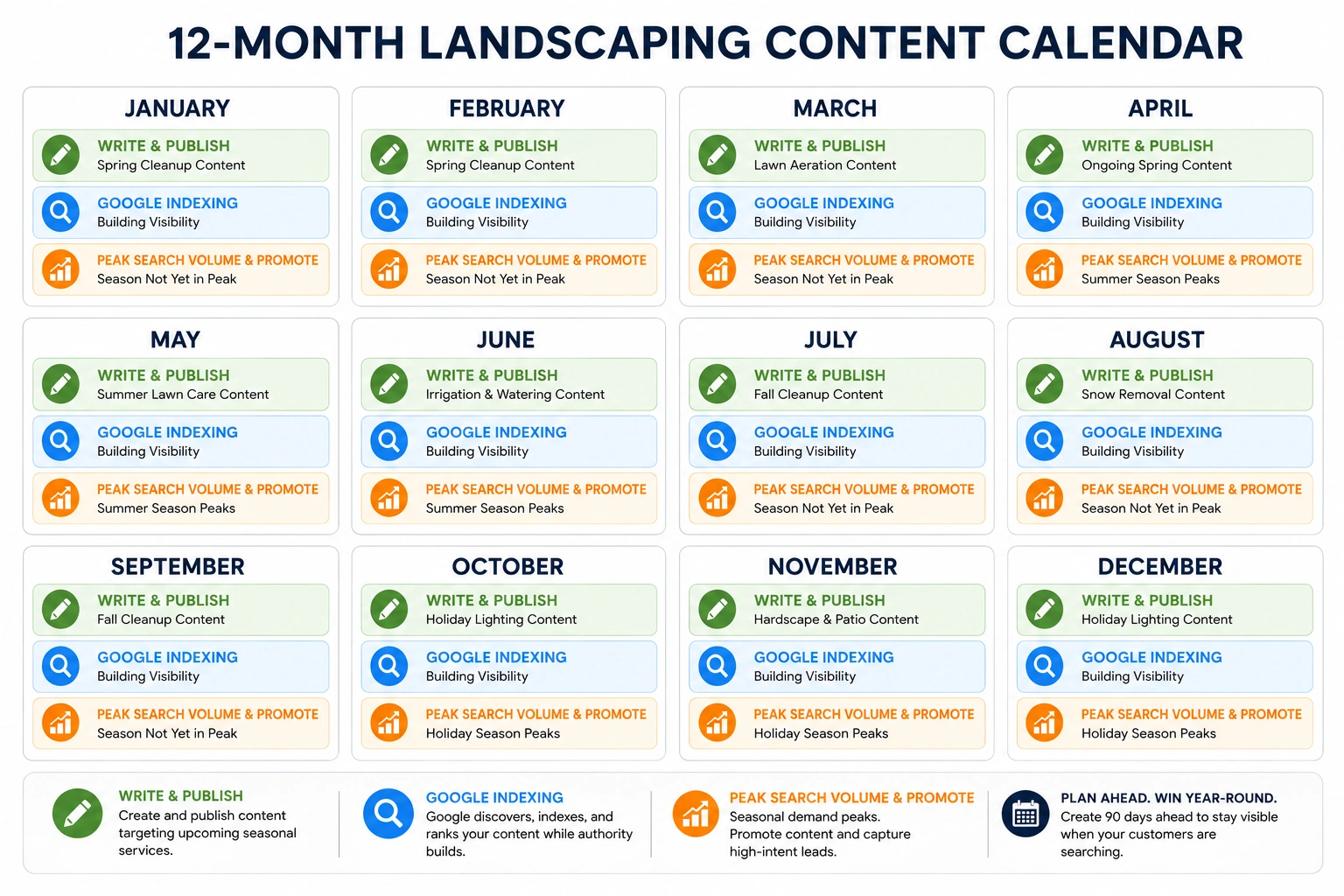
A year-round landscaping SEO calendar maps content creation, Google indexing, and seasonal promotion for maximum visibility.
Discover When Your Customers Are Searching
Want to know exactly when homeowners in your area start searching for lawn care? Use our guide to identify seasonal keyword trends and align your marketing calendar with real-time local demand.
Local SEO and Lead Generation Tactics for Landscaping Companies
Local SEO Checklist for Lawn Care Companies
Your Google Business Profile is the most visible local SEO asset you control, and most landscaping companies treat it like a static directory listing. That is a mistake. It is not. The profile is a dynamic platform that favors consistent, seasonally relevant activity with higher map pack visibility, which, in most local markets, drives more phone calls than the organic results below it.
- Seasonally Update Primary Categories: Your GBP primary category directly influences which searches trigger your listing. Prioritize “Snow Removal Service” from October through March in cold-weather markets, then shift to “Lawn Care Service” or “Landscape Contractor” for the spring and summer season. This is a deliberate signal to Google about which service is most relevant right now.
- Optimize for Hyper-Local Keywords: Generic terms like “lawn care service” are competitive at scale. What people truly search for are hyper-local terms: “lawn aeration service in Charlotte,” “sprinkler repair [Neighborhood],” “leaf cleanup [Zip Code]” : which are far less contested and carry stronger purchase intent. Using these helps us show up when people search for lawn care in Charlotte or whichever local cities we target.
- Upload Seasonal Project Photos: Geotagged photos of recent work are one of the most underutilized local SEO signals available to landscaping companies. A consistent cadence of high-quality before-and-after photos, spring cleanups in April, summer lawn transformations in July, snow plowing jobs in January, tells both Google and prospective clients that your business is active, skilled, and local.
- Publish Weekly Google Updates: Weekly GBP posts highlighting seasonal promotions, early-booking discounts, or time-sensitive maintenance reminders keep your profile fresh and give Google additional signals about your current service focus. A post about pre-emergent weed control in March is more relevant to a searcher in March than a generic post from six months ago.
- Maintain Citation Consistency: Your business name, address, and phone number need to be identical across every directory, aggregator, and social profile where your business appears. Discrepancies, even minor ones like “St.” vs. “Street”, create conflicting signals that erode local search trust. Citation consistency is unglamorous work, but its absence is one of the most common reasons a well-optimized site underperforms in the local map pack.
Backlink Building and Authority for Landscaping Sites
Building High-Quality Inbound Links
Backlinks remain one of the most lasting ranking signals in Google’s algorithm, not because Google hasn’t tried to reduce their influence, but because a link from a credible, relevant external site is genuinely hard to fabricate at scale. For a local landscaping company, the most valuable links are from locally trusted sources that reinforce your geographic relevance.
Local sponsorships are one of the most efficient link-building channels available to green industry businesses. Sponsoring a youth sports team, a community garden, or a neighborhood beautification initiative typically earns a link from the organization’s website, often a .org domain with genuine local credibility, along with the goodwill of the community members who see your name on the jersey or the garden sign. These links are earned, contextually relevant, and nearly impossible for competitors to replicate quickly. They build trust.
Guest content on local real estate and home improvement websites is another highly effective tactic, particularly for landscaping companies targeting terms like real estate lead generation and front yard landscaping ideas. A local real estate agent’s blog that publishes your guide to “curb appeal landscaping before listing your home” earns you a relevant backlink, positions you in front of an audience with an immediate property improvement need, and builds a referral relationship with a professional who regularly encounters clients who need landscaping work.
Linkable assets, content so genuinely useful that other local businesses and publications link to it without being asked, are the most scalable link-building investment a landscaping company can make. A thorough guide to soil types in your specific region, a regional planting calendar with frost date data, or a detailed irrigation water usage calculator for your local climate are the kinds of resources that local nurseries, real estate agents, and home improvement bloggers will reference and link to repeatedly. The upfront investment in creating them is significant; the compounding return over time is substantial.
Link building for local service businesses is messy. There is no clean playbook that works universally. It takes real effort. Some markets respond well to local PR; others are so insular that the only links that move the needle come from directory citations and chamber of commerce memberships. The honest approach is to start with the tactics most likely to yield results in your specific market: sponsorships, local partnerships, and linkable assets: and iterate based on what truly works.
Measuring Seasonal SEO Success and ROI
Key Metrics to Track
Measuring the performance of a seasonal SEO campaign requires a different analytical lens than measuring a paid advertising campaign. The returns are slower to appear, harder to attribute to a single action, and far more durable once they compound, which means the metrics we track need to reflect that longer time horizon.
Google Search Console is the most direct tool for monitoring seasonal page performance before peak demand arrives. Watch impressions for your target seasonal pages during the 90-day lead-time window. Rising impressions without corresponding clicks typically indicates that your page is appearing in search results but ranking too low to attract traffic, a signal that the page needs stronger internal linking, more detailed content, or additional authority before the season peaks. Clicks without conversions point to a landing page problem rather than an SEO problem. Fix the page first.
Organic conversion tracking in Google Analytics 4, specifically form submissions and phone call events tied to organic traffic sessions, is how we connect SEO activity to actual revenue. The Hernandez Trees & Lawn Care case study documented a 1,350% increase in phone call leads over a 5-month local SEO campaign, with the gains concentrated in seasonal service pages that had been optimized for local search intent. That kind of result does not happen by accident: it comes from tracking which pages are generating calls, doubling down on what we’ve seen work, and fixing what doesn’t.
Keyword ranking monitoring for seasonal terms during the lead-time window gives us an early warning system. If your snow removal page isn’t climbing toward the first page by September, you need to intervene. Refresh the content. Build more internal links or fix technical issues before October’s search volume surge arrives. Checking rankings during peak season is like checking the forecast after you’ve already planted.
Calculating the ROI of your SEO investment requires comparing organic customer acquisition cost to your paid advertising cost-per-lead. Organic leads cost less. For most landscaping companies running Google Local Services Ads or pay-per-click campaigns, the cost per acquired customer through paid channels ranges from $50 to $200 depending on the market and service. Organic leads, once the SEO infrastructure is in place, cost a fraction of that: the investment is front-loaded into content creation and technical optimization, not paid per click. The GrowSmallBiz landscaping study documented a 7.21% organic conversion rate alongside a 45.41% year-over-year increase in organic traffic: a cost-per-lead that paid advertising simply cannot match at scale.
Frequently Asked Questions About Landscaping SEO
What is landscaping SEO and how does it differ from general SEO?
Landscaping SEO is the specialized practice of optimizing a landscaping or lawn care company’s website to rank higher in local search results. While general SEO focuses on broad, national search terms, landscaping SEO targets hyper-local, transactional queries, like “lawn care service near me,” and is heavily dependent on Google Business Profile optimization, local citations, and seasonal search intent. The competitive dynamics are also different: you’re not competing against national brands, you’re competing against the three other landscaping companies in your zip code who are also trying to appear in the map pack.
Should I delete my seasonal service pages during the off-season?
No. Deleting seasonal pages destroys their accumulated search engine authority, removes them from Google’s index, and severs any external backlinks they’ve earned. Keep the pages live year-round, remove them from your main header navigation when the service is out of season, update the call-to-action to capture early-booking leads, and use footer links or your HTML sitemap to maintain a crawl path for search engine bots.
How far in advance should I publish seasonal lawn care content?
Publish or update seasonal content 60 to 90 days before historical search volume peaks for that service in your market. That buffer gives Google’s crawlers sufficient time to index the content, evaluate its relevance against competing pages, and assign it a stable ranking position before consumers begin actively searching. For highly competitive terms in dense markets, 90 days is the minimum, not the target.
Is blogging truly necessary for a lawn care business?
Yes, and not just for traffic volume. A well-structured blog builds topical authority, the signal that tells Google your site is a detailed, trustworthy resource on a subject, not just a service directory. Detailed guides on topics like “how to winterize sprinkler systems” or “when to apply pre-emergent fertilizer” demonstrate expertise to both Google and prospective clients, making them more likely to trust you when they are ready to hire. The Redline Landscapes case study showed a 55% increase in organic search traffic following a content and localized keyword strategy, a result that a service-page-only approach rarely achieves.
Is SEO dead or evolving in 2026?
SEO is not dead; it is simply evolving. AI-powered search experiences and voice search are changing how some queries get answered, but the underlying mechanics, high-quality content, structured site architecture, and local trust signals, remain the most effective ways to build a sustainable lead pipeline. If anything, the rise of AI search summaries increases the value of well-structured, authoritative content, because AI systems primarily surface pages that demonstrate clear expertise and are organized for easy comprehension. The fundamentals have not been replaced; they have been amplified.
Your Next Steps for Seasonal Growth
The shift from reactive to forward-planning lawn care SEO does not require rebuilding your entire website in a weekend. What to focus on first is an audit of your current site structure. Start there. Walk through every core service you offer, spring mulching, summer irrigation, fall aeration, winter snow removal, and verify that each one has its own permanent, dedicated service page with a unique URL, optimized title tag, and content that speaks directly to the specific user intent behind that service. If any of those pages do not exist, or if they’ve been deleted and rebuilt seasonally, that is your first priority.
From there, map your content calendar against the 90-day lead-time rule. Identify the two or three seasonal services that represent your highest revenue opportunity in the next quarter, and work backward from their historical search volume peak to determine your publication deadline. If you are reading this in summer, your fall cleanup and snow removal content should be in production right now. Do not wait.
The compounding nature of SEO means the businesses that start this process earliest accumulate the most durable advantages. A competitor who builds a permanent, well-optimized seasonal page architecture this year will be harder to displace next year, and nearly impossible to displace in three years. The window to build that kind of structural advantage in your local market is open, but it does not stay open forever.
To go deeper on the tactical side, our guide on how to market your landscaping business covers additional marketing ideas that complement a strong SEO foundation, from referral programs to seasonal promotions that reinforce the search strategy we are building here.
Ready to stop worrying about seasonal slumps? Let’s analyze your current search visibility and build a customized seasonal SEO calendar for your business. Contact BizIQ today to schedule your free, no-obligation local SEO audit. Digital marketing for landscaping companies : that’s what we do.